MACHINE REFERENCE

Commodore Plus/4

The Commodore Plus/4 arrived in June 1984 with a word processor, spreadsheet, database and graphing package built straight into its 64 KB of ROM, ready to run the moment it was switched on.

Why it matters

The Plus/4 shows good engineering undone by bad positioning. The TED chip packed a 121-colour palette and a built-in RS-232 UART capable of 19,200 bit/s into a single piece of silicon, at a time when most home micros needed several separate chips to do the same job less elegantly. The ‘3 Plus 1’ suite in ROM meant a buyer could write a letter or build a spreadsheet with nothing more than the machine itself, no tape or disk required. What killed it commercially was that Commodore launched it at $299, a few pounds either side of a Commodore 64, while advertising it as more capable. In practice it lacked the C64’s sprite hardware and its SID sound chip, and it could not run the C64’s existing software library. Commodore was competing against its own best-selling product with a machine that looked like a downgrade next to it, and buyers who already understood the C64’s position in the market noticed immediately.

What to check before you buy

  • Ask for a power-on test, or at minimum a clear description of what happens when it's switched on. A dead TED chip or CPU usually means a black screen, and parts are hard to source.
  • Check which PSU is included. The Plus/4's power brick looks similar to the C64's but uses a different connector, and an incorrect or failing original PSU is a common cause of board damage.
  • Inspect the keyboard action if you can. The rubber-dome mechanism was never especially crisp even new, so don't mistake age-related stiffness for a fault you need to fix.
  • Confirm PAL or NTSC before buying, particularly if importing. The two aren't interchangeable with a UK or European television setup.
  • Ask whether the board has had its electrolytic capacitors replaced. An unrestored example will likely need this work doing regardless of how it currently performs.
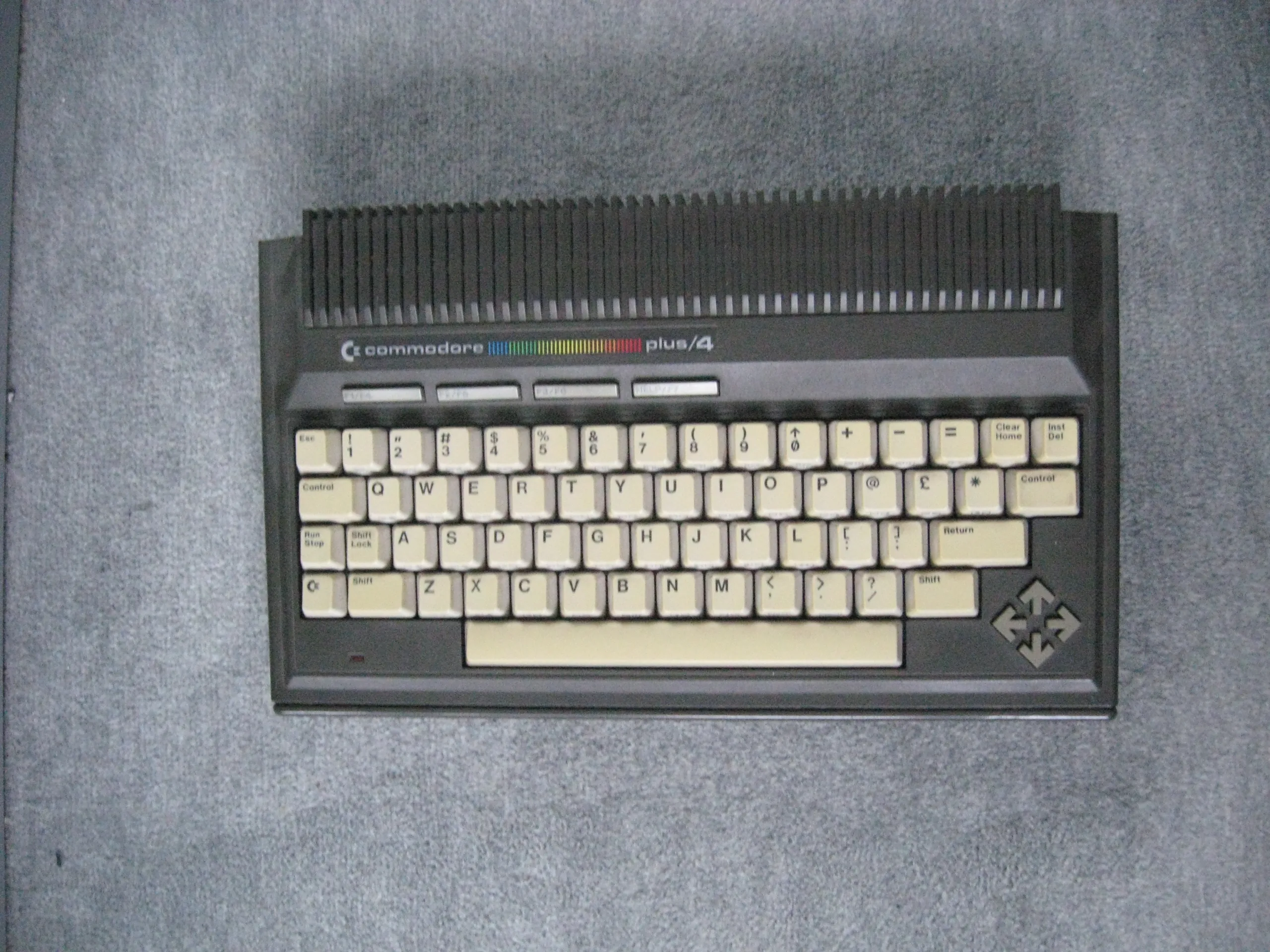
Commodore Plus/4 home computer

Photo: Jumbo1435, Wikimedia Commons (CC BY-SA 3.0)

Released

1984

RAM

64 KB (approximately 60 KB available to BASIC)

CPU

MOS Technology 7501 (later 8501), 1.76 MHz PAL / 1.79 MHz NTSC, clock-throttled to roughly half speed during visible screen display

Launch price

$299 (US)

Manufacturer

Commodore International

Form factor

All-in-one keyboard computer (wedge-shaped case, integrated keyboard)

CPU

MOS Technology 7501 (later 8501), 1.76 MHz PAL / 1.79 MHz NTSC, clock-throttled to roughly half speed during visible screen display

Chipset

MOS Technology TED (7360/8360), a combined video, sound and I/O chip

RAM

64 KB (approximately 60 KB available to BASIC)

ROM

64 KB, containing BASIC 3.5, KERNAL, character set and the “3 Plus 1” office suite

Graphics

TED-generated 320×200 (or 160×200) resolution, 121 colours (15 hues x 8 luminance levels, plus black), no hardware sprites

Audio

Two-voice square wave via TED, four-octave range plus white noise

Storage

Commodore 1541 disk drive (serial bus, slower) or purpose-built 1551 disk drive (parallel, faster) via expansion port; Commodore cassette deck via 7-pin mini-DIN port

Ports

Commodore serial bus, 7-pin cassette port, two 8-pin mini-DIN joystick/controller ports, user port (electrically different from the C64), ROM cartridge slot, composite/S-video and mono audio out, RF modulator, built-in MOS 6551 UART (RS-232, up to 19,200 bit/s)

OS

Commodore BASIC 3.5 with KERNAL

PSU

External power brick supplying 9V AC and 5V DC, epoxy-potted and not user-serviceable; connector is a similar but physically different square type to the C64’s, not interchangeable

Units sold

Approximately 400,000 Plus/4 units, within a wider 264-series (C16, C116, Plus/4) production run of around 1 million machines. Sources vary on the exact split, so 400,000 is reported as a reasonable consensus figure rather than an exact count

Successors

No direct replacement in the TED line; Commodore returned to C64-compatible architecture with the Commodore 128 (1985), developed partly by the same engineering team

  • TED chip failure
    The TED chip was one of the first MOS Technology parts built on the newer HMOS process, and the early batches had a notably high failure rate. Since the TED was unique to the 264 series, working replacements are now scarce and often expensive.
  • Power supply and capacitor failure
    The external PSU is an epoxy-potted brick that cannot be opened or serviced, and original units are known to fail with age; a failing PSU can send overvoltage into the motherboard and take other components with it. The machine's own electrolytic capacitors also dry out or leak over time and typically need replacing on any unrestored board.
  • Keyboard feel and reliability
    The Plus/4's keyboard used a rubber-dome mechanism that contemporary reviewers and later restorers both describe as mushy and poor for sustained typing, a notable weakness given the machine was marketed as a productivity computer.
  • 1984 Commodore launches the Plus/4 in the US in June, alongside the lower-spec Commodore 16, as part of the TED-based 264 series
  • 1984 European release follows later in the year; the machine finds stronger uptake in markets including Germany and Hungary than in the US
  • 1985 Commodore discontinues the Plus/4 as sales fail to meet expectations, undercut by its own incompatibility with the Commodore 64's software library
  • 1985 Commodore releases the Commodore 128, restoring C64 compatibility and effectively closing the door on the TED architecture
  • 1986 Remaining Plus/4 stock is liquidated at steep discount, with units reported selling for as little as $79