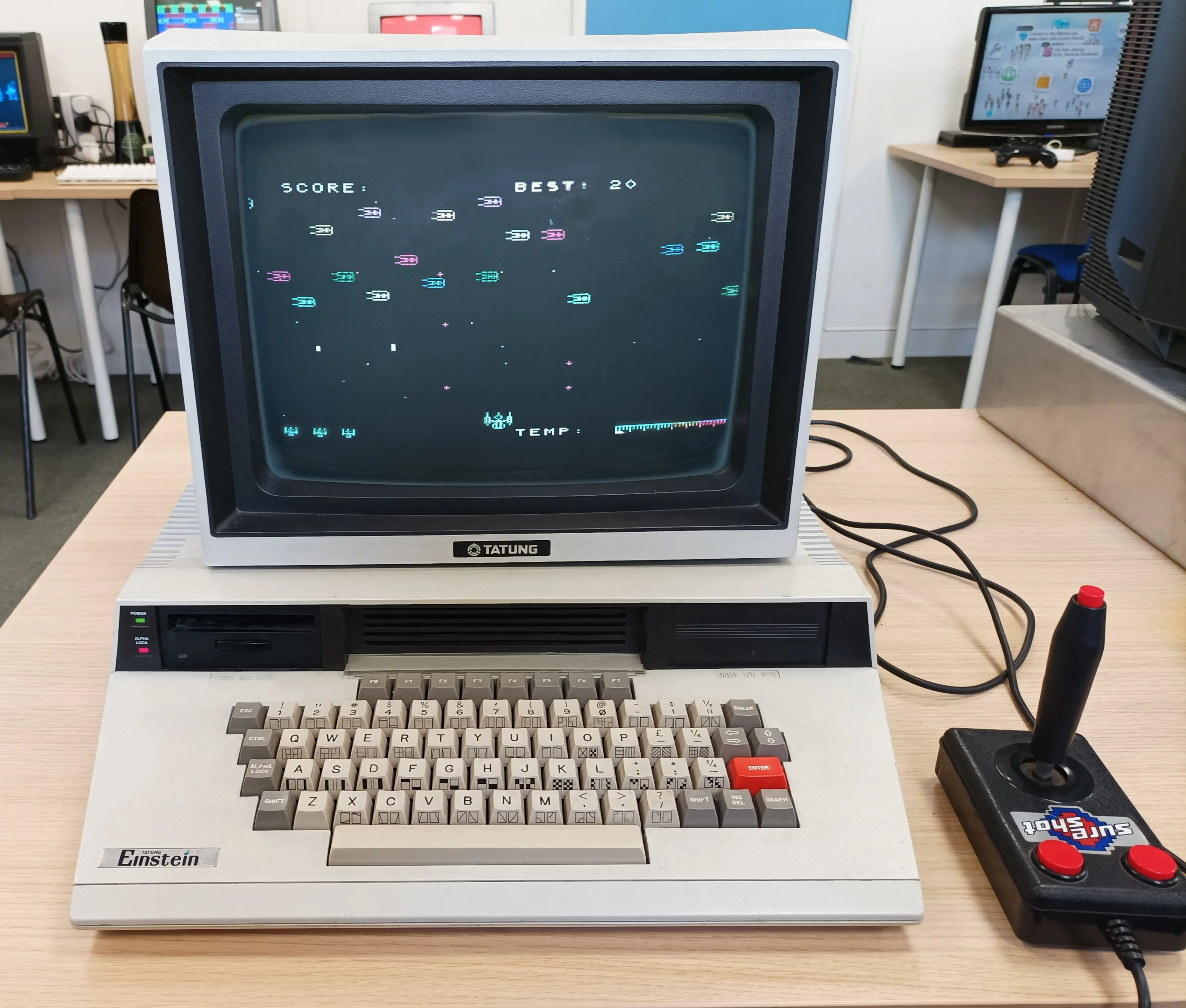
Here is a question worth asking before you even open the case: why would a company build a computer with arcade-grade sprites and a three-voice sound chip, then sell it to accountants? That is the Tatung Einstein in one sentence. The unit on my bench arrived with its floppy drive still spinning happily after four decades, its keyboard unmarked by a single sticky key and a badge on the lid that most British computing history has quietly filed under “also-ran.” It should not have been. The engineering underneath that beige lid is some of the most capable silicon fitted to any British 8-bit of 1984. What happened to it afterwards is a different story, and not one that reflects well on the people who decided how to sell it.
Tatung was, and still is, a genuine Taiwanese electronics giant. Its UK arm had spent years quietly building televisions and other consumer electronics before anyone there sat down to design a computer. Real factories, real jobs. In 1984, that division put together a Z80-based machine, designed at Tatung’s own research laboratory in Bradford and assembled at plants in Bridgnorth and Telford. It launched that summer at £499 for the standard configuration, with business bundles pushing closer to £900. Not cheap. Roughly five thousand units were later shipped out to Taipei. This was a proper industrial concern, with the manufacturing muscle to build something genuinely well engineered. And for once, it did.
A processor everyone knew, wired to graphics nobody expected
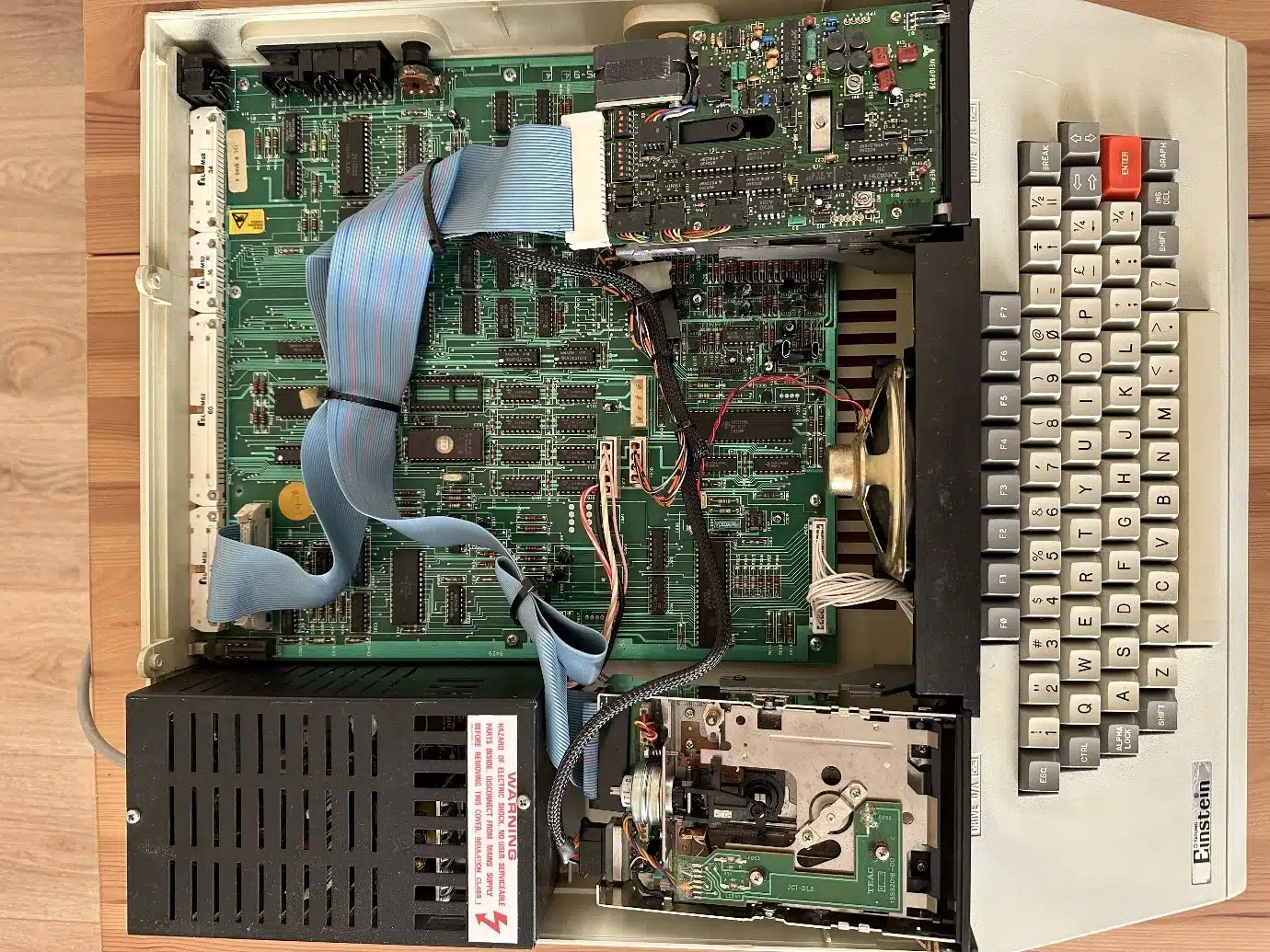
Start with the familiar part. The Einstein runs a Zilog Z80A at 4MHz, the same silicon doing duty in the Spectrum, the Amstrad CPC and half the arcade cabinets of the era. Nothing exotic there, and nothing needed to be. What the Z80A is paired with is where this machine stops looking like a British home micro and starts looking like something else entirely.
The video comes from a Texas Instruments TMS9129, the PAL member of TI’s 9918A video display processor family, the same lineage doing the graphics work inside every European MSX machine of the period. Feed it 16KB of dedicated video RAM and it delivers 256 by 192 pixel resolution, a 16-colour palette and hardware support for 32 sprites. Real sprites, moved by silicon. Sound comes from a General Instrument AY-3-8910, a three-voice programmable chip that also happens to moonlight as the keyboard scanner, reading the matrix so the CPU does not have to. This is not incidental hardware. It is the exact chipset combination that made contemporary MSX computers genuinely capable games machines, sitting inside a British micro that nobody at Tatung seemed interested in marketing as one.
Compare that against a 48K Spectrum’s attribute-clash graphics and single-channel beeper, and the Einstein is not a close contest. It is not even the same conversation. The hardware sprites alone meant smooth animation without the CPU burning cycles shifting bytes around in software. No wasted cycles. The AY chip’s channels gave programmers actual chords instead of one grudging square wave. Whoever specified this board at Tatung understood exactly what serious games hardware looked like in 1984. Full stop. The tragedy, and it is entirely a business tragedy rather than an engineering one, is that almost nobody who bought an Einstein was ever told.
The drive that made loading screens someone else’s problem
Here is where the Einstein earns its place in this magazine regardless of anything else. While the rest of the British home computer market was still queuing up cassette tapes and listening to that particular screech of hope and dread, Tatung built a floppy disc drive into the case as standard. No fiddling with a separate datacorder. No praying the volume knob hadn’t drifted overnight. A single 3-inch drive, built around a TEAC FD-30A mechanism, single-sided, 40 tracks, MFM encoding, roughly 200KB formatted per disk. A second drive bay sat ready for anyone who wanted to double up.
Two hundred kilobytes does not sound like much today. Not exactly a hard drive. In 1984 it felt enormous to anyone used to waiting five minutes for a cassette to load. Program load times on the Einstein were measured in seconds instead. Save, reload, tweak, run again. That cycle, boring as it sounds written down, is the actual engine of software development. It is precisely why so many programmers who could not otherwise justify the machine’s price ended up owning one anyway. Worth it, every time. The drive alone changed what kind of relationship a coder could have with their own work.
A keyboard, a pipe and an operating system wearing three names
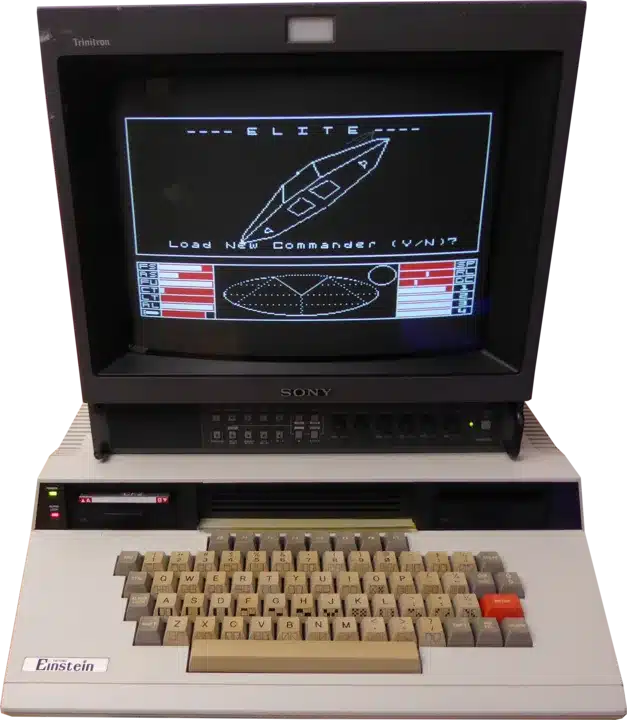
Pick the thing up and the build quality tells you Tatung was not playing around. The case runs to 43.5 by 51.5 centimetres, generous enough to sit a contemporary 14-inch monitor directly on top. Room to breathe, in other words. The 51-key keyboard has a typewriter-style travel that has outlasted plenty of supposedly premium machines from the same decade, and there is a serial port, a Centronics printer port, twin joystick connectors and something Tatung called the “Tatung Pipe,” a direct expansion interface onto the Z80’s own bus for anyone who wanted to build real hardware rather than plug in a cartridge. None of that reads like a toy.
Switch it on and you land in MOS, a Machine Operating System boot environment that then hands off to whatever you have loaded from disk. Three letters, one job. Usually that is Xtal DOS, a CP/M-compatible operating system, paired with Xtal BASIC, both reportedly written by Crystal Computers of Torquay. BBC BASIC was also available, for those who preferred Acorn’s dialect. CP/M compatibility was the point. On paper it is a sound decision: a small business could, in theory, run the same business software that ran on far pricier CP/M machines elsewhere. In practice the Einstein got measured against purpose-built CP/M boxes on exactly the compatibility details that mattered to an accountant, and lost.
Marketed at the office, loved by bedroom programmers
So here is the actual failure, and it belongs entirely to the people deciding how to sell this thing, not to the engineers who built it. Tatung had, sitting on a circuit board, a video and sound combination on par with the best games hardware Japan was exporting that year. They pointed it at small business owners instead. Dressed it up in CP/M respectability. Charged £499 for the privilege at a moment when Amstrad’s CPC 464 had just landed at a lower price with its own disk option waiting in the wings, and Sinclair was still hoovering up the pocket-money end of the market by the truckload. No contest, really. The Einstein was not cheap enough to win on price, not compatible enough to win on business software and not marketed anywhere near hard enough to win on the one thing it was genuinely brilliant at. It fell into the gap between two audiences that Tatung’s own positioning had carved out, and it stayed there.
What actually happened is more interesting than what was planned. Rumour, mostly, at first. Word got around among working programmers, especially in the North West of England, that the Einstein was the fastest machine available for writing and testing Z80 code. Nobody wants to hand-assemble and cassette-load a routine forty times a day when a disk drive will do it in seconds. Games got written on Einsteins. Then sold on the very machines Tatung had never bothered to compete with directly: Spectrums, CPCs, Commodore 64s. The Einstein became the workbench behind other people’s finished products, an accidental development kit for a market its own maker had misjudged from launch day onward. That is not a failure of engineering. Whoever wrote that video and sound spec knew precisely what they were doing.

The verdict from the bench
Strip away the marketing and what is left on this bench is a genuinely well-built, genuinely capable machine let down by the people who decided who it was for. Simple as that. The floppy drive alone puts it ahead of most of its 1984 British rivals on pure usability. The video and sound chipset puts it ahead of nearly all of them on raw capability. And yet. None of that showed up in the sales figures, because none of it showed up in the advertising either. I do not know what it would have taken for Tatung to market this as the games machine its hardware clearly wanted to be. Neither, it seems, did Tatung. Forty years on, the Einstein survives mostly as a collector’s curiosity, and a quiet answer to a question nobody at the company thought to ask at the time: what happens when you build something brilliant and then tell everyone it is something else?