MACHINE REFERENCE

Commodore Amiga 500

Commodore Amiga 500 — the machine that brought genuine multitasking to a home computer for the first time, sold in a case barely bigger than its own keyboard.

Why it matters

The A500 took the technically remarkable but expensive Amiga 1000 and repackaged it as something an ordinary household could actually justify buying, and the gamble paid off spectacularly: it became by far the best-selling Amiga model and, for a few years either side of 1990, one of the defining games and creative computers in Europe. Its custom Agnus/Denise/Paula chipset gave it colour and sound years ahead of contemporary PCs, which is exactly why so much of the era’s demoscene output and early digital video and audio experimentation happened on Amiga hardware rather than anywhere else.

What to check before you buy

  • If a trapdoor RAM expansion (commonly an A501) is fitted, check it specifically for battery leakage — it’s a genuinely destructive fault distinct from the base motherboard
  • Smell and inspect the external PSU brick before plugging it in; ageing capacitors inside are a known long-term reliability weak point
  • The Gary custom chip is prone to corrosion-related failure, but Commodore socketed all the custom chips, so diagnosis and replacement are usually straightforward once identified
  • Confirm the Kickstart/Workbench version fitted, since software compatibility varies meaningfully between 1.2, 1.3 and later revisions
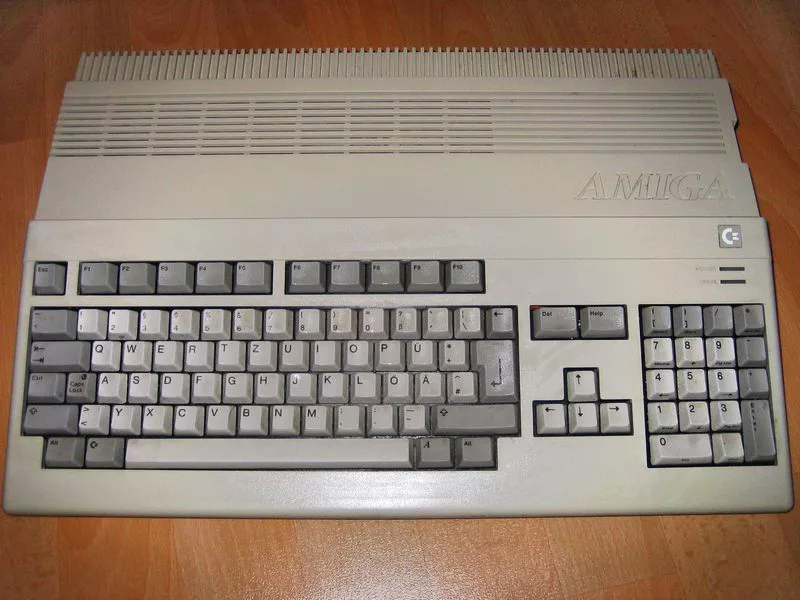
Commodore Amiga 500, a cream keyboard computer with a numeric keypad

Photo: Dragan, Wikimedia Commons (CC BY-SA 3.0)

Released

1987

RAM

512 KB chip RAM standard (many later units shipped with 1 MB), expandable well beyond via trapdoor and Zorro II-adjacent expansion

CPU

Motorola 68000 @ 7.16 MHz (NTSC) / 7.09 MHz (PAL)

Launch price

US$699; £499 (UK)

Manufacturer

Commodore International

Form factor

All-in-one keyboard unit with a built-in floppy drive, designed to sit under a monitor

CPU

Motorola 68000 @ 7.16 MHz (NTSC) / 7.09 MHz (PAL)

Chipset

Original Chip Set (OCS) — Agnus, Denise and Paula custom chips; later A500 production moved to the Enhanced Chip Set (ECS)

RAM

512 KB chip RAM standard (many later units shipped with 1 MB), expandable well beyond via trapdoor and Zorro II-adjacent expansion

ROM

256 KB Kickstart ROM (version 1.2 or 1.3 depending on production date)

Graphics

Up to a 4,096-colour palette; PAL up to 768×580 interlaced, NTSC up to 768×484 interlaced, plus several lower-resolution modes

Audio

Paula chip — 4× 8-bit PCM channels at up to 28 kHz, stereo output

Storage

Built-in 3.5″ floppy drive (880 KB); external drives daisy-chainable

Ports

2× DE-9 joystick/mouse ports, stereo RCA audio out, DB-25 parallel and serial ports, proprietary RGB video port, trapdoor RAM expansion slot, rear expansion edge connector

OS

AmigaOS (Kickstart 1.2/1.3 + Workbench), upgradeable with sufficient RAM fitted

PSU

External brick, AC in, DC out (+5V, ±12V) — original bricks are a well-known long-term reliability weak point

Units sold

approx. 2.6 million worldwide (including the later A500 Plus) — Commodore’s best-selling Amiga model

Successors

Amiga 500 Plus (1991, ECS chipset); Amiga 600; Amiga 1200

  • Gary custom chip corrosion/failure
    The Gary glue-logic chip (floppy and bus control) is prone to corrosion-related failure; Commodore socketed all the custom chips on Amiga boards, though, making replacement straightforward once diagnosed.
  • Trapdoor RAM expansion battery leakage
    Many A500s were fitted with a battery-backed RAM expansion (commonly an A501); the nickel-cadmium battery on these boards leaks corrosive electrolyte after years of service, eating through copper traces and nearby components.
  • External PSU capacitor ageing
    The original external "brick" PSU's electrolytic capacitors and other components degrade with age, causing instability, unstable voltages, or a whining noise at power-on — a real fire risk if left unaddressed rather than just an annoyance.
  • 1985 Amiga 1000 launched as the platform's debut machine
  • 1987 Amiga 500 announced at January CES; released April–October depending on region
  • 1988 UK price cut from £499 to £399
  • 1991 Amiga 500 Plus introduced with the Enhanced Chip Set
  • 1992 Both A500 and A500 Plus discontinued in favour of the Amiga 600