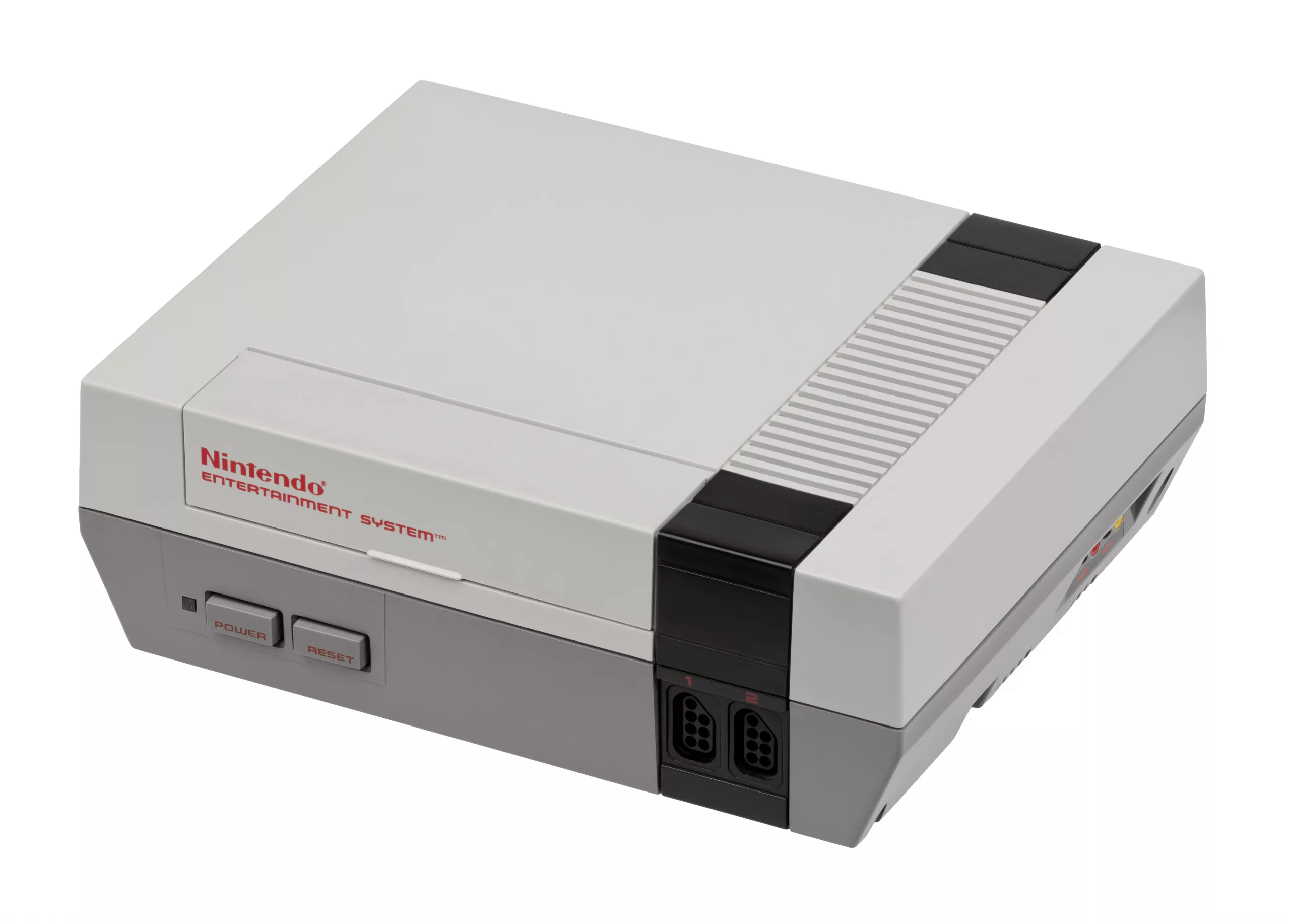
Super Mario Bros is a side-scrolling platform game designed by Shigeru Miyamoto and Takashi Tezuka for Nintendo, released on the Famicom in Japan on 13 September 1985 and on the Nintendo Entertainment System in America that autumn. It sold 40.24 million copies on the NES alone. Nintendo’s own records give the American date as 18 October 1985, the day the NES itself went on sale in New York. Nobody has ever produced a receipt, an advertisement or a shipping note that proves it.
- Designers: Shigeru Miyamoto and Takashi Tezuka
- Programmers: Toshihiko Nakago and Kazuaki Morita, of SRD
- Music: Koji Kondo, six tracks plus every sound effect
- Japan: 13 September 1985, Famicom
- North America: October 1985, NES New York test market. Exact date disputed
- UK: 15 May 1987
- Cartridge: NROM board, 32KB PRG ROM and 8KB CHR ROM, feeding a Ricoh 2A03 CPU and the NES PPU
- Sales: 40.24 million on NES; over 58 million counting ports and re-releases
Why Nintendo launched the NES into a market that had just died
The building Nintendo of America leased in Hackensack, New Jersey was musty, and it held everything the company had riding on America: the stock, and the seven-foot retail display units it had built itself because no shop over there was going to build them.
Hiroshi Yamauchi had picked the city from Kyoto. ‘We’re launching in New York because that’s where everything happens,’ he said, which is the sort of line that sounds like strategy and is actually a dare. Two years earlier the American home console business had come apart so completely that buyers were still writing off Atari stock. The phrase ‘video game’ had gone commercially radioactive.
So Bruce Lowry, the sales vice president Nintendo had hired out of Pioneer, went round the retailers with a machine he was not allowed to describe accurately. ‘We can’t say anything about it being a video game console,’ he said. The grey box was styled to sit under a telly beside a VCR rather than on a toy shelf. The light gun was renamed the Zapper because focus groups showed parents flinching at ‘light gun’. Cartridges became Game Paks. The whole thing was called an Entertainment System, a name vague enough to cover a robot.
The buyer at Woolworth’s gave Lowry the shortest answer in the story: ‘No way. Not touching it. See ya.’
What rescued it was an offer no sane distributor makes. Nintendo would ship the stock, build the displays, run the demonstrations, and buy back anything unsold after ninety days at no cost to the retailer. Minoru Arakawa, running Nintendo of America and married to Yamauchi’s daughter, had agreed to carry every ounce of the risk himself. At Toys R Us, executive vice president Howard Moore heard it out and said: ‘Well, that’s why I’m Executive Vice President, Bruce. We’ll do it.’
Roughly 500 shops across New York, New Jersey and Connecticut. $139.99 at the till, $98 wholesale. The target was 50,000 units by Christmas, and the figure actually shifted sits somewhere between 50,000 and 90,000 depending which account you read.
How Super Mario Bros grew out of Excitebike’s scrolling engine
Six thousand miles away, the game that would justify all of it was being built by people who had no idea any of that was going on.
Development started in the autumn of 1984, running alongside The Legend of Zelda with the same small group working on both. Miyamoto had been designing more or less alone until Takashi Tezuka arrived. ‘Back then, before Tezuka-san came, I was doing all the design work myself, so it was a big help just to have another designer,’ he said later. Tezuka was in his first year at the company and behaved accordingly. ‘Tezuka-san was a new guy back then, but he said whatever he wanted, like, “I want to fly around the sky on a cloud.”‘
The technical inheritance came from a motorbike game. Toshihiko Nakago of SRD had been pulled in when Miyamoto walked up to him and said ‘We’re going to be working on Excitebike together’, and the partial-screen scrolling routine that team wrote for Excitebike is what made Super Mario Bros possible at all. The warp pipes came out of the same work. Miyamoto has also pointed at Namco’s Pac-Land, a scrolling arcade game from 1984, as the thing that showed him what a moving playfield could feel like.
By December 1984 there was a prototype, and the thing you controlled in it was a rectangle sixteen pixels wide and thirty-two tall. Koji Kondo was handed that rectangle and told to work out what its world sounded like.
The size of the rectangle turns out to be the entire design. The team had built the early levels around a small Mario, planning to scale the sprite up later. Instead they made the change of size into the mechanic, and in February 1985 they implemented the Super Mushroom. The game took its name from it.
They threw out their own rules where the rules were less fun, too. An earlier build punished you for landing on a turtle. They rewrote it so that, in the team’s phrase, you could jump on turtles all you want. Bowser began as an ox, borrowed from Toei’s 1960 animated film Alakazam the Great, and became a turtle because Tezuka suggested it.
What forty kilobytes of ROM actually bought you
The cartridge is a plain NROM board. Thirty-two kilobytes of program ROM feeding the Ricoh 2A03, which is a 6502 with the decimal mode disabled and an audio generator bolted on, and eight kilobytes of character ROM feeding the PPU with 8×8 tiles. Forty kilobytes, all in, for eight worlds.
Everything after that is compression by cunning. The clouds and the bushes are the same sprite in different colours. Background tiles were laid down by an algorithm rather than stored. Sound effects were doubled up: the noise Mario makes going down a pipe is the noise he makes taking a hit, and the jump is the swimming stroke.
Goombas exist because the memory ran out. Late in the project, with nothing left to spend, the designers animated them by flipping a single static image back and forth. That is a mirror rather than an animation, and it produced one of the most recognisable walks in the medium.
When Kondo finished the score there were roughly twenty bytes free. They went on the small crown beside the life counter.
World 1-1 was finished in July 1985 and the schedule then ran on another three or four weeks. The game went to manufacturing that August.
Why nobody can prove when Super Mario Bros went on sale in America
Here is the part that ought to embarrass an industry.
In 2012 Frank Cifaldi went looking for the American release date of the best-selling game of its generation and could not find it. What he found instead was a stack of documents that almost agree. Ed Semrad, writing in the Milwaukee Journal on 5 October 1985, listed Super Mario Bros among fifteen launch titles. A Macy’s advertisement from 17 November 1985 shows the same fifteen. A Nintendo warranty card lists them again. There is a photograph of a test-launch shop display with the box sitting on it. A copyright filing gives 19 October as the publication date. Nintendo’s internal records say 18 October, which is very probably a ship date rather than a day anyone could walk in and buy the thing.
Cifaldi’s conclusion, after all that, was that he was not satisfied. Then an anonymous tip arrived pointing at 17 November instead. Most reference books had been saying 1986 for years.
One detail gets flattened in the retellings and is worth keeping straight: Super Mario Bros was not the pack-in at the New York launch. The box you carried home in October 1985 held a console, two controllers, the R.O.B. robot, the Zapper, Duck Hunt and Gyromite. Mario was a separate cartridge on the shelf, one of fifteen. The bundling that turned it into the best-selling game on earth came afterwards, once the NES had gone national.
World 1-1 and the tutorial that never says a word
Start the game and touch nothing. A Goomba walks into you and you die. That is the first lesson, delivered in about four seconds, at a cost of nothing but pride.
Then comes the block above your head, the mushroom that pops out of it, and the detail that gives the whole design away. The mushroom travels right, meets the pipe, and comes back towards you. A player instinctively running away from a moving object has to work fairly hard to avoid it. Nintendo wanted you to eat that mushroom, so the level is shaped to feed it to you.
Miyamoto’s stated aim was that players should gradually and naturally understand what they are doing, through repetition and escalation rather than instruction. Read the level as a document and you can watch the argument being made. Every mechanic the game will ever use is introduced in the first screen and a half, and none of it is written down.
That is what the game genuinely invented. The scrolling was Pac-Land’s idea and Excitebike’s code. The jumping arc was Donkey Kong’s, refined. What was new was the notion that a level could teach.
Why Britain waited until 1987 to meet Mario
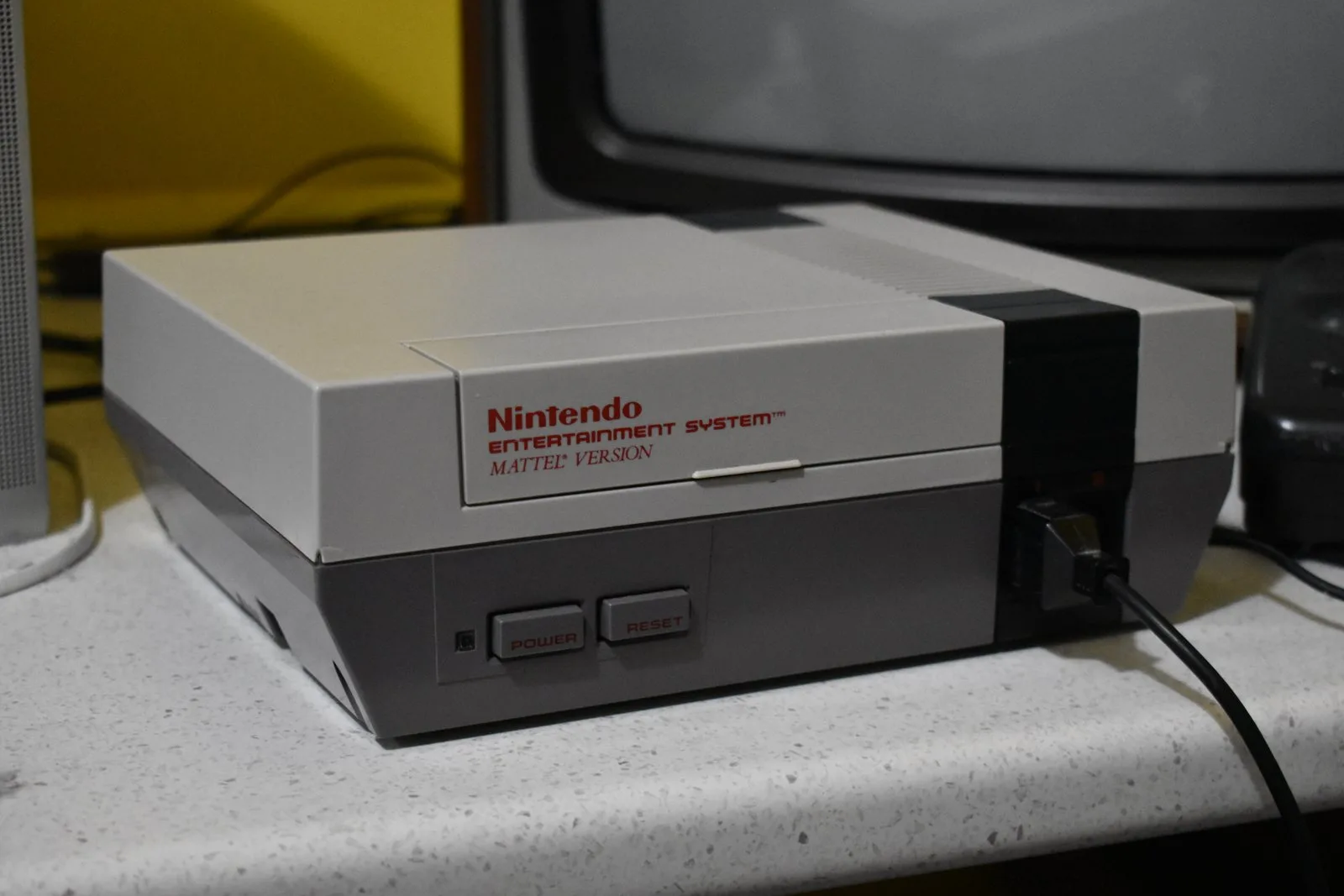
Photo: Matthew Paul Argall, Wikimedia Commons (CC BY 2.0)
Britain got there almost two years late, and got there badly.
The NES reached the UK in 1987 with Mattel handling distribution, and early British machines carried a Mattel logo because the name Nintendo meant nothing to anyone here. A Computer & Video Games advertisement in June 1987 put the basic set, with Super Mario Bros in the box, at £129.99, and the deluxe set with R.O.B. and the Zapper at £199.99.
The problem was the shelf. Mattel had persuaded exactly one major chain to stock it, Boots the Chemist, where it did not sell especially well either. The 1987 Argos catalogue listed the machine among the novelties, and by the spring of 1988 it had gone from Argos altogether. When C&VG launched its Mean Machines section in October 1987, it treated the NES as a curiosity of unclear significance, which in this country it was.
Sega had got there first, and had a distributor who understood British retail. In 1988 the Master System took roughly five-eighths of British 8-bit console sales. Mattel lost the NES distribution after 1989, and by 1994 the two machines had converged on about 1.5 million units each in the UK.
So the machine that dragged console gaming back from the dead in America spent its British debut losing to a Sega box in a chemist’s. There is a boardroom somewhere that deserves the blame for that, and it is not in Kyoto.
What survives, and what does not
In 1990 a study found that more American children could identify Mario than could identify Mickey Mouse. The game held the all-time sales record for more than twenty years, until Wii Sports took it. In 2021 a sealed copy sold for $2 million, and in 2026 another went for $3 million.
Three million dollars for a sealed box, and we still cannot say which day the shops opened with it inside. Nintendo pushed the most consequential forty kilobytes in the medium’s history into a market that had already written itself off, using a plastic robot as cover and a buyback guarantee as a crowbar, and the surviving paperwork amounts to a Macy’s advert and a warranty card. Miyamoto’s team squeezed an entire genre out of a cartridge with twenty bytes to spare. The least the rest of us could have managed was to write the date down.