MACHINE REFERENCE

Unitron AP II

The Unitron AP II landed on Brazilian desks in 1982 built close enough to the Apple II Plus that peripheral cards designed for Cupertino’s machine could be plugged straight into its eight expansion slots. Nobody at Unitron pretended otherwise: this was a reverse-engineered board, in a market where buying the real thing was against the law.

Why it matters

Brazil’s military government had made importing a microcomputer illegal, so a domestic clone industry grew to fill the gap. English Wikipedia’s own tally puts the number of competing Apple II Plus clones sold in the country in the early 1980s at around twenty, and the AP II was one of the earliest and most complete of them. Unitron, founded on 12 February 1982 in a modest workshop in São Paulo’s Freguesia do Ó district, did well enough out of it to gamble the company on a Macintosh 512K clone three years later, a decision that brought Apple’s lawyers, IBM’s lobbyists and eventually the US Trade Representative’s office down on Brazil’s national computer policy. The AP II itself was never the direct target of that fight; it was the success that funded it, and the reason the fight happened at all.

What to check before you buy

  • Finding one at all is the real obstacle. Surviving units rarely if ever surface outside Brazil, so expect to search Brazilian classifieds and collector groups rather than the usual retro-computing marketplaces.
  • Confirm which expansion cards are fitted (Z80/CP/M, 80-column, extra RAM) before buying, since period cards are Brazil-specific and cannot be swapped in from a genuine Apple II.
  • Check the internal linear power supply carefully: it was built for Brazilian mains voltages, and forty-plus years of electrolytic capacitors is a long time regardless of country.
  • Test the keyboard mechanism and any 80-column card thoroughly. Static RAM of this vintage (the 2114 chips used on the 80-column card) is a known failure point.
  • Ask for provenance and any surviving disks or manuals, since Apple DOS 3.3 media this old is now scarcer than the hardware itself.
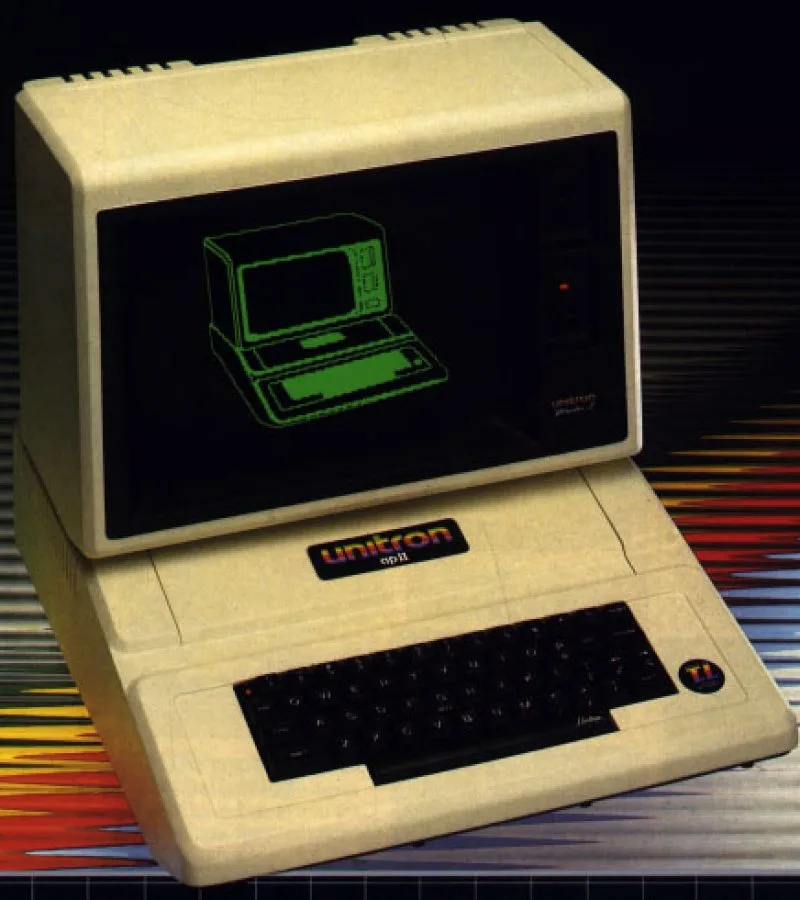
Unitron AP II

Photo: Coopermiti museum, Brazil (coopermiti.com.br)

Released

1982

RAM

16KB standard, expandable; sources differ on the ceiling (two independent sources give 128KB via expansion cards)

CPU

MOS Technology 6502, 1MHz

Launch price

Unknown; no contemporary price in cruzeiros was found in sources checked

Manufacturer

Unitron Eletrônica (São Paulo, Brazil)

Form factor

Desktop home/personal computer, single-piece case with integrated keyboard, separate monitor

CPU

MOS Technology 6502, 1MHz

Chipset

None: discrete 6502-based logic reverse-engineered from the Apple II Plus, no custom ASIC

RAM

16KB standard, expandable; sources differ on the ceiling (two independent sources give 128KB via expansion cards)

ROM

12KB

Graphics

Text 40×24 (80 columns with add-on card); lo-res 40×48 in 16 colours; hi-res 280×192 in 6 colours (Apple II-standard modes)

Audio

Internal speaker, 1-bit toggle (Apple II-style)

Storage

Cassette interface (1200 baud); external 5.25″ or 8″ floppy drive (143KB, single-sided); optional 5MB hard disk

Ports

8 internal expansion slots; composite video output; cassette in/out; game I/O port

OS

Apple DOS 3.3 (CP/M 2.2 available via optional Z80 expansion card)

PSU

Internal linear supply, built into the case

Units sold

Unknown. Contemporary and retrospective sources describe it only as commercially successful enough within Brazil to fund Unitron’s 1985 Macintosh-clone project

Successors

Unitron AP II TI (1984, revised “intelligent keyboard” with lowercase and Portuguese accents); the unrelated Unitron Mac 512 (1985-86) never reached market

  • 80-column card character corruption
    On at least one documented restoration, a failed 2114 SRAM chip on the optional 80-column expansion card produced garbled on-screen characters; replacing the chip resolved it. Given the card's age, this class of static-RAM failure should be expected on other surviving units.
    Unitron ApII restoration log (AMX Project) →
  • 1982 Unitron Eletrônica, founded 12 February 1982 in the Freguesia do Ó district of São Paulo, launches the AP II, built to the Apple II Plus's architecture, into Brazil's import-restricted market
  • 1984 Unitron releases the AP II TI, adding a lowercase, accent-capable "teclado inteligente" for Portuguese-language word processing
  • 1984 Brazil's Congress passes Law 7.232 (29 October), formalising the "reserva de mercado" that had already been protecting locally-built clones like the AP II from imported competition
  • 1985-86 Trading on the AP II's success, Unitron reverse-engineers a Macintosh 512K clone; Apple lobbies Washington, the US opens a Section 301 investigation into Brazil's informatics policy, and the Brazilian government blocks the Mac clone's sale under threat of trade retaliation
  • 1991-92 Law 8.248/91 dismantles the market reserve ahead of its original 1992 expiry, removing the protected environment that had made machines like the AP II viable