MACHINE REFERENCE

Atari 400

The Atari 400 was the cheaper sibling of the Atari 800 in November 1979, with a membrane keyboard, one cartridge slot and the ANTIC and POKEY chips that made the whole Atari 8-bit line.

Why it matters

The 400 put the Atari 8-bit chip set, ANTIC for the display, CTIA for graphics and POKEY for sound, into a $550 machine for families. It also had hardware sprites. The 400 and 800 launched a family that sold about 4 million machines in total and stayed on sale until 1992.

What to check before you buy

  • Press the membrane keys everywhere. Dead patches are common, and a replacement membrane is the fix.
  • Check the RAM. A 400 sold with 8 KB is limited, and a 16 KB or 48 KB upgrade makes it far more useful.
  • Look at the case for yellowing and cracks around the cartridge slot.
  • Ask whether the power adapter and the controller leads are included.
  • Test the picture and sound; POKEY and ANTIC faults show up quickly.
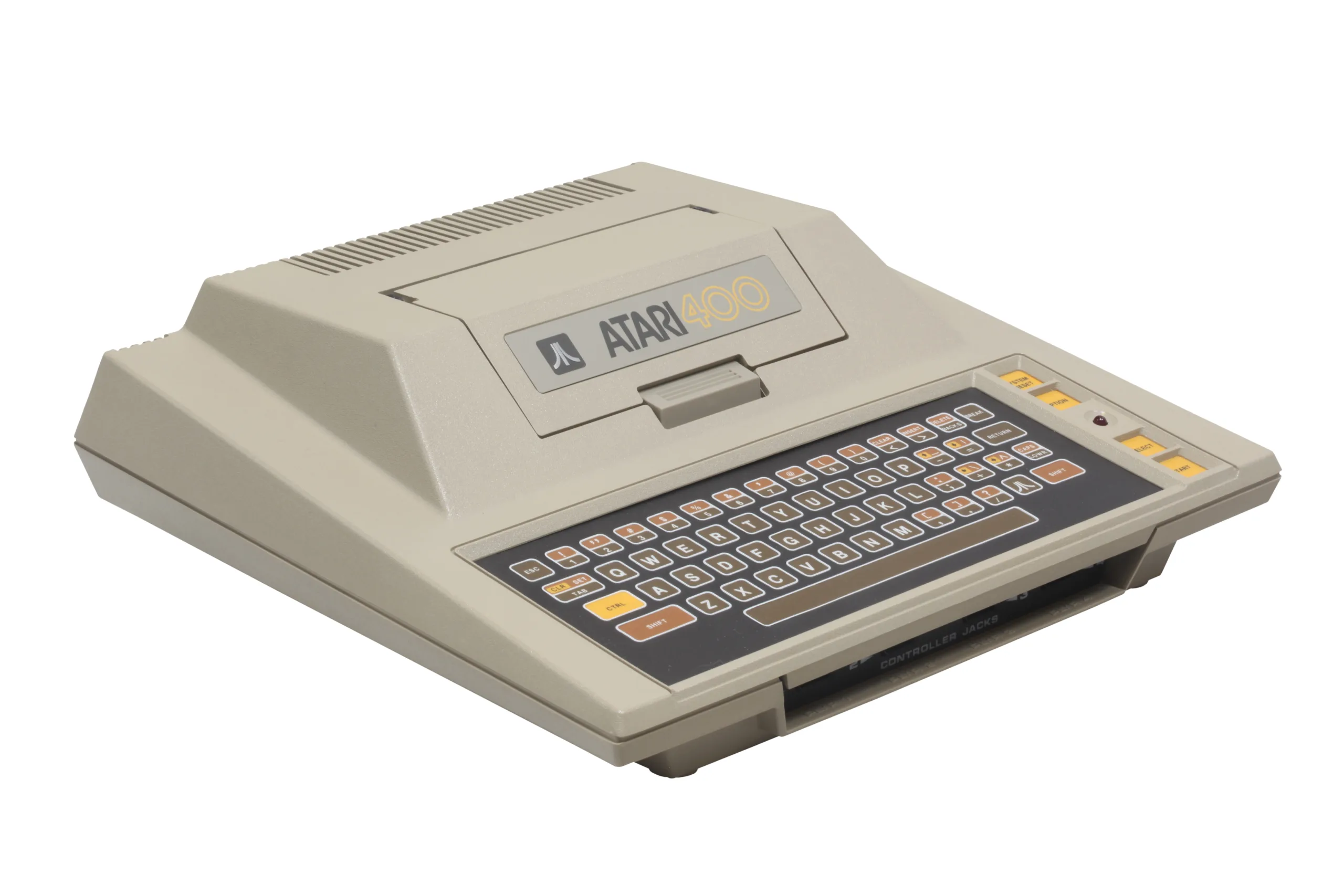
Atari 400 computer on display at Musée Bolo

Photo: Rama & Musée Bolo, Wikimedia Commons (CC BY-SA 2.0 fr)

Released

1979

RAM

8 KB at launch; 16 KB later

CPU

MOS Technology 6502B, 1.79 MHz (NTSC) or 1.77 MHz (PAL)

Launch price

$550 (US)

Manufacturer

Atari, Inc.

Form factor

Compact keyboard computer with a membrane keyboard

CPU

MOS Technology 6502B, 1.79 MHz (NTSC) or 1.77 MHz (PAL)

Chipset

ANTIC display processor, CTIA graphics chip (later GTIA) and POKEY sound and input chip

RAM

8 KB at launch; 16 KB later

ROM

10 KB

Graphics

Up to 384 pixels per line, eight hardware sprites (players and missiles), raster interrupts; a palette of 128 colours (16 hues x 8 luminances) on the 400, though some sources quote 256

Audio

Four POKEY oscillators with noise mixing, or two with digital sound

Storage

Cassette (Atari 410), 5.25-inch floppy (Atari 810) and ROM cartridge

Ports

Four joystick ports, Atari SIO serial bus, one cartridge slot, TV output

OS

Atari OS in ROM; Atari DOS on disk

PSU

External power adapter

Units sold

Unknown for the 400 alone; about 4 million for the whole Atari 8-bit family

Successors

Atari 1200XL, 600XL and 800XL (1983)

  • Membrane keyboard
    The 400's sealed membrane keyboard gives no tactile feedback and wears with use. It is fine for games and poor for typing, and a worn one needs a replacement membrane.
  • Overheating memory modules
    Atari's plug-in memory modules were reported to overheat. Check any upgraded RAM and the heat around it.
  • 1979 The Atari 400 and 800 launch in November
  • 1983 The XL series (1200XL, 600XL, 800XL) replaces them
  • 1985 Atari Corporation launches the 65XE and 130XE
  • 1992 The Atari 8-bit line is discontinued