MACHINE REFERENCE

Apple IIe

The Apple IIe went on sale in January 1983 at $1,395 with a motherboard of 31 chips, where the design it replaced had needed over a hundred.

Why it matters

Walt Broedner’s team cut the component count from 109 to 31 while keeping close to full compatibility, according to Userlandia, and the motherboard gained 64 KB of RAM, lowercase and 80-column support on the way. That is a hard thing to do to a working design. The old Apple II had its Reset key next to Return; the IIe made you press Control, Reset and Open Apple together. Apple then kept the machine in production from January 1983 to November 1993, longer than any other Apple computer to that point. The business decisions around it are easier to question. In the UK the 64 KB machine cost £845 in April 1983, and the IIGS upgrade kit that swapped in a new motherboard cost $500 plus your old one, which most owners found saved little once they had bought a new drive and monitor.

What to check before you buy

  • Treat the power supply as the first suspect. The switched-mode unit (commonly an Astec AA11040B) is a known failure point, and restorers disagree about ticking: some units tick unloaded and still run fine. Ask whether it has been serviced, and replace only parts that have actually failed.
  • Look at the main board near the power connector for failed tantalum capacitors. One documented machine had a dead short on the -12 V line from a single tantalum, and the power supply turned out to be innocent.
  • Press every key. Sticky or dead keys are common and can usually be cleaned, but wash the keyboard with the power off and the keyboard unplugged, because AY-5-3600 encoder chips have failed in a documented restoration.
  • Find out which revision it is. The original has a 6502, the Enhanced (March 1985) has a 65C02 and MouseText, and the light grey Platinum (January 1987) comes with the extended 80-column card. Early boards cannot do double hi-res, so check the board revision if you want those modes.
  • Run a memory test and watch for random freezes or garbage on screen. One documented crash turned out to be bad RAM chips, and the same restorer found a faulty demodulator chip behind colour problems. Check for the 80-column card and a drive too, as they change the price. The IIe outputs composite video only, so you need a monitor or a composite-capable TV.
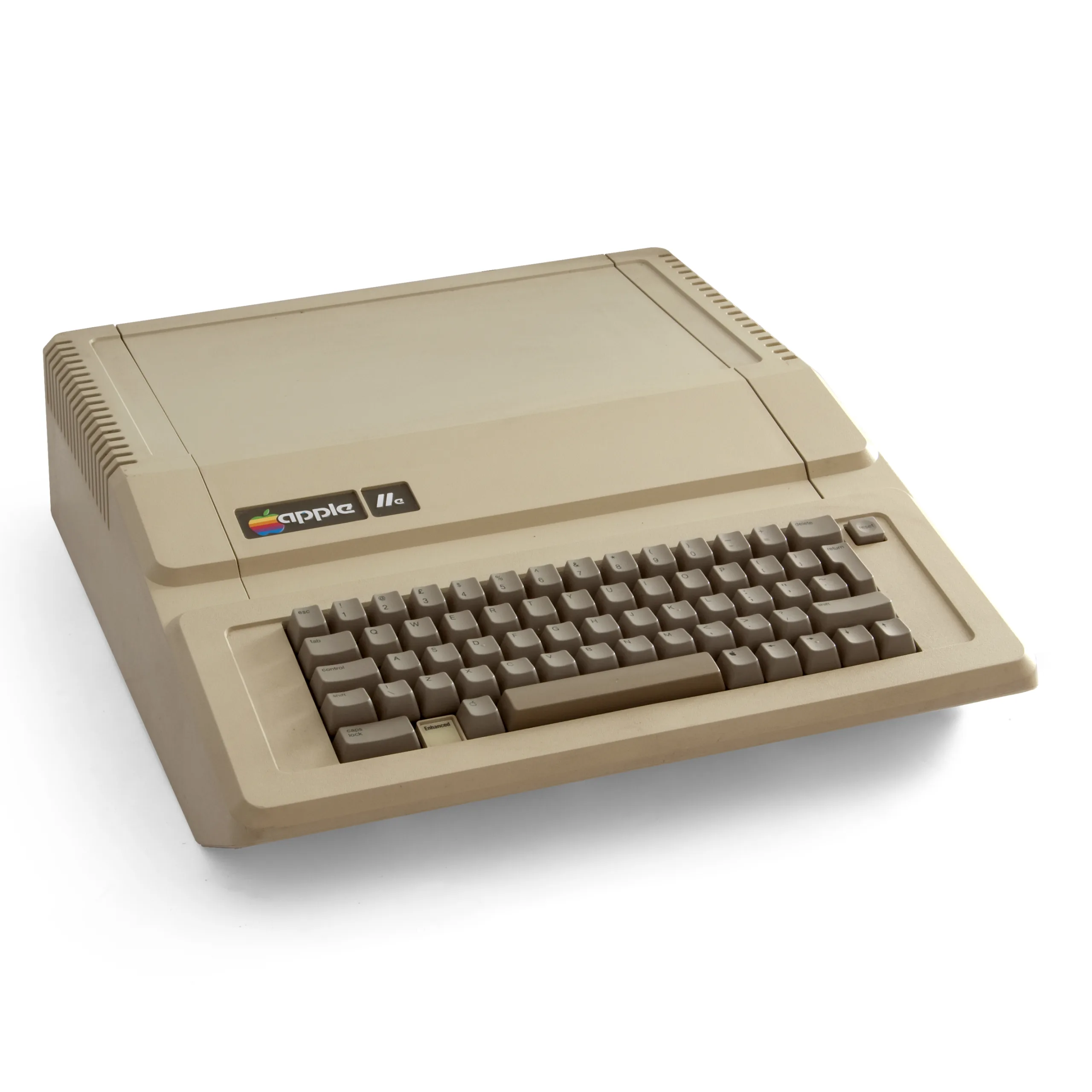
Apple IIe (Enhanced) computer with its keyboard

Photo: Bilby, Wikimedia Commons (CC BY 3.0)

Released

1983

RAM

64 KB as standard. 128 KB with the Extended 80-Column Text Card, which was fitted to every Platinum IIe. Third-party cards go further; English Wikipedia gives a ceiling of 1 MB

CPU

MOS Technology/Synertek 6502 at 1.023 MHz in the original IIe. The Enhanced IIe (March 1985) and Platinum use a 65C02 at the same speed

Launch price

$1,395 for the main unit in the USA; $1,995 for a package with a Disk II drive, monitor and 80-column card. £845 for the 64 KB machine in the UK, April 1983

Manufacturer

Apple Computer, Inc., Cupertino, California, USA. Hardware planning led by Walt Broedner, with Peter Quinn as design manager

Form factor

All-in-one keyboard computer with a full ASCII keyboard, including lowercase, and two modifier keys marked Open Apple and Solid Apple. A restart needs Control, Reset and Open Apple pressed together. The case changed to light grey, which Apple called Platinum, in January 1987, and the Platinum keyboard matches the Apple IIGS keyboard

CPU

MOS Technology/Synertek 6502 at 1.023 MHz in the original IIe. The Enhanced IIe (March 1985) and Platinum use a 65C02 at the same speed

Chipset

No separate graphics or sound chip. The original motherboard has 31 chips, down from over a hundred on the design it replaced (Apple II History; Userlandia gives 109 to 31). Early boards cannot do double hi-res graphics, which arrived with the Revision B board

RAM

64 KB as standard. 128 KB with the Extended 80-Column Text Card, which was fitted to every Platinum IIe. Third-party cards go further; English Wikipedia gives a ceiling of 1 MB

ROM

16 KB. The Enhanced upgrade swapped four chips: the 65C02, two ROMs carrying Applesoft and Monitor changes, and a new character generator ROM that added MouseText

Graphics

40-column text built in; 80-column text with the 80-column card. Lo-res 40 x 48 in 16 colours, hi-res 280 x 192 in 6 colours, plus double lo-res and double hi-res modes on Revision B and later boards with the 80-column card. NTSC composite video on an RCA socket

Audio

One-bit speaker, toggled by software. No sound chip

Storage

Cassette interface (in and out). Disk II 5.25-inch floppy drives were the normal storage, and Apple sold a bundle at launch that included one

Ports

Seven expansion slots plus an auxiliary slot that takes the 64 KB extended memory and 80-column card; NTSC composite video (RCA); cassette in and out; DE-9 joystick connector on the back panel; a numeric keypad port on the logic board

OS

Applesoft BASIC and the Monitor in ROM. Apple DOS 3.3 from disk (ProDOS also ran on it)

PSU

Internal switched-mode supply; the Astec AA11040B is the type discussed by restorers. Specific output ratings were not confirmed in the sources read

Units sold

No audited Apple IIe total was found, so none is given. Apple II History records sixty to seventy thousand a month by May 1983. Userlandia says 400,000 in 1983 and a million more in 1984, a single source. A figure of 4.25 million appears on a collectors’ forum and its own thread questions it. The whole Apple II series (all models) is put at about 6 million by English Wikipedia

Successors

Apple IIc (24 April 1984, $1,295), a compact sibling that sold alongside it; Apple IIGS (15 September 1986, $999 without monitor). Apple also offered a kit that swapped the IIe motherboard for a IIGS board. The Apple IIe Card for Macintosh LC computers followed in March 1991

  • Failed tantalum capacitors near the power connector
    One restorer found four tantalum capacitors by the power connector had failed. One, between ground and -12 V, had failed short, which killed the machine and left suspiciously low resistance between ground and 5 V. The power supply, which was swapped out first, checked out fine.
    The resurrection of my Apple ][e (Applefritter) →
  • Power supply failure, and ticking that is not always a fault
    The switched-mode supply (Astec AA11040B in the cases discussed) is a common failure point. One forum thread names the small 220 uF capacitor at C12 as the usual culprit, which stops the supply starting. The same thread reports units that tick when unloaded and still deliver stable voltages on a motherboard, and one expert advises replacing only parts that have demonstrably failed.
    Apple IIe Astec AA 11040B Power Supplies (Applefritter) →
  • Dirty keyboard and a fragile encoder chip
    One Enhanced IIe had six keys that produced nothing and others that repeated after moisture from a wash. Exercising the plungers and isopropyl alcohol helped, but two AY-5-3600 keyboard encoder chips then failed in turn, which the restorer blamed on vigorous pressing and an alcohol wash while the keyboard was plugged in and powered.
    Restoring two Apple IIe units, part 2 (Classic Computers NZ) →
  • 1983 In January the Apple IIe goes on sale at $1,395, with 64 KB of RAM, lowercase and a motherboard cut from over a hundred chips to thirty-one; the 64 KB machine is £845 in the UK by April
  • 1983 By May it is selling sixty to seventy thousand units a month, over twice the average sales of the II Plus
  • 1985 The Enhanced IIe arrives in March: a 65C02 processor, two revised ROMs and a new character ROM with MouseText replace four chips
  • 1987 The Platinum IIe appears in January in a light grey case, with an IIGS-style keyboard and the extended 80-column card in every unit
  • 1993 The Apple IIe is discontinued in November, almost eleven years after launch and the longest run of any Apple computer to that point