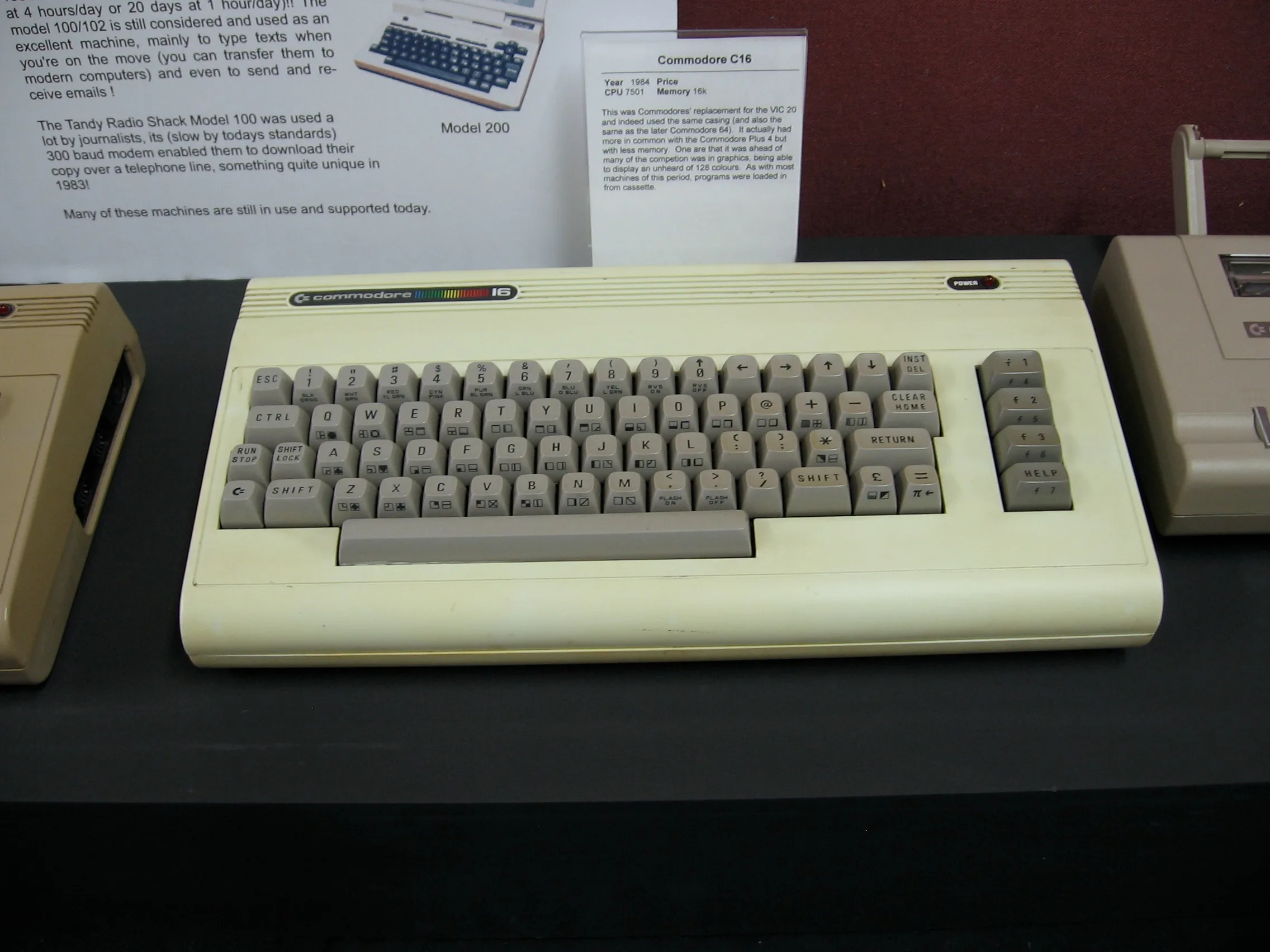
The Commodore 16 was the cheapest of Commodore’s 264 series, launched in 1984 at US$99 with 16 KB of RAM and a single TED chip doing the work of several.
Why it matters
The TED chip handled video, two-voice sound, timers and joystick reading in one package, which kept the board small and cheap, and that is good engineering for a machine meant to cost about $100. The price of it was no sprites, no SID and colour data stored in main memory. The C16 was meant to replace the VIC-20, but it ran neither VIC-20 nor C64 software, and the C64 was already on sale at $199. In America it sank within a year. In the UK it had a good 1985 once the price fell from £149 to £89 and then £49, and Commodore kept selling it in Mexico under the Sigma name until 1992. Sales figures are contested: 1,266,000 appears in c64-wiki and Wikipedia, yet Wikipedia also puts the whole 264 series at about a million.
What to check before you buy
- Start with the power supply and the fuse on the motherboard. A failed linear supply can damage the board, and a blown fuse is a common cause of a dead machine.
- Switch on and look for a picture. Faint scan lines suggest a dead TED, while a black screen can point to the CPU, the PLA or the address chips. All three overheat.
- Ask whether the electrolytic capacitors have been replaced. Old ones dry out or fail short, and a recap is cheap insurance.
- Check which model it is. A C16 has 16 KB, the Commodore 116 is a European cost-reduced version with a rubber keyboard, and the Plus/4 has 64 KB. Listings mix them up.
- Test the keyboard, both joystick ports and the cassette port. C64 joysticks need an adapter, so do not assume your existing ones will fit. Ask too about mods such as a 64 KB RAM swap or a replacement CPU.