MACHINE REFERENCE

Inves Spectrum 48K+

The Inves Spectrum 48K+ (sold in Spain as the Inves Spectrum+) looks like a Sinclair ZX Spectrum+ from across a room, but Investronica built it on its own board, with its own ULA and its own ROM, and sold it from 1986 at 19,900 pesetas.

Why it matters

Investronica had been Sinclair’s Spanish importer. New Spanish tariffs had made local manufacture cheaper than importing, so in 1985 it showed a Spanish-made Spectrum 128 at SIMO in Madrid, and its own Spectrum+ followed in 1986, the year Amstrad bought Sinclair. The engineering is the interesting part. A Texas Instruments TAHC10 replaces the Ferranti ULA, two TMS4464 chips replace sixteen RAM chips, and a crystal at five times the CPU clock lets the ULA and Z80 share memory without the delays that Sinclair’s contended memory causes. That redesign is also why Commando, Bomb Jack, Arkanoid and Top Gun struggle on it. The dispute afterwards is murkier. English Wikipedia says Amstrad sued in 1987 and won a ruling in 1991, while Parcela Digital reports the Spanish Supreme Court finding for Investronica in September 1997. Those accounts cannot both be right. No sales figure turned up in any source consulted.

What to check before you buy

  • Run several games, and include Commando, Bomb Jack, Arkanoid and Top Gun. They are known to misbehave on this machine, so poor results are normal; look for a crash or garbled screen on titles that others report working.
  • Look at the badge. A genuine Inves has a black embossed inves logo at top left and Spectrum+ in red, with no Sinclair logo or rainbow. A plain Spectrum+ case with an Inves board swapped in, or the reverse, is possible.
  • Press every key and look for dead groups. The Spectrum+ membrane is the commonest Spectrum fault, and a trapped membrane leg near the TV modulator causes the same symptoms.
  • Check the Kempston joystick port and the reset button are intact, and ask whether the Spanish-labelled keyboard is original. The Spanish ROM messages show on a bare BASIC prompt.
  • Ask about the power supply. It is a 9 V centre-negative unit and differs from the original Sinclair one, so confirm polarity and voltage before plugging in anything that is not the matching adaptor.
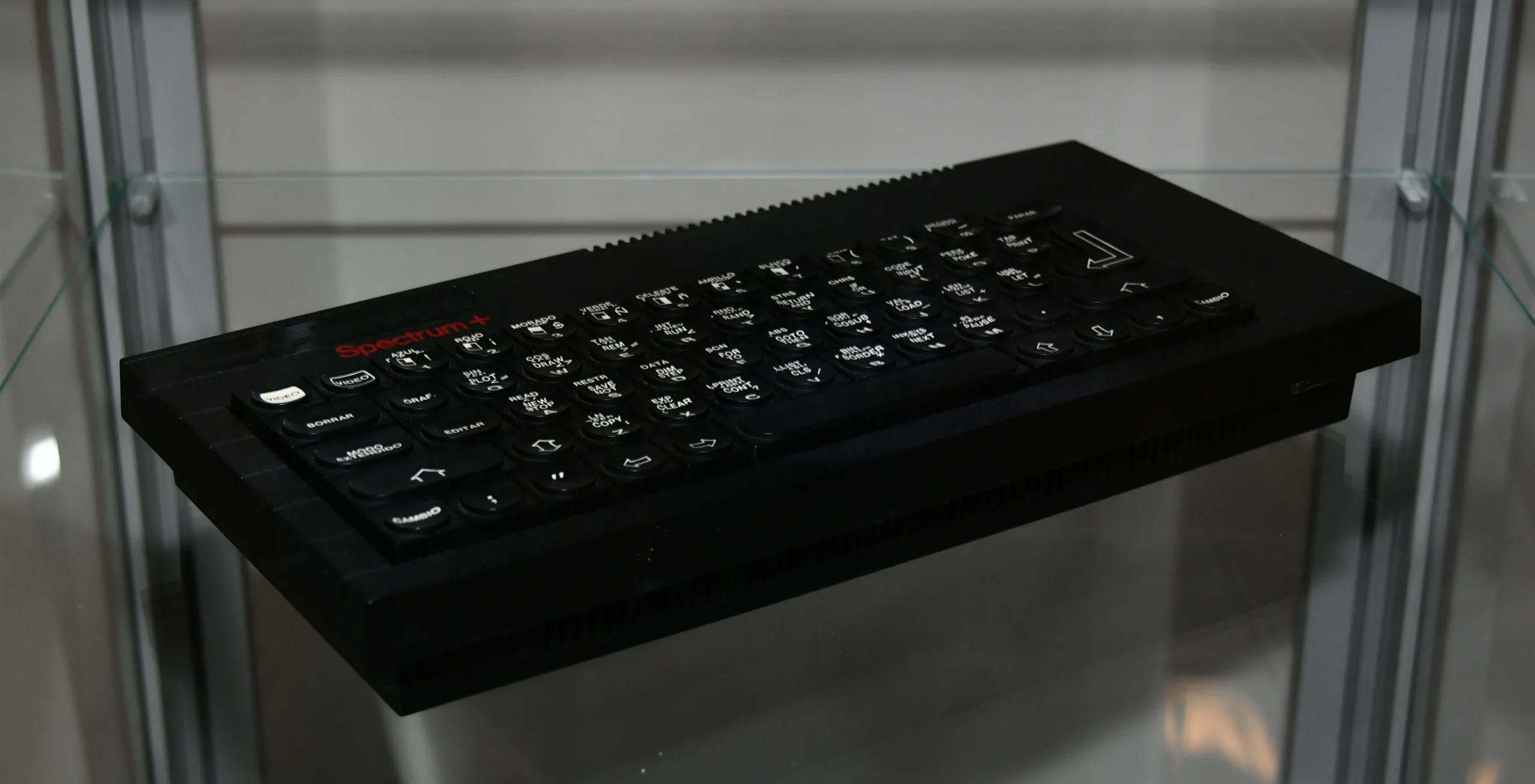
Inves Spectrum+ Spanish ZX Spectrum+ clone at RetroMadrid 2018

Photo: Fernando Saenz Perez (AUIC Oficial), Wikimedia Commons (Public Domain)

Released

1986

RAM

64 KB in two TMS4464 chips (the original used sixteen). 48 KB is usable as on a 48K Spectrum; Spanish Wikipedia notes the first 16 KB is write-only, which is how the ROM sits in the same address space

CPU

Zilog Z80A at 3.5 MHz

Launch price

19,900 pesetas (Spanish Wikipedia; a second summary quotes the same figure). That is about €120 at the fixed euro conversion rate, before inflation

Manufacturer

Investronica S.A., Madrid, Spain (a subsidiary of the El Corte Ingles group). Sold as the Inves Spectrum+

Form factor

Copy of the Sinclair ZX Spectrum+ case with a black injection-moulded keyboard. A black embossed inves logo sits at top left and the name is printed as Spectrum+ in red, with no Sinclair logo or rainbow stripe. A Kempston joystick port is on the rear

CPU

Zilog Z80A at 3.5 MHz

Chipset

Redesigned board with its own PCB layout. A Texas Instruments TAHC10 replaces the Ferranti ULA. The crystal runs at five times the CPU clock (Sinclair used four times), so the ULA and CPU are served interleaved. There is no contended memory, and a line takes 228 T-states against 224 on a 48K Spectrum

RAM

64 KB in two TMS4464 chips (the original used sixteen). 48 KB is usable as on a 48K Spectrum; Spanish Wikipedia notes the first 16 KB is write-only, which is how the ROM sits in the same address space

ROM

16 KB, on a socketed EPROM in place of the original mask ROM. It is a modified Sinclair BASIC ROM with Spanish-language messages and support for the characters N with tilde and the inverted ! and ?

Graphics

256 x 192 bitmap with 8 colours plus a brightness bit, as on the 48K Spectrum, from the ULA replacement. Spanish Wikipedia records vertical colour lines at attribute block boundaries and a distinctive pattern of vertical bars on power-up. Output is RF PAL TV

Audio

Internal speaker, one-bit beeper, as the Sinclair original

Storage

Cassette via EAR and MIC sockets. Spanish Wikipedia lists ZX Microdrive, Rotronics Wafadrive and floppy interfaces as supported options

Ports

Rear edge expansion connector, EAR and MIC jacks, RF TV output, 9 V DC power input, Kempston-compatible joystick port (DE-9) on the rear. Retro Ordenadores Orty also lists a reset button on the left side

OS

Sinclair BASIC in the modified 16 KB EPROM, with Spanish messages and a Spanish-labelled keyboard layout. It is not an exact copy of the Sinclair ROM and some games misbehave on it

PSU

External 9 V DC supply, centre negative per Retro Ordenadores Orty. RetroWiki notes that the supply differs from the original Sinclair one. The current rating was not found

Units sold

Unknown. No production or sales figure was found in any source

Successors

None found. Investronica did not follow it with another Spectrum-style machine; Spanish Wikipedia records that it released its first IBM PC compatible in 1986. It had earlier built a Spanish-made 128 KB Spectrum, shown at SIMO in 1985

  • Game incompatibilities
    The redesigned board and modified ROM mean some Spectrum software does not run properly. Spanish Wikipedia names Commando, Bomb Jack, Arkanoid and Top Gun, English Wikipedia lists Bombjack, Commando and Top Gun, and a clone archive page adds Breakthrough. The cause is variously blamed on the localised ROM and on different RAM timing. This is how the machine was built, not wear.
    Inves Spectrum+ (List of ZX Spectrum clones, Wikipedia) →
  • The killer command that was not
    A rumour in a December 1987 issue of MicroHobby said certain commands wrecked the computer. Testing found nothing was damaged: the result was a temporary effect, cleared by powering off. One archive writer found that poking values to ROM addresses such as 254, 510 and 766 acts as an AND mask on data going to the ULA, which survives a soft reset but not a power cycle.
    Inves Spectrum+ technical notes (k1.spdns.de) →
  • Spectrum+ keyboard membrane wear
    The Inves reuses the Spectrum+ case and keyboard layout, so the usual Spectrum+ complaint applies. A repair guide for the Spectrum+ says groups of dead keys are 'almost always a worn out keyboard membrane', and that a membrane leg trapped between the case and the TV modulator can cause the same fault. Whether Inves-specific membranes are sold was not confirmed.
    Replacing the keyboard membrane, Spectrum+ and 128 (Dataserve Retro) →
  • 1982 Investronica becomes the exclusive importer of Sinclair computers in Spain, around 1982 to 1983
  • 1985 At SIMO in Madrid, Investronica presents a Spanish-made ZX Spectrum 128, after new Spanish tariffs on computers of 64 KB or less made local manufacture cheaper than importing
  • 1986 Amstrad buys Sinclair on 7 April for £5 million, and Investronica launches its own Inves Spectrum+ at 19,900 pesetas
  • 1987 Amstrad sues Investronica. Spanish Wikipedia gives 1987 as the end of the Inves Spectrum+; English Wikipedia says a court sided with Amstrad in 1991
  • 1997 On 29 September the Spanish Supreme Court dismisses Amstrad's appeal and finds that Investronica did not infringe copyright, according to Parcela Digital