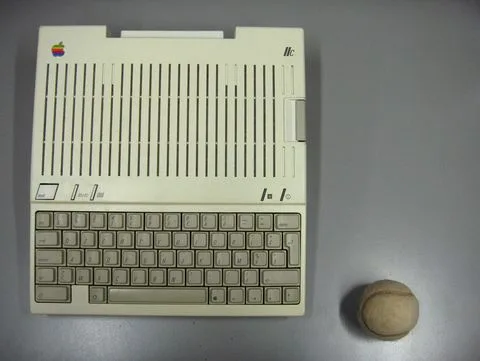
The Apple IIc was Apple’s compact Apple II, launched in April 1984 at US$1,295 with 128 KB, a built-in floppy drive and a handle, and no expansion slots at all.
Why it matters
The IIc is an Apple IIe folded into a case with a handle, and the engineering deserves respect. Apple fitted 128 KB of RAM, a floppy drive, two serial ports and double hi-res graphics into a sealed shell that fits a briefcase, and designed it to run in ambient temperatures up to 40°C, with heat from the drive helping to draw air through the vents. It also introduced the Snow White design language and the off-white Fog colour. The commercial side was less tidy. Apple aimed for a $995 price and landed on $1,295, and the machine that looked portable still needed a mains brick and a separate monitor, with no battery and no screen. Apple predicted 100,000 sales a month and averaged about 100,000 a year, although first-year figures of 400,000 also circulate. Early boards had a serial timing fault that broke some 1200-baud modems. It ran most Apple II software, but with no slots it could not take the cards that made the IIe so adaptable.
What to check before you buy
- Check the power brick and the internal converter. The IIc takes 15 V DC into an internal converter, and an Apple II forum poster calls the supply the most common fault in these machines. The converter's case is welded shut, so a recap means levering it out.
- Boot a disk and listen to the drive. Frozen oil in the head rails, bearings and motor pulley, and a dead write-protect LED, are the usual reasons for a drive that spins but will not read. Test with a known-good disk.
- Press every key. The original keyboard has a spill guard and a dampener layer that disintegrate with age, and a parts seller says the early switches fail with age too. Check the key feel and that nothing is dead or stuck.
- Find out which revision it is. The original ROM has no self-test and the early boards have the slow serial timing; later models have 32 KB of ROM, UniDisk 3.5 support and the Memory Expansion card connector. Listings rarely say which.
- Check what is included. A Disk IIc, mouse, monitor and original brick are all separate purchases, and the IIc has no slots, so missing accessories cannot be replaced with cards. Ask for the 15 V brick and its DIN-7 plug in the photos.