The reviewer from Racunari magazine had a lamp problem. The TIM-011 had an on-off switch with a built-in bulb, and he wasn’t impressed. If you planned to rely on it to tell you the machine was running, he wrote, you’d need to put a mirror behind your desk.
That’s the sort of detail a good hands-on test turns up, and the test in question, by Dejan Ristanovic, in the February 1988 issue, is the best record we have of what the machine was like to live with. He spent a month working with one. He lost two floppy disks to it. He also came away calling it a computer of mature concept, very near the top of 8-bit technology. Both verdicts were fair.
A grey box built for the post office
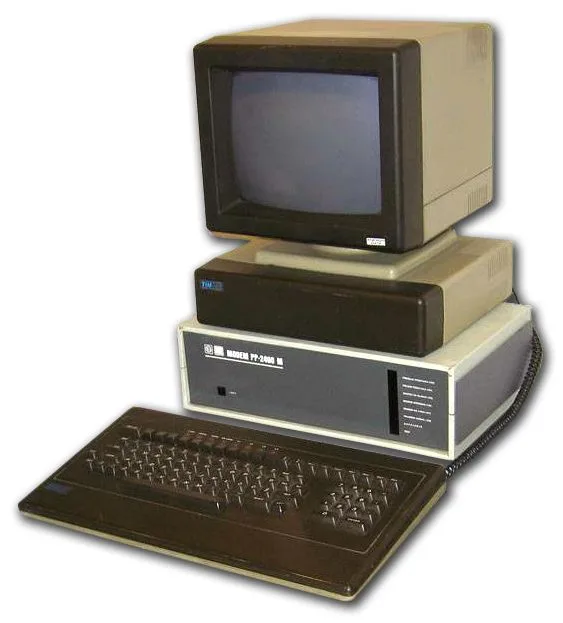
The TIM-011 came from the Mihajlo Pupin Institute in Belgrade, and it came in a box the Institute already had. According to Racunari, the case was the standard grey injection-moulded one that Pupin used for its post-office counter terminals, roughly 370 by 320 by 80 millimetres, with a 12-inch monochrome monitor sitting on a swivel base on top. If you hadn’t been to a post office lately, the reviewer added, that was the shape to picture.
Pupin made a whole family of these machines. A page on the Institute’s history says the TIM line was run by Dr Dragoljub Milicevic and Dr Dusan Starcevic, and that it ran to about ten models between 1983 and 1990. The same source says the TIM-100 went to the Yugoslav postal service in roughly a thousand units, and that the top model, the TIM-600, had a 20 MHz 8086 running UNIX. I only have that second-hand, from a single article.
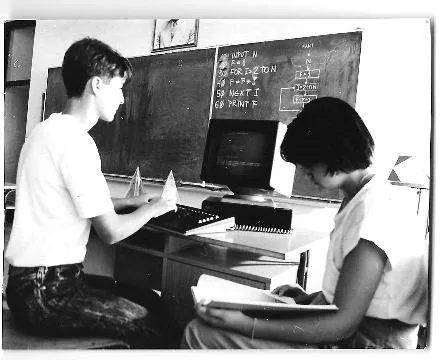
The TIM-011 was the small one. It was meant for classrooms, and the people who write about it afterwards are consistent on that. A man who says he worked at the Institute, writing on a Serbian forum, puts it plainly: it was developed exclusively as a school computer. He taught Fortran IV on a room of them, he says, with a TIM-020 as the server. A forum post is a forum post, and I’d treat his account as that.
Somebody else’s board, with a screen added
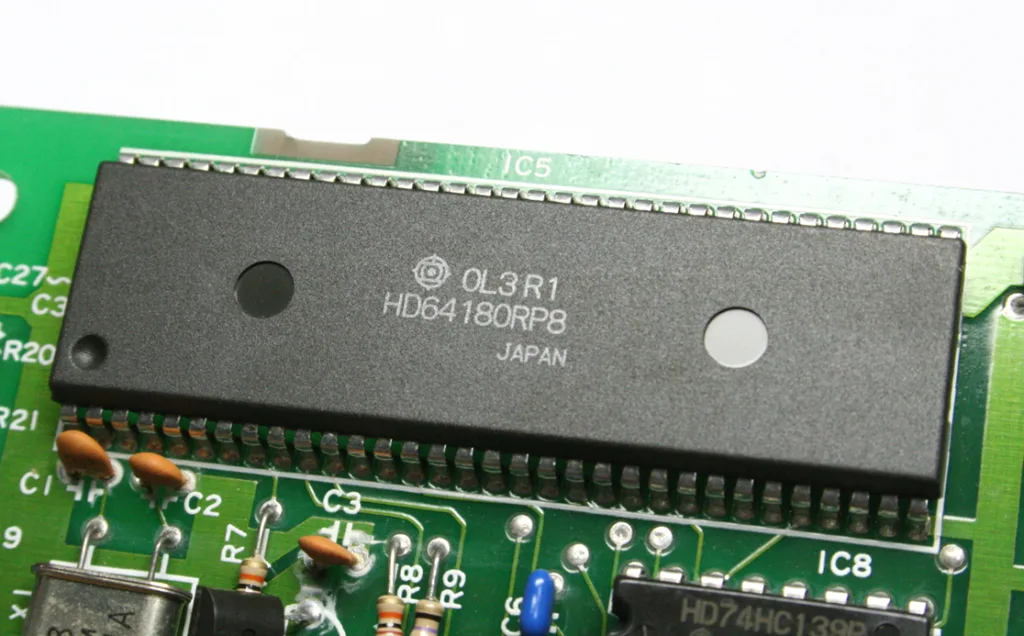
Inside was a Hitachi HD64180, a Z80-compatible processor with a lot of extras built in, running at 6.144 MHz. It had an on-chip memory manager, two DMA channels, two serial ports and two timers, and its LDIR block-copy instruction took 14 clock cycles where a Z80 needed 21. Ristanovic gave it a paragraph of its own, because, in his words, he would bet that 95% of his readers had never heard of it.
The machine carried 256 KB of RAM plus 32 KB of video memory, and the picture came from a circuit of about fifteen ordinary TTL chips instead of a video controller. A blog devoted to the machine says the whole design leans heavily on the SB180, a single-board computer from Micromint, which Steve Ciarcia described in Byte magazine in September 1985, and that the TIM-011 was that design with a display bolted on. English Wikipedia says the connection wasn’t announced at the time. None of my sources says whether anyone in Belgrade asked permission.
It’s easy to be sniffy about that, and I’d rather not be. A school computer in 1987 Yugoslavia had to be built from parts a Belgrade institute could actually get. The HD64180 was a good chip, a published design gave the team a head start, and the video stage was their own work. The reviewer called the graphics original, fast and entirely free of any screen-refresh worry for the processor.
Green, wobbling and a month late
The picture was 512 by 256 pixels in four shades of grey, or green on the built-in monitor. The text mode gave 80 columns by 24 rows with a character set loaded into RAM, so that three small programs, ASC, LAT and CIR, switched the screen between ASCII, a Serbian Latin set and Cyrillic. Ristanovic suggested typing CIR and then listing a BASIC program, and promised that the fun was guaranteed.
He was less kind about the power supply. The picture on his unit wobbled for a few minutes after every switch-on, and again during some disk accesses. He blamed the switch-mode supply that Pupin, he wrote, had insisted on without any real need, and which had caused the designers a great deal of trouble.
The review itself ran a month late, because the magazine had waited for the operating system to be put in order. As far as the scan of the introduction can be read, Racunari had until then printed only write-ups by makers, so the editors presented this as a first look from outside. That the Pupin people made a unit available says something for their nerve.
CP/M in the age of the PC
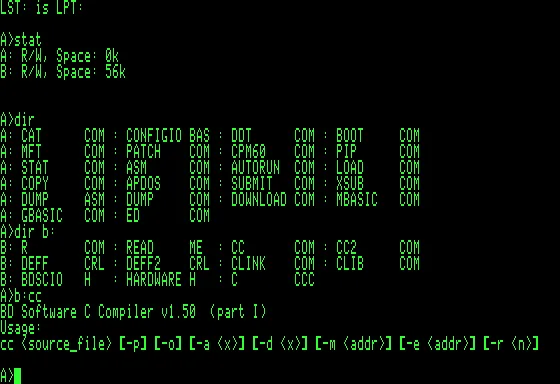
The operating system was ZCPR3, an upgrade to CP/M 2.2, and it divided opinion at once, starting with the man who wrote the review. He called CP/M 2.2 an awful operating system, one whose weaknesses could fill a book. ZCPR3, he explained, was written to use the HD64180 while staying as compatible with CP/M software as possible.
Boot took about 25 seconds from a system floppy. The command interpreter then copied itself to a RAM disk, which meant that pressing CTRL-C no longer demanded a system disk in the drive, a touch he called genuinely nice. Delete the file by accident, though, and the machine hangs. There was no command-line editor, so a long command with a typo had to be typed again from the start. There was no DISKCOPY either, which struck him as incomprehensible: backing up the system disk took half an hour of SYSGEN, VFILER and RAM-disk juggling.
One feature he liked in principle was a protected ‘wheel byte’ that could stop pupils wiping each other’s disks. In practice he found the password was SYSTEM, from a quick DUMP of the program, and that a BASIC POKE could flip the byte anyway. He still thought a few changes would make it excellent. ZCPR3 was public domain, he noted, so the Pupin team had been free to reconfigure it, and he did some reconfiguring of his own in barely half an hour.
BASIC was Microsoft’s CP/M version 5.21 of 1981, with graphics and sound commands added: PLOT, LINE, FILL, PAINT, ELIPSE, TEXT and SOUND. Some old keywords had to go to make room in the token table, which he thought nobody would miss. The new commands, in his view, were implemented excellently and ran extremely fast. Free memory was 22,066 bytes. On the benchmark chart from the British magazine PCW the TIM-011 stood alongside Acorn’s BBC B.
What the reviewer couldn’t forgive
The keyboard was the part he liked least, and his list was long. Several keys, including SET UP, COPY and BRK, did nothing at all. DEL sat directly above RET. The CAPS key was huge and CTRL tiny, and the slash and question mark had been lifted to the top row. The Serbian letters on the keycaps didn’t carry the ASCII symbols, so a programmer had to guess where the square bracket lived. Then there was the weight. The keyboard was wider than the computer and, he wrote, incomprehensibly heavy, as if the whole machine were inside it. The rear edge also hit the disk drive, which made inserting a floppy awkward.
He picked on the disk format too. The first public showing had used 40-track 5.25-inch drives in IBM format. The production machine used a 3.5-inch drive holding 780 KB, which is tougher for a classroom, and he did lose two disks in a month. Even so, 5.25-inch disks were far easier and cheaper to find in Yugoslavia, and a PC-compatible format would have let a school swap files with the IBM machines that were becoming the business standard.
His verdict, though, was warmer than the list. The TIM-011 was a very successful project, he wrote, spoiled by the teething troubles of keyboard, power supply and disk drive. All of them were easy to fix, he added, which didn’t mean they would be fixed. The machine was practically finished and the project, he thought, was still at the very beginning, because the school software and Serbian documentation hadn’t been written. His own test unit had arrived with no documentation at all.
Build your own in 1988
By the autumn the magazine was running a self-build scheme. Racunari’s October 1988 issue says printed circuit boards had been delivered at the end of September, and that readers could order parts in five kits from an Austrian shop, Mlakar and Co, in Unterbergen near the Ljubelj border crossing. You paid in Austrian schillings, from a foreign-currency account or by American Express card. The editors apologised for the price of chips after what they called the American-Japanese memory war.
The five kits were the processor and memory chips at 2,260.80 schillings, other chips and connectors at 717.70, a NEC 3.5-inch drive at 1,471, a PC XT keyboard at 760 and a 12-inch monitor at 1,529. The total was 6,738.50 schillings before postage and 7,473.50 with it. Those prices come from the magazine’s order form. I don’t have a figure for what a school paid for a finished machine.
The scheme also shows how the project was growing. Racunari said C, Modula-2 and a BASIC compiler had been ported, able to use the whole megabyte the 68-pin version of the processor could address, and that a mouse and a hard-disk interface were planned. The magazine even told readers how to rewire the board so a PC keyboard worked. The fix involved cutting two pins off a 74LS240 before fitting it, and adding two 2.2 kilohm pull-up resistors, and the editors admitted they had forgotten the resistors on the first boards.
Twelve hundred machines and a hard question
How many were made? A blog devoted to the machine gives about 1,200, mainly in secondary-school computer rooms, from 1987 into the 1990s. The same author estimates that fewer than ten survive. A Serbian moderator once said the TIM-011 was never sold publicly, and a pupil at a technical school in Smederevo remembers learning BASIC on one. Those two statements are not in conflict.
The man who taught Fortran on them thinks the choice of an 8-bit CP/M machine in the age of the PC was a mistake. In his view a TIM-020 running MS-DOS would have been cheaper in volume. Racunari’s reviewer had raised the same question in 1988 and declined to answer it, saying only that CP/M’s software library wasn’t far behind MS-DOS’s, but that a mountain of school software still had to be written. He was right about the mountain. I can’t tell you whether anyone climbed it.
A little of the machine has outlived the classrooms. It is emulated in MAME, someone has written a new Tetris called TimTris that placed fifth at the Revision demo party in 2024, and a modern replica board, the TIM011B, has been drawn up by Rob Taylor and Ian Cudlip. My verdict: the people at Pupin chose a good chip, borrowed a good design and built their own screen. Then they let a magazine tell the world about the keyboard before anyone had fixed it, and that may be the most honest thing about the whole project.