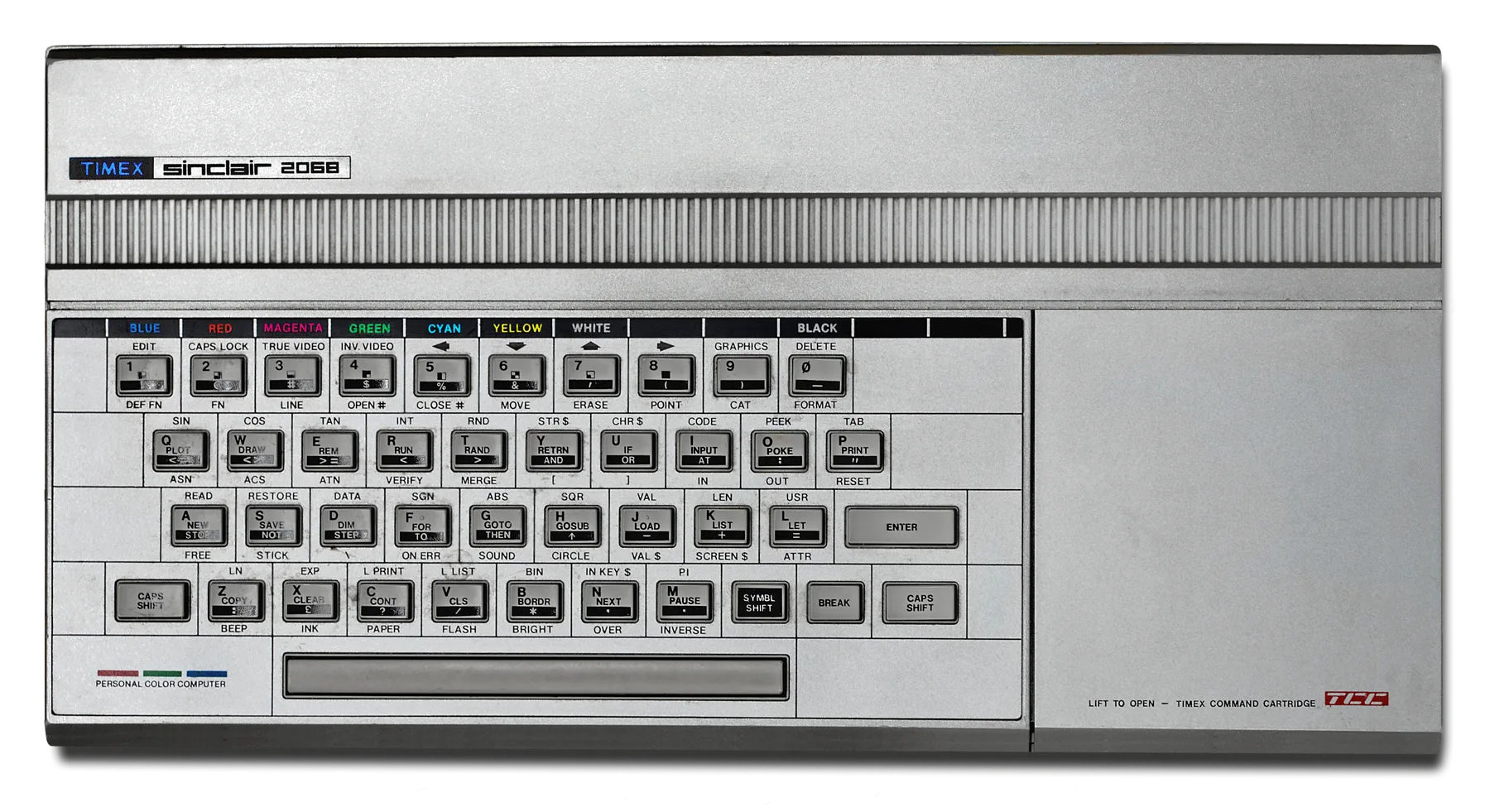
Michael Wiesenberg had reviewed enough machines by December 1983 to know when something felt genuinely well made. Sitting at his desk with a brand new Timex Sinclair 2068, he found keys that clicked back properly under his fingers, three-voice sound thick enough to rival a real synthesiser, and a memory system that finally felt roomy rather than cramped. He wrote it up for InfoWorld as an excellent product, one that compared well with machines costing far more. Then he tried loading a cassette of British ZX Spectrum software onto it, and nothing happened at all.
The machine really was better: a better keyboard, better sound, better graphics modes and more ports. Timex took Sinclair’s cut-price British hit, fixed nearly everything wrong with it, and still killed it in under four months. The fixes were what killed it.
Sinclair’s cheap trick, and why Americans would not buy it
The ZX Spectrum launched in the UK in 1982 at £175 for the 48K model and went on to become one of the best-selling home computers of the decade, built on the back of Clive Sinclair’s ruthless refusal to spend money on anything that would not shift units. That meant a case moulded around a rubber membrane keyboard that earned the nickname “dead flesh” from more or less everyone who ever typed on one, and a single one-bit beeper standing in for what other machines called a sound chip. British buyers tolerated it, mostly, because nothing else at that price came remotely close.
Timex knew this would not fly in the United States. The company had spent years quietly manufacturing Spectrums for Sinclair under contract, at plants in Dundee and in Caparica, Portugal, and it understood the hardware down to the trace. When Timex Computer Corporation set up in Waterbury, Connecticut, to sell its own version into a market that already had the Commodore 64 and the Atari 800XL waiting, the company decided the rubber keyboard and the beeper were the first things to go.
It was not starting from nothing. Timex’s earlier machine, the bare-bones TS1000, had sold something like 550,000 units in its first five months on the American market, a genuine hit that gave the company both the capital and the confidence to aim higher the second time round. If a machine with almost no features could sell that fast, the thinking went, a proper one should sell faster still.
Building a genuinely better Spectrum
Where the Spectrum was a compact black slab, the 2068 was a wide silver wedge, wearing its ambition on the outside. It swapped Sinclair’s membrane for real typewriter-style keys, borrowed wholesale from a Brother electronic typewriter, the EP-20, so that each one had proper spring travel and an audible click. It added two Atari-standard joystick ports, composite video output alongside the usual aerial lead, and a 3.5mm audio jack. Most importantly, it replaced the single beeper with a General Instrument AY-3-8912, a genuine three-voice sound chip with its own noise channel, the same silicon that would not reach an official Sinclair machine until the 128K arrived two years later.
Under the case, Sinclair’s custom ULA chip was gone too, replaced by a Timex-designed part called the SCLD, which handled bank selection and drove two extra video modes: a 512×192 high-resolution mono mode built for sharper text, and a colour mode that cut down, though never eliminated, the Spectrum’s infamous attribute clash. Spec for spec, this was a machine that could sit next to a Commodore 64 without embarrassment.

Image source unknown. If this is your picture, contact us and we’ll credit or remove it.
The 72K that was not really 72K
To fit the control logic for all that new silicon, Timex had to grow the ROM from Sinclair’s 16 KB to 24 KB, split across two bank-switched pages. Someone in Timex Computer Corporation’s marketing department then noticed that 48 KB of RAM plus 24 KB of ROM added up to a tidy 72K, and that number went straight onto double-page advertisements promising the power of a machine costing twice as much. Reviewers were not fooled for long. Most of that extra 24K was tied up running the video hardware, with only a sliver ever free for a programmer to use, and one contemporary trade write-up put it plainly: the 72K 2068 was probably more like a 48K machine. It is a strange thing to watch a company undersell a real achievement with a marketing trick nobody needed.
The address that broke everything
British Spectrum programmers, chasing every last cycle out of a 3.5 MHz Z80A, routinely called machine code routines directly at fixed addresses inside Sinclair’s 16 KB ROM rather than going through a proper published entry point. It was faster, and on a single, unchanging ROM it was safe enough. Timex’s expanded ROM broke that assumption on two fronts at once: the new code was bank-switched across two pages, a Main ROM sitting at 0000 to 1FFF and a Shadow ROM at 2000 to 3FFF, and the extra BASIC commands needed to control it all had shifted the old jump tables wholesale. Worse, the AY-3-8912 sat at a different I/O port on the 2068 than it eventually would on Sinclair’s own machines, so even sound code was not safe. Of the roughly 1,726 titles published for the British Spectrum, something like one in ten would actually run on a stock TS2068.

Photo: Thomas Conté, Wikimedia Commons (CC BY-SA 2.0)
So Timex had an enormous, ready-made software library sitting across the Atlantic, and almost none of it worked. Its own American catalogue at launch numbered around forty titles, priced between $9.95 and $22.95, and shelves at Sears and Kmart stayed close to bare through the machine’s entire time on the market.
Real keys, and an ingeniously devised torture device
Reviewers split hard on the keyboard, and both sides were describing the same forty-two keys. Wiesenberg praised the click. Jules Gilder, writing for Electronic Fun, called the layout “impossibly complicated” and reported that four of his six sample tapes would not load at all. Mark Brownstein, reviewing for Video Games magazine under the headline “Was it too little, too late?”, went further still, calling the keyboard “an ingeniously devised torture device.”
Both men had a point, because Timex had kept Sinclair’s single-keystroke tokenised BASIC entry even while giving the keys a proper typewriter action. Each key carried up to six separate functions, stacked in tiny print across its top, front and sides. Programmers who already knew where every keyword lived found it fast. Anyone new to the machine, squinting at six labels while hunting for a colon, was not thinking about how good the switches felt underneath.
The Zebra fix
Hobbyists solved the compatibility problem faster than Timex ever did. Companies like Zebra Systems began selling small cartridges and edge-connector boards, nicknamed “twisters,” that carried nothing more than an authentic 16 KB Sinclair ROM. Plugged in, the board bank-switched the original British code straight over the Timex firmware, and a cassette that had refused to load a minute earlier ran exactly as it would on a real Spectrum.
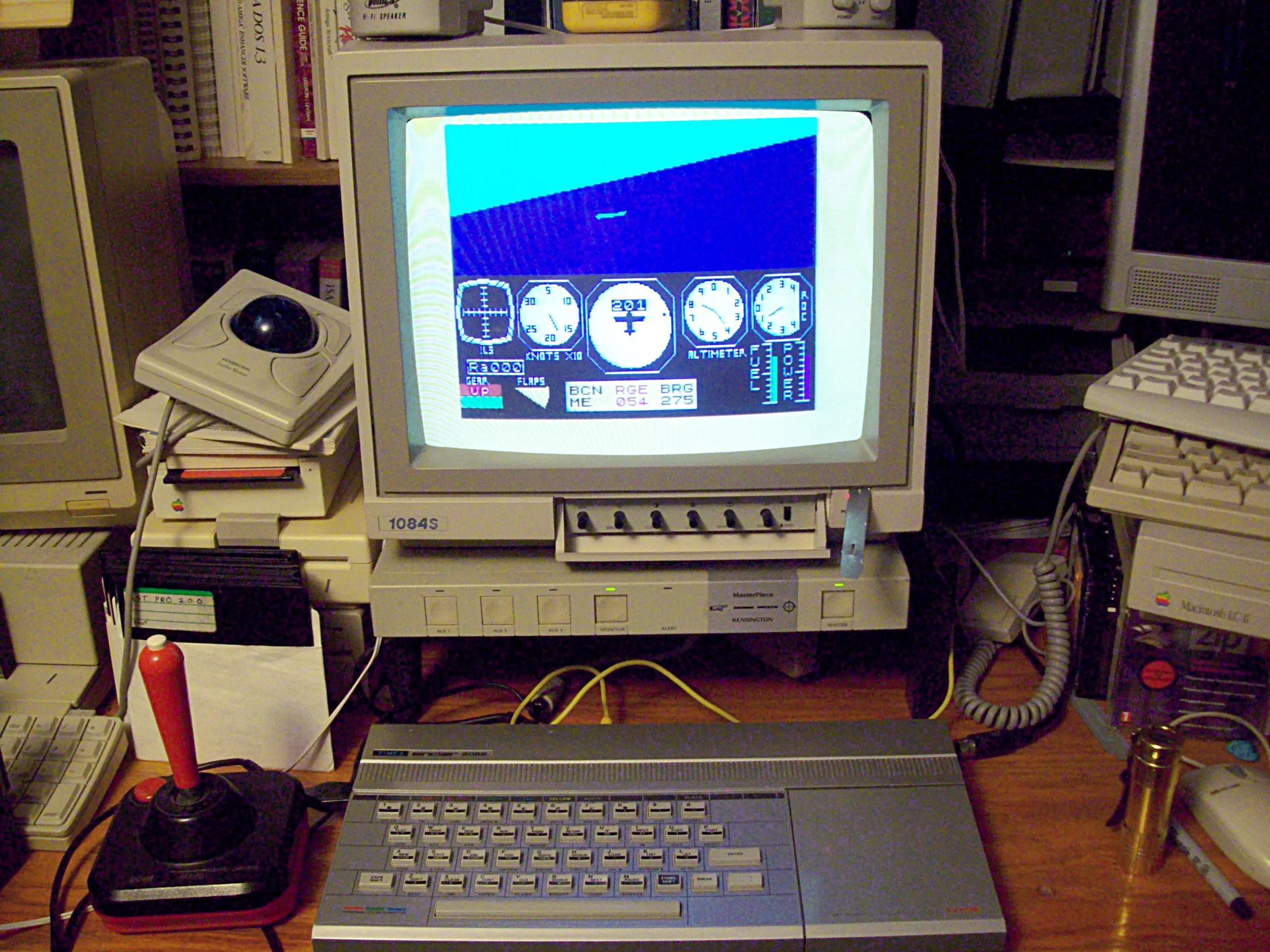
Image source unknown. If this is your picture, contact us and we’ll credit or remove it.
Four months
By February 1984, Timex had already cut the price from $199.95 to $139, chasing Commodore’s relentless discounting of the C64, and it was not enough. Timex Computer Corporation folded its computer division that same winter and walked away from the US home computer market entirely, a little over a year after it had been set up, and barely four months after the 2068 itself went on sale. The company that had sold 550,000 TS1000s in five months, on the strength of almost nothing, could not sell this far better machine fast enough to survive a single Christmas.
Caparica and Warsaw keep the lights on
Timex’s American exit did not end the platform. The plant at Caparica, outside Lisbon, which had spent years quietly building Spectrums and Timex machines under contract, kept going as an independent operation, releasing the PAL-formatted TC 2068 and later a cost-reduced TC 2048 through the mid-1980s. In 1986, a joint venture between Poland’s state-owned Unimor and a company called Polbrit International took the same hardware and sold it into Polish state shops as the Unipolbrit Komputer 2086, a name that squeezes Britain, Poland and Timex into one slightly awkward portmanteau. It went on selling for years, long after anyone in Waterbury was still thinking about it.
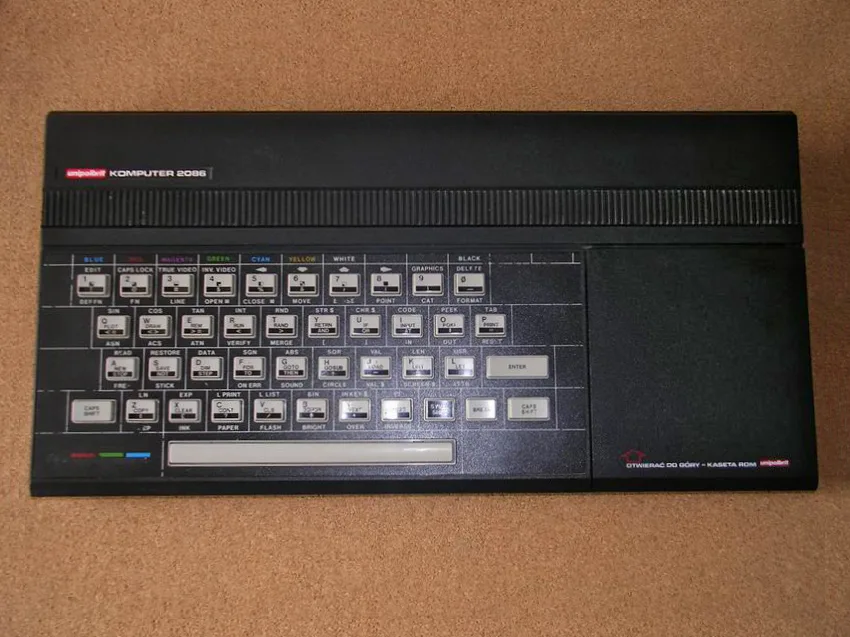
Photo: Krzysztof Hryń, Wikimedia Commons (CC BY-SA 3.0)
A better machine, and the wrong verdict
The Timex Sinclair 2068 was, in every way its designers set out to prove, a better Spectrum than the one Sinclair sold in Britain, and a joint venture on the other side of the Iron Curtain kept building it under a Polish name for years after Timex walked away. What Timex broke was the thing that mattered more: the software people already owned. Sinclair never made that mistake, mostly because it never had the money to do anything but the cheapest thing, and for once the cheapest thing was right.
Related reading: “Replacing the Spectrum’s dead-flesh keyboard membrane” — https://8bitarchitect.net/repair-tutorials/replacing-the-spectrums-dead-flesh-keyboard-membrane/