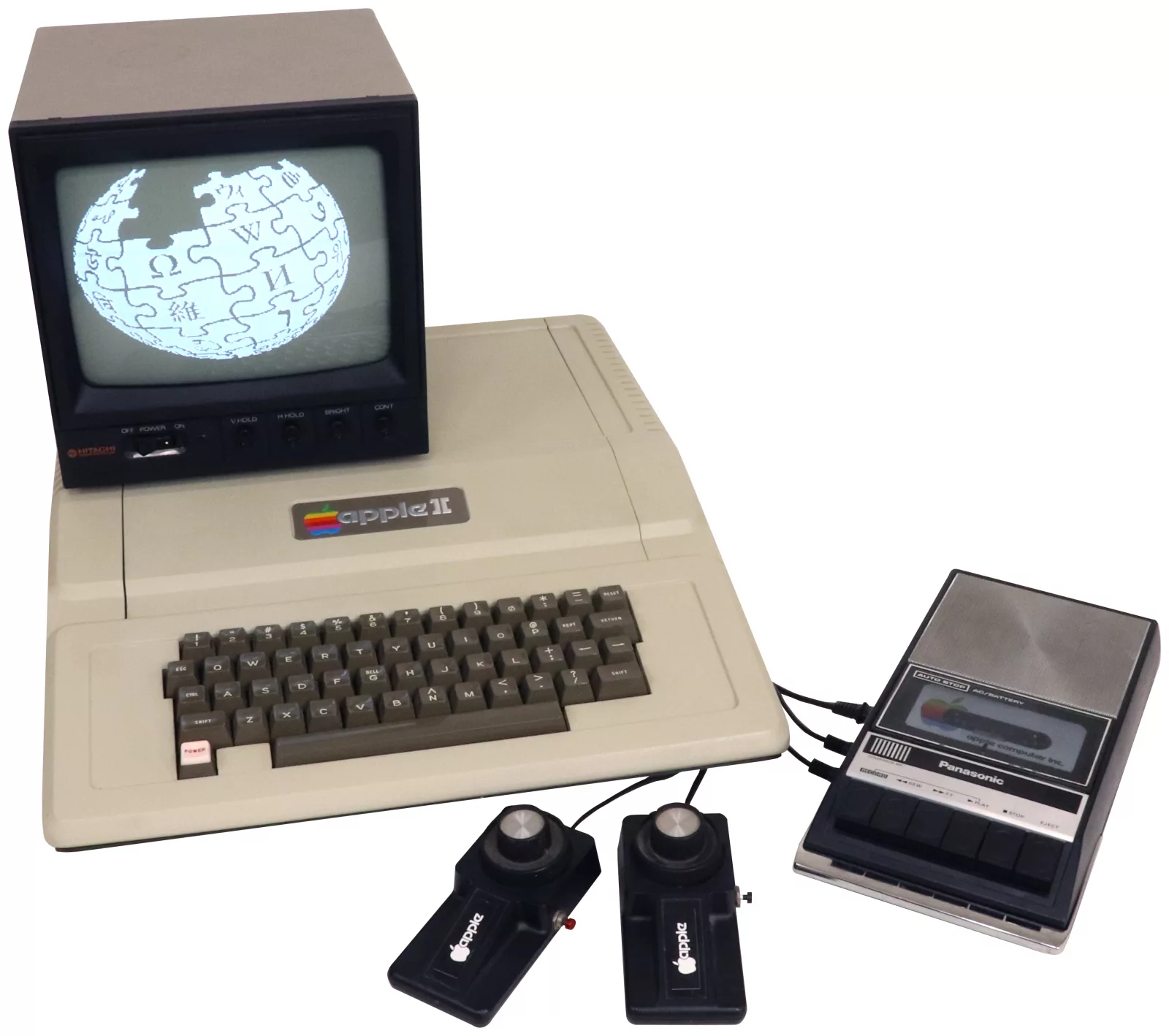
The Apple II is an 8-bit home computer built around the MOS Technology 6502, shown publicly by Apple Computer at the West Coast Computer Faire in San Francisco on 16 April 1977 and sold as complete systems from June that year. The processor inside it was cheap and unremarkable. What made the machine sell was that it came finished: colour graphics, sound, BASIC in ROM, a keyboard and a moulded plastic case, sold to a buyer who was assumed to own no soldering iron and to want none.
- Public debut: West Coast Computer Faire, 16-17 April 1977. Bare motherboards shipped from 10 May 1977, complete systems from June.
- CPU: MOS Technology 6502 at 1.023 MHz
- RAM: 4KB to 48KB, set by jumper blocks on the board
- ROM: 8KB, holding Wozniak’s Integer BASIC and the System Monitor
- Graphics: 40×48 lo-res with 16 colour values (two greys are identical, so 15 you can actually see); 280×192 hi-res in 6 colours
- Launch price: $1,298 with 4KB, rising to $2,638 with 48KB. Monitor and cassette recorder extra.
What Apple actually showed at the West Coast Computer Faire
San Francisco Civic Auditorium, the morning of 16 April 1977, and something over twelve thousand people are pushing through the doors of the first West Coast Computer Faire. Most of what waits inside is bare. Card cages, S-100 backplanes, boards laid out on trestle tables with their sockets facing the ceiling, front panels of blinking lamps, and a great many men explaining why their kit is easier to build than the other man’s kit.
Apple had taken a double booth immediately inside the entrance, which cost money the company did not obviously have. Mike Markkula had coached Jobs and Wozniak to behave like an established firm rather than a garage, and Regis McKenna’s agency built them illuminated Plexiglas signs carrying the new rainbow logo on three sides, mounted high enough to read from anywhere on the floor. The rainbow was doing a job. It existed to tell you, before you were close enough to see a screen, that this machine did colour.
Then you got close enough to see the screen, and it was not a screen. Apple had an Advent projection monitor throwing colour graphics up at a size nobody else in the hall could match. Jim Warren, who organised the Faire, and the editors at Byte were both slow to work out what they were looking at. The visitors were quicker. Apple came away with roughly three hundred orders for a machine that was not yet shipping.
Why Steve Wozniak built colour into the Apple II before anything else
The reason the Apple II had colour at all is that Wozniak had built Breakout for Atari in 1975 out of discrete logic, and had come away from the experience wanting a machine on which that sort of thing could be written in software instead. He has never dressed the priority order up as market research.
‘A lot of features of the Apple II went in because I had designed Breakout for Atari … color was added in first, so that games could be programmed,’ he said. Everything else in the machine’s personality followed from that one decision: the speaker, the paddle inputs, the deliberately small amount of supporting circuitry around them.
The colour itself is the most elegant piece of cheating in 1970s home computing. Wozniak did not fit a colour generator, because a colour generator would have cost chips and chips cost money. Instead he ran the whole machine from a single 14.31818 MHz crystal, divided down to 3.579545 MHz, which is exactly the NTSC colour subcarrier frequency, and clocked the 6502 at 1.023 MHz, two-sevenths of that subcarrier. With the timing locked to the colour burst, a pattern of plain black-and-white pixels arriving at a television in the right phase gets decoded by the set itself as colour. The Apple II does not generate colour. It generates a signal that a colour television cannot help misreading, and Wozniak worked out precisely which lies to tell it.
The same video circuitry pulled a second shift. Every row of dynamic RAM was read often enough by the display fetches that the memory refreshed itself as a side effect, which deleted an entire refresh circuit from the bill of materials. That is the Apple II in one detail. Almost every part of it was doing two jobs, because the alternative was another chip to pay for.
The first six thousand boards shipped without a colour-killer circuit, so text on a colour set came out fringed with colour whether you wanted it or not. Later revisions fixed that, along with the cassette input, which had been unreliable enough to matter.
The eight expansion slots Steve Jobs did not want
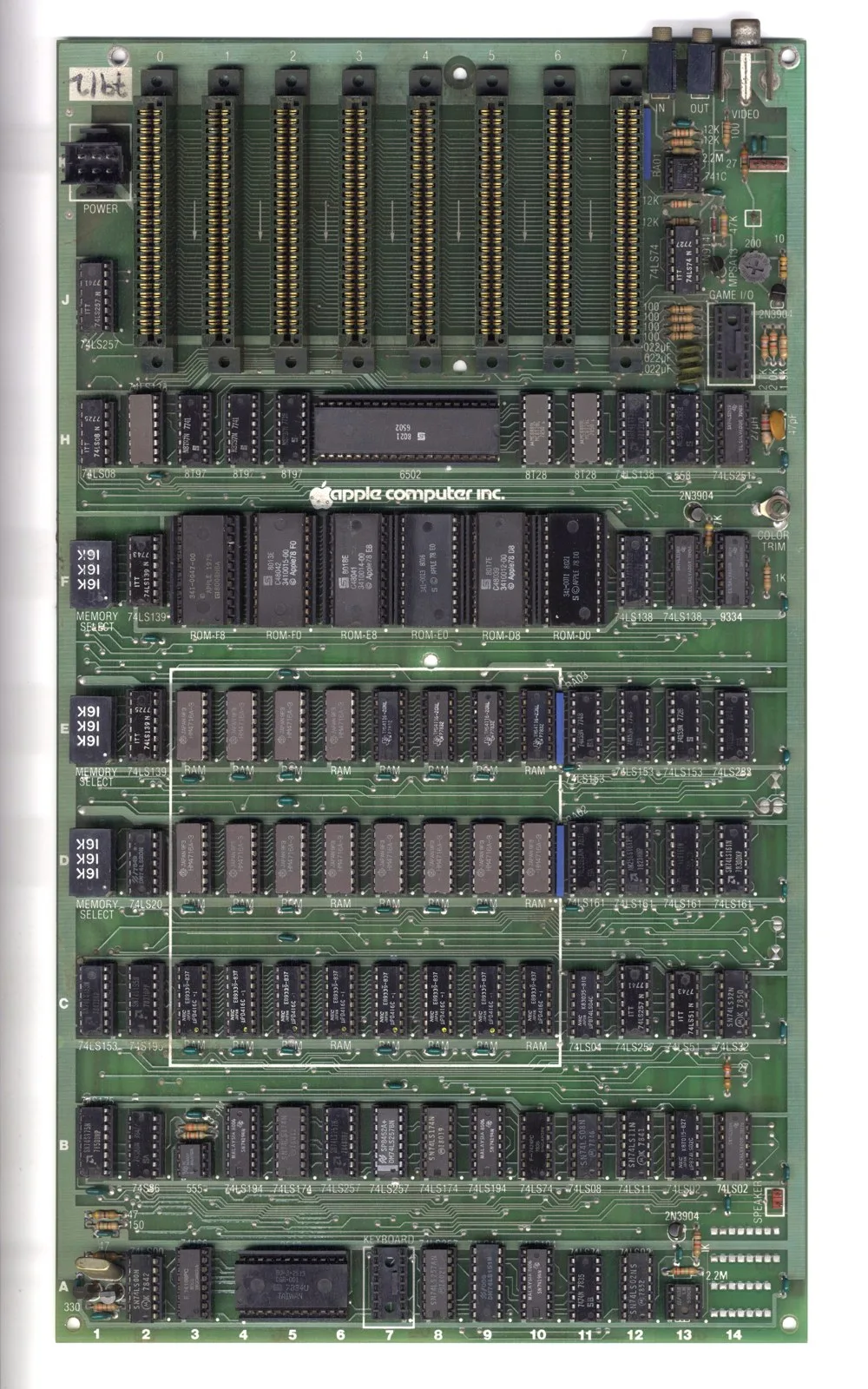
Photo: Sckop, Wikimedia Commons (CC BY-SA 3.0) — an Apple II j-plus board, sharing the standard eight-slot layout
Jobs argued for two slots. One for a printer, one for a modem, and what else could anyone possibly need. Wozniak, who had come out of Hewlett-Packard and had watched what engineers do to any machine with a spare connector on it, insisted on eight, on the grounds that people would always find something to fill them.
Wozniak won, and that argument is the most consequential thing about the Apple II that has nothing to do with the 6502. The slots are where the Disk II controller went, and the serial card, the 80-column card, the clock card, the Z-80 SoftCard that let an Apple II run CP/M software it had no business running. A school could buy one machine and change what it was for by opening the lid. So could a business, which is why businesses did.
There were real corners cut elsewhere. The board carried no interrupt request wiring at all, a cost decision taken on the assumption that a machine for games and education would never need interrupts. Programmers spent the next decade politely disagreeing. Against that, every integrated circuit on the board sat in a socket, which cost more to build and made the thing genuinely serviceable, and forty-nine years later that decision is why so many of these boards can still be brought back.
A case with no visible screws and a power supply with no fan
Jobs wanted a computer that people outside the Homebrew Computer Club would want to own, and he had a reference point: the moulded plastic on a Hewlett-Packard calculator. He rejected sheet metal outright. Jerry Manock was brought in to design the case for $1,800 and produced a beige moulding in Pantone 453, with no screws visible from the outside and a lid a person could lift with their fingers.
That case created a thermal problem, because Jobs also refused to allow a fan. Rod Holt, an analogue engineer Jobs poached from Atari at $200 a day, solved it with a switching power supply that chopped the incoming power thousands of times a second rather than the sixty times a linear supply manages, storing energy for far shorter periods and throwing off far less waste heat as a result. It worked well enough that Holt came in as employee number five and chief engineer, after Manock turned down a full-time job.
The early cases, though, were a mess, and the record is honest about it. The first run was hand-moulded and the plastic came out with visible bubbles and blemishes. Worse, there were no vent openings, so heat built up under the lid until the plastic itself began to soften. Apple moved to machine moulding, cut vents into the design within about three months, and replaced the bad cases free of charge. A small story, but a revealing one: the first genuinely consumer-grade home computer shipped in a case that got soft.
What $1,298 bought, and what the competition was charging
It bought a 4KB machine, with no monitor and no cassette recorder to load anything from. A useful Apple II with 48KB fitted came to $2,638. Set that against the field it shared 1977 with. Tandy put the TRS-80 Model I on sale on 3 August at $599.95, across the counters of several thousand Radio Shack shops. Commodore had announced the PET 2001 at $795 back in January and had a prototype at the same Faire.
Byte later took to calling the three of them the 1977 trinity, and in that company the Apple II was flatly the expensive one. The money that let Apple survive being the expensive one came from Mike Markkula, who put in $91,000 of his own cash, secured a $250,000 line of credit, took a third of the company and wrote the first business plan. His stated ambition at the time reads like bluster and was not: ‘I came to the conclusion that we could build a Fortune 500 company in less than five years, and that would be really fun.’ Apple entered the Fortune 500 in May 1983, at number 411.
The numbers underneath that are steep enough to be worth stating plainly. Apple’s revenue for the 1977 financial year, Apple I included, was $775,000. By 1980 it was $118 million.
How the Disk II and VisiCalc turned a hobby machine into an office machine
Markkula wanted a disk drive to show at the Consumer Electronics Show in January 1978, and said so late in 1977, which left roughly two weeks. Wozniak and Randy Wigginton spent the Christmas break on it, living on McDonald’s. Wigginton took Christmas Day off. Wozniak did not.
What came out of that fortnight is one of the great pieces of 8-bit engineering. Rival floppy controllers of the period used thirty-odd chips to handle sector timing and data separation in hardware. Wozniak’s controller used eight, because he moved the work into software running on the 6502 and let the processor do the counting. The prototype mechanisms, incidentally, came off a pile of rejected Shugart SA400 drives. The finished Disk II held 140KB, generally sat in slot 6, and demonstrated at CES in January 1978 as promised.
The original Apple II was discontinued in May 1979 and replaced the following month by the Apple II Plus at $1,195, with Microsoft-authored Applesoft BASIC in ROM in place of Wozniak’s Integer BASIC. Slower, but capable of floating point, which mattered for what happened next.
On 17 October 1979 Personal Software began selling VisiCalc, written by Dan Bricklin and Bob Frankston at Software Arts, for $100. It ran on the Apple II and nothing else. Around a million copies went out over the following four years, and the effect on Apple’s customer base was total. People who did not care about computers, who had never soldered anything and never would, started buying a two-thousand-dollar machine because it was the only way to run one hundred-dollar spreadsheet. Every part of the design that made that possible had been settled two years earlier by a man who wanted to write Breakout without a soldering iron.
What Britain got instead: the ITT 2020
None of the above quite happened here, and the reason is a television standard. Wozniak’s colour depends on the NTSC subcarrier, and a British set decodes PAL, so an American Apple II plugged into a British telly produces monochrome and disappointment.
Apple’s answer was to license the design to ITT Consumer Products, the first licensed Apple clone anyone ever made. The ITT 2020 appeared in 1979, assembled at ITT’s plant in Basildon. Reaching PAL meant a 17.73 MHz crystal in place of the American 14.318 MHz, and that change dragged the hi-res display up to 360 dots across instead of 280, which needed a ninth bit of video memory and broke most American hi-res software outright. The BASIC in ROM was a reworked Applesoft called Palsoft. The disk controller had timing of its own and stayed stuck on DOS 3.2. Microsense Computer Limited handled distribution in Britain.
A complete ITT 2020 system with disk, printer and a colour television came to somewhere around £3,500.
Apple’s own Europlus, a II Plus rewired for 50 Hz and 220 volts with monochrome PAL from the built-in socket and colour only via a card in slot 7, arrived to do the job properly, and ITT withdrew. Apple bought Microsense outright in 1981 for $3.5 million and turned it into Apple Computer UK.
The machine that won by being finished
Judged as hardware, the Apple II is not the best 8-bit machine of its decade and never pretended to be. Fifty-two keys, uppercase only. No interrupts. Six hi-res colours you have to earn by putting your pixels in the correct column. A high-resolution mode that is really 140 pixels across wearing a disguise.
It won because in June 1977 it was the only one of the three you could carry out of a shop and switch on. Everything Wozniak did in that design was aimed at removing a chip, and the money he saved went into the things a non-engineer could actually see. Businesses and schools bought it because it was the only machine on the market that had already answered the question of what you do with it once you get it home.
Wozniak set out his rule in Byte in May 1977, before a single complete system had shipped: ‘To me, a personal computer should be small, reliable, convenient to use and inexpensive.’ He got three of those four. The fourth is why British schools ended up on BBC Micros and British bedrooms on Spectrums, and why the Apple II’s life in this country was spent mostly in offices and laboratories, running a spreadsheet, several thousand pounds away from the kitchen table it had been designed to replace.