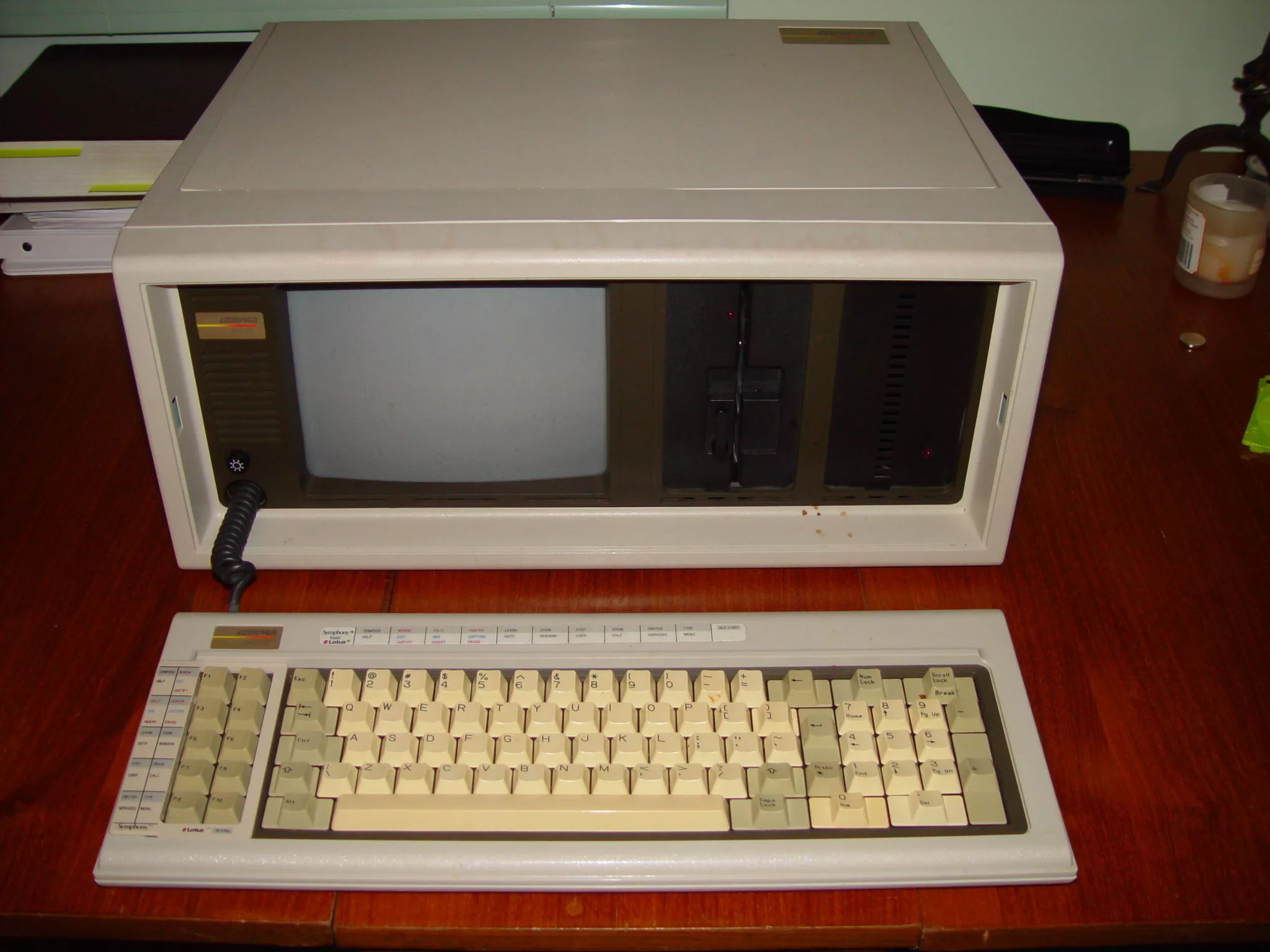
In March 1983 Compaq began shipping a 13 kg suitcase with a handle on the top: an Intel 8088 running at 4.77 MHz, 128 KB of RAM, a 9in green screen, a pair of 360 KB floppy drives, $2,995. The handle was never the point. The point was a few kilobytes of ROM on the motherboard, a BIOS that Compaq had spent something close to $1 million rebuilding from nothing, written by engineers who were forbidden, on legal advice, from ever looking at the code they were replacing.
- CPU: Intel 8088 at 4.77 MHz
- RAM: 128 KB, expandable to 640 KB
- Storage: one or two 360 KB 5.25in floppy drives
- Display: built-in 9in green-screen monitor on a hybrid MDA/CGA video card
- Launch price: $2,995 single drive, $3,590 dual drive
- Announced 4 November 1982, shipped March 1983
- Weight: 28 lb (13 kg)
The engineer who contaminated himself by reading a manual
Gary Stimac had done nothing wrong, exactly. He had bought an IBM PC Technical Reference manual, the way any engineer in 1982 would, and he had turned to the back, where IBM had printed the complete assembly listing of the PC’s BIOS. Every line of it. IBM had published the source code to the one part of the machine it actually owned.
Reading it was the problem. The moment Stimac’s eyes crossed that listing he became, in the language Compaq’s lawyers were about to start using, contaminated. Anything he wrote from then on could be argued in court to derive from IBM’s copyrighted code, and IBM’s legal department in 1982 was not a body you wanted forming opinions about you.
So Compaq built an airlock around him.
Stimac would read IBM’s documentation and describe, out loud, what the BIOS did. Not how it did it. What it did: this call takes these values, returns those, leaves the machine in that state. Across the table sat a Compaq lawyer, writing it down and stripping out anything that smelled proprietary. What came out the other side was a functional specification, a description of behaviour with the implementation surgically removed.
That document went to Steve Flannigan and a team who had never seen the listing, and they wrote a BIOS to match it. A best guess first, then trial and error against real software until the mismatches stopped happening.
Stimac took the discipline personally. “Nobody in the entire office could ever buy a copy of a technical manual after that without me removing the [BIOS] pages and destroying them,” he said later. Picture that for a second: a senior engineer going through the office post with a pair of scissors, protecting his colleagues from information.
The bad boss, the Mexican restaurant and the placemat
Rewind eighteen months. Rod Canion, Jim Harris and Bill Murto were senior managers at Texas Instruments in Houston, and by September 1981 they had had enough. Canion’s account of why is refreshingly unheroic. “We got a bad boss,” he said. “He just wasn’t fun to work for. He wasn’t a bad person! Just… not a good boss.”
They did not start with computers. The three of them gave serious thought to opening a Mexican restaurant, which is the sort of detail that usually gets sanded off a founding story before it reaches print. What tipped them towards hardware was Canion’s read on the market: there was going to be an explosion in personal computers, and TI was not going to be part of it.
A consultant named Portia Isaacson introduced Canion to the venture capitalist L.J. Sevin, and Sevin gave him one piece of advice that shaped everything that followed. Don’t take anything with you but what’s in your mind. A warning about intellectual property, delivered before a single line of Compaq code existed. The clean room starts here, not in the lab.
Sevin and his partner Ben Rosen committed through Sevin Rosen on condition that a second investor came in. Kleiner Perkins did, and the round came to roughly $3 million. The company was incorporated on 16 February 1982 under the name Gateway Technology. Compaq came later, off a list produced by Ogilvy & Mather, and by the company’s own telling it was the name least rejected rather than the name anyone loved. The tidy “Compatibility and Quality” story was reverse-engineered afterwards, which is at least thematically appropriate.
In January 1982 Canion arrived at the question the whole company would be built on: what if you could make a portable computer that ran the software written for the IBM PC? He and Harris took it to a Houston branch of House of Pies with Ted Papajohn, a retired industrial designer, who sketched the machine on a placemat. It came out looking something like an Osborne 1, only less army surplus. That placemat and a business plan were the pitch.
Why the IBM PC could be cloned at all
IBM built the IBM PC 5150 in about a year by buying nearly all of it. The 8088 came from Intel. The drives and support logic came off the shelf. The operating system was licensed from Microsoft rather than owned. The expansion bus was documented so thoroughly that a third party could design a card over a weekend. Openness was the schedule, not the strategy.
The one proprietary piece was the BIOS: the ROM code sitting between DOS and the actual silicon, handling the keyboard, the disk controller, the video, the interrupt vectors. Copy that and you had a machine that ran Lotus 1-2-3. Fail to copy it and you had an expensive doorstop with an 8088 in it.
And IBM printed it in the manual. Not a summary of the calls: the listing. On its own terms the reasoning was sound, because anyone writing hardware or low-level software for the PC needed to know precisely what the BIOS did. The commercial consequence was that IBM handed every prospective cloner a complete specification and then dared them to use it.
That is the decision worth being rude about, and note where the rudeness is aimed. The engineering was fine. The engineering was, given twelve months and a corporate culture that normally took five years, extraordinary. Somebody upstairs decided that shipping on time mattered more than owning the platform for a decade, and they were entirely right about the shipping on time.
Compaq was not the first IBM PC clone, and it turned out not to matter
Worth saying plainly, because the phrase “first IBM PC clone” gets welded to the Compaq Portable constantly and it is not quite true. Columbia Data Products got there first. The MPC 1600 shipped in June 1982, nine months ahead of the Portable, and Columbia had gone the clean-room route too.
What Columbia did not have was Compaq’s distribution, Compaq’s timing, or Compaq’s appetite for the fight.
Meanwhile the companies that skipped the airlock found out exactly why it existed. Eagle Computer and Corona Data Systems both shipped machines with BIOS code lifted rather than rebuilt, and in early 1984 IBM sued them both for copyright infringement. Apple v. Franklin had settled the underlying question the previous year: object code in ROM is copyrightable, and “we only copied the binary” is not a defence. Corona agreed to stop. Eagle halted manufacture and went away to engineer a BIOS properly, which is to say the expensive way, which is to say the way Compaq had already paid for.
IBM never sued Compaq. That is the entire return on the million dollars. Not a faster machine, not a cheaper one. An absence of litigation.
The DOS that was not the DOS
Then Stimac found the other problem, and this one belonged to Microsoft.
Compaq had licensed MS-DOS on the reasonable assumption that MS-DOS and the PC DOS shipping on IBM machines were the same product wearing different badges. They were not. Canion rang Bill Gates about it directly, and Gates explained why: IBM’s contract had required separate teams for the two versions, and over successive releases the two had quietly drifted apart.
Gates pointed them at the last version before the split. Compaq licensed that, worked it over and shipped it as Compaq DOS 1.10.
There is a version of this story where a founder discovers his supplier has sold him a subtly different product and it becomes eighteen months of depositions. Instead a man picked up a telephone and got a straight answer, which tells you how small this industry still was at the end of 1982.
The video card that fixed a problem IBM had created
The compatibility work is the part that deserves applause rather than a punchline, and the video card is where you can see it most clearly.
An IBM PC buyer in 1982 had to choose. MDA gave you one 80×25 text mode, crisp, built from 9×14 character cells, and no graphics whatsoever. CGA gave you graphics at 640×200 or 320×200, plus 80×25 and 40×25 text built from coarser 8×8 cells. The matching monitors were single-frequency, so an MDA display could not show a CGA signal and a CGA display could not show an MDA one. Choose wrong and half your software was unusable.
The Portable had one screen bolted into the case, so choosing was not available. Compaq’s answer was a video card that was neither an MDA nor a CGA, carrying both cards’ character fonts in ROM and driving an internal display that would accept either signal. CGA’s graphics modes appeared as normal, in greenscale rather than colour. CGA’s 80×25 text was quietly swapped for the sharper MDA rendering, because on a 9in screen the gap between an 8×8 and a 9×14 character cell is the gap between a spreadsheet you can read and a spreadsheet you squint at for eight hours.
The detection was almost rude in its simplicity. If the CRTC character height register held 13, meaning 14-row characters, the card dropped into its high-resolution mode. Ctrl+Alt+< and Ctrl+Alt+> let you force it either way from the keyboard. And while the card sat in high-resolution mode it sent no signal at all to the external monitor socket.
That last decision is the one I keep coming back to. Somebody sat down, thought about a customer plugging the wrong monitor into the back, and then spent silicon on making sure nothing caught fire. Nobody buys a computer because of that. It gets designed in anyway, by people who would rather not have it on their conscience.
What $111 million in a single year actually bought
Compaq’s own first-year plan called for $30 million of revenue. They finished on $111 million from 53,000 machines, at the time the largest first year any American company had ever recorded. (The Computer History Museum’s own clone exhibit cites a higher figure, more than $150 million, for that first year; $111 million and 53,000 units is the figure in Compaq’s own accounts and most secondary sources.) Year two came in at $329 million. Year three at $503.9 million.
The distribution strategy did a great deal of that work. Compaq sold through resellers only and never went direct, so no dealer ever had to worry about being undercut by the manufacturer whose machine they were selling. H.L. “Sparky” Sparks, who had built IBM’s own dealer channel, was recruited to run it, an introduction that arrived through John Doerr at Kleiner Perkins. IBM’s dealers, in other words, were signed up for a second time by the man who had signed them up the first time.
BYTE’s verdict was that the machine “looks like a sure winner”, which for BYTE in 1983 counted as shouting.
And Canion’s compatibility standard was absolute in a way that sounds unhinged until you think about what compatibility actually means in practice. “If it was running on an IBM PC already we’d make it work on ours,” he said. “We’d even create flaws that would be comparable to IBM’s flaws.” Bugs are part of the specification. If a program depends on the wrong thing happening at the right moment, then the wrong thing has to happen, on schedule, in your machine too.
The million dollars bought a precedent, not a computer
By May 1984 Phoenix Technologies had a clean-room BIOS of its own, built the same way, with contaminated engineers writing specifications for clean ones. In July that year Phoenix announced it would license the code to anybody who wanted it. American Megatrends followed. The single component of the IBM PC that IBM genuinely owned had become a part you could order, like a floppy controller or a can of solder.
Everything after that was arithmetic. The architecture IBM had opened up in order to ship on time stopped being IBM’s architecture, and the money walked over to Intel and Microsoft, who sold to everyone and cared not at all whose badge was screwed to the front of the case.
Compaq’s million dollars did not buy a faster computer or a cheaper one. It bought a method, and then, by surviving contact with IBM’s lawyers without a writ ever landing, handed that method to the entire industry for free. The machine that carried it weighed 13 kg, had a handle riveted to the top, and looked like a sewing machine that had been to business school.