MACHINE REFERENCE

CoBra

The CoBra was a Romanian ZX Spectrum-compatible computer designed in Brașov in 1986, with a CP/M mode if you added a floppy controller.

Why it matters

The team at ITCI couldn’t buy a Sinclair ULA, so they rebuilt its job from discrete TTL logic and went further than the machine they were copying: 64 KB of RAM and a floppy interface that could boot CP/M. About 1,000 official units went to factories, hospitals and accounting offices between 1988 and 1990, because private ownership of computers was not allowed. A black market in student-built copies grew up around it, and at the 1988 România 88 exhibition in Moscow the display machine was reportedly stripped of its chips overnight.

What to check before you buy

  • Real factory CoBras are very rare, so be wary of anything sold as one without photos and provenance.
  • Ask whether it is an official ITCI unit or a student-built copy; they differ a lot inside.
  • Check the 4116 RAM chips and the power rails; the original design depends on a correct start-up sequence.
  • If you want to run CP/M, look for the floppy daughter board and the extra eight keys.
  • Modern replica boards are an easier way to own one, and the KiCad files are on GitHub.
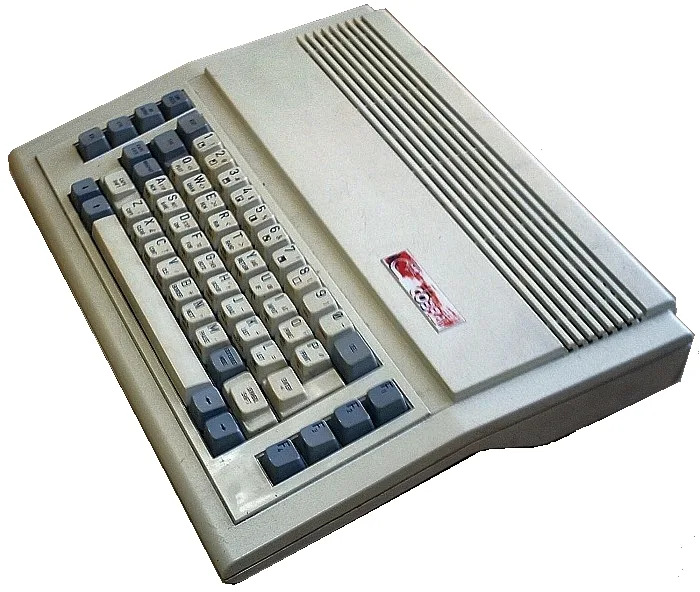
CoBra Romanian home computer made in Brașov

Photo: Alex:D, Wikimedia Commons (CC BY-SA 4.0)

Released

1988

RAM

64 KB (four banks of eight 4116 chips)

CPU

Zilog Z80A, 3.5 MHz (the Romanian MMN80CPU clone, made from 1988, can also be used)

Launch price

About 35,000 lei (reported)

Manufacturer

ITCI (Institute for Computing Technology and Informatics), Brașov, Romania

Form factor

Keyboard computer in a case, with a CP/M variant with floppy drive

CPU

Zilog Z80A, 3.5 MHz (the Romanian MMN80CPU clone, made from 1988, can also be used)

Chipset

Discrete 7400-series TTL logic in place of the Sinclair ULA

RAM

64 KB (four banks of eight 4116 chips)

ROM

16 KB BASIC interpreter plus 2 to 16 KB of boot code

Graphics

256 x 192, ZX Spectrum-compatible video

Audio

Unknown

Storage

Cassette; optional i8272 floppy controller on a daughter board for CP/M

Ports

RS-232 (bit-banged), joystick port, 8-bit parallel input, 3 x 32-pin DIN41612 expansion connector

OS

ZX Spectrum BASIC; CP/M with the floppy interface (three memory maps: power-on, Spectrum mode and CP/M mode)

PSU

Unknown

Units sold

About 1,000 official units (reported); many more unofficial builds

Successors

CoBra-2 ‘Turbo Spectrum’ prototype only

  • 4116 memory power sequencing
    The 4116 DRAMs need -5 V, +5 V and +12 V brought up in order, and the wrong sequence kills them. Designer Vasile Prodan fixed it with one diode in the ground rail.
  • Overheating video logic in replicas
    A 2022 hobbyist rebuild using period Eastern Bloc parts hit the same problem as the original team: overheating video ICs and memory glitches.
  • Low-quality Eastern Bloc logic chips
    Student-built clones suffered from unreliable Soviet-sourced ICs, so failing chips are the first thing to suspect.
  • 1986 The CoBra is designed at ITCI Brașov, inspired by the Romanian HC 85 family and the Sinclair ZX Spectrum
  • 1988 CoBra is shown at the România 88 exhibition in Moscow, where an exhibition machine is reported to have been stripped of its chips overnight
  • 1988 Official assembly of about 1,000 units begins at SPIACT in Brașov
  • 1990 Official production stops after state funding ends