MACHINE REFERENCE

Commodore 16

The Commodore 16 was the cheapest of Commodore’s 264 series, launched in 1984 at US$99 with 16 KB of RAM and a single TED chip doing the work of several.

Why it matters

The TED chip handled video, two-voice sound, timers and joystick reading in one package, which kept the board small and cheap, and that is good engineering for a machine meant to cost about $100. The price of it was no sprites, no SID and colour data stored in main memory. The C16 was meant to replace the VIC-20, but it ran neither VIC-20 nor C64 software, and the C64 was already on sale at $199. In America it sank within a year. In the UK it had a good 1985 once the price fell from £149 to £89 and then £49, and Commodore kept selling it in Mexico under the Sigma name until 1992. Sales figures are contested: 1,266,000 appears in c64-wiki and Wikipedia, yet Wikipedia also puts the whole 264 series at about a million.

What to check before you buy

  • Start with the power supply and the fuse on the motherboard. A failed linear supply can damage the board, and a blown fuse is a common cause of a dead machine.
  • Switch on and look for a picture. Faint scan lines suggest a dead TED, while a black screen can point to the CPU, the PLA or the address chips. All three overheat.
  • Ask whether the electrolytic capacitors have been replaced. Old ones dry out or fail short, and a recap is cheap insurance.
  • Check which model it is. A C16 has 16 KB, the Commodore 116 is a European cost-reduced version with a rubber keyboard, and the Plus/4 has 64 KB. Listings mix them up.
  • Test the keyboard, both joystick ports and the cassette port. C64 joysticks need an adapter, so do not assume your existing ones will fit. Ask too about mods such as a 64 KB RAM swap or a replacement CPU.
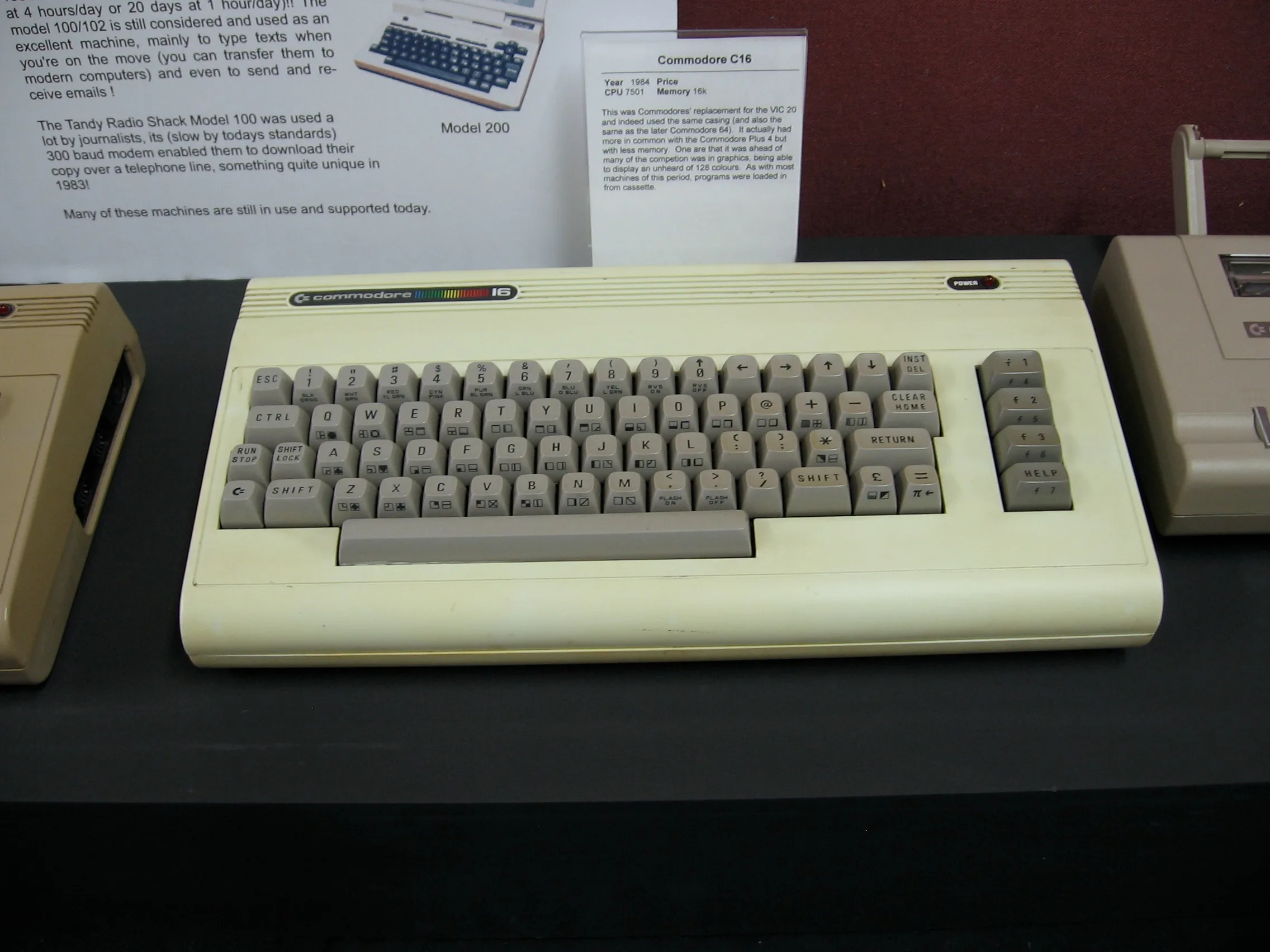
Commodore 16 home computer on a museum display table

Photo: Marcin Wichary, Wikimedia Commons (CC BY 2.0)

Released

1984

RAM

16 KB, of which 12 KB is free to BASIC. Two 4416 chips on the board; one restorer swapped them for 41464 chips to reach 64 KB. Commodore offered no memory expansion for it (Wikipedia)

CPU

MOS Technology 7501 or 8501 (6502 family) at 0.89 or 1.76 MHz, with an effective average around 1.1 MHz because the TED takes memory cycles from the CPU during screen drawing. Retroisle gives 1.7 MHz with the screen blanked

Launch price

US$99 (Wikipedia, c64-wiki). UK prices vary by source: £129.99 for a starter pack with a cassette unit and tutorial (Popular Computing Weekly, June 1984), £139.99 for another pack, £140 (Gondolin) and £149 (Computing History). Computers Museum lists £65, which looks like a later price

Manufacturer

Commodore Business Machines (Commodore International), West Chester, Pennsylvania, USA. Licensed production in Mexico (Sigma) and Argentina (Drean)

Form factor

Slim keyboard computer, about 40 x 20 x 8 cm (Wikipedia gives 40.7 x 20.4 x 7.7 cm) and about 925 g. Full-travel typewriter-style keyboard with 66 keys, four separate cursor keys, a HELP key and four function keys. Sources describe the case as dark (charcoal black or dark grey/brown) with light grey keys. It was a cost-reduced sibling of the Plus/4, which has a 59-key keyboard

CPU

MOS Technology 7501 or 8501 (6502 family) at 0.89 or 1.76 MHz, with an effective average around 1.1 MHz because the TED takes memory cycles from the CPU during screen drawing. Retroisle gives 1.7 MHz with the screen blanked

Chipset

MOS 7360/8360 TED (video, two-voice sound, timers and joystick reading in one chip), the 7501/8501 CPU and a 251641-02 PLA. The TED has no separate colour RAM and uses main memory for it

RAM

16 KB, of which 12 KB is free to BASIC. Two 4416 chips on the board; one restorer swapped them for 41464 chips to reach 64 KB. Commodore offered no memory expansion for it (Wikipedia)

ROM

32 KB: BASIC 3.5, the KERNAL and the character set (c64-wiki). The Plus/4 version adds a built-in office suite, which the C16 does not have

Graphics

TED: 40 x 25 text and bitmap modes of 320 x 200 (hi-res, 2 colours per 8 x 8 cell) and 160 x 200 (multicolour, 4 colours per cell), plus reduced-height variants. Palette of 121 colours (16 hues at 8 luminance levels, counted as 121 by c64-wiki and Wikipedia; Compute! in 1984 quoted 128). No hardware sprites. Outputs RF/UHF and composite video

Audio

TED sound: two tone generators with four octaves, the second switchable to white noise. No SID chip, and no separate audio chip

Storage

Cassette via the Commodore 1531 Datasette; Computing History also lists the 1551 disk drive (parallel interface) and a serial bus socket. ROM cartridges via the 50-pin expansion port

Ports

RF (UHF) TV output; 8-pin DIN video and audio output; two 8-pin mini-DIN joystick ports (not compatible with C64 joysticks without an adapter); cassette port (7-pin mini-DIN in Computers Museum, 8-pin in some listings); 6-pin DIN serial bus; 50-pin cartridge/expansion port; power input. Wikipedia says the user port and modem port were omitted to save cost, though Computers Museum lists a 24-pin user port

OS

Commodore BASIC 3.5 with 75 or more commands, a built-in machine-language monitor on the 264 family, and a windowing command on the Plus/4 and C16 range. Not compatible with VIC-20 or C64 software

PSU

External linear supply, 9 V DC at about 1 A (Retroisle), on a single round DIN plug; c64-wiki gives about 0.8 A. Valoroso describes the supply as under-specified, with a fuse on the motherboard and little smoothing

Units sold

Disputed. c64-wiki and Wikipedia give 1,266,000 shipped worldwide, but Wikipedia also says the whole 264 series (Plus/4, C16 and C116) sold about 1 million, with C16 and C116 together about 60 percent. Computers Museum gives under 250,000 in Europe. Treat any single figure as unconfirmed

Successors

No direct successor. The Plus/4 and the cost-reduced Commodore 116 were siblings in the 264 series. The range was discontinued in 1985 (Wikipedia), although Retroisle says it was gone entirely by late 1986

  • Under-specified power supply and blown board fuse
    Valoroso describes the C16 as having a linear supply of inadequate power, with resistor R10 helping and next to no filter capacitors. In one repair the fuse on the motherboard had blown, and the restorer replaced the 6.3 x 32 mm fuse with a 5 x 20 mm one and added filter capacitors and surge protection around the 7805 regulator.
    Commodore 16 repair (Valoroso) →
  • CPU, TED and PLA overheating
    Retroisle lists the CPU, the TED chip and the 251641-02 PLA as the three main failure points, all prone to overheating. A restorer on Virt Vic Tinkerings found a dead CPU on his C16 and machined aluminium heatsinks for the CPU and TED to keep them cooler.
    Commodore 16, 116 and Plus/4 technical details (Retroisle) →
  • Black screen from failed support chips and tired capacitors
    A black screen can mean a bus conflict or an addressing fault. In one repair the cause was a dead 7711 chip-select chip and two 74LS257 address multiplexers, followed by a faulty CPU and a PLA that needed replacing. The restorer also recapped the board because old electrolytics dry out or fail short.
    Commodore C16 repair, restoration and upgrade (Retro Repairs and Refurbs) →
  • 1984 The 264 family is announced at the Winter CES, with the 264 expected to cost under $500 and to use a new 7501 CPU and two tone generators in place of the SID
  • 1984 In June the C16 and Plus/4 appear at the Commodore Show in London, with the C16 starter pack at £129.99 and the Plus/4 at £249
  • 1984 Jack Tramiel leaves Commodore as president, the year the Plus/4 and C16 launch
  • 1985 In the UK the C16 has a good year, and its price falls from £149 to £89 and then £49
  • 1986 Remaining stock is sold at reduced prices in Eastern Europe, notably Hungary, while the Sigma-Commodore 16 stays on sale in Mexico until 1992