MACHINE REFERENCE

Didaktik Gama

The Didaktik Gama is a Czechoslovak ZX Spectrum clone built in Skalica from 1987, with 80 KB of RAM (32 KB more than a 48K Spectrum) switched in by an Intel 8255 chip.

Why it matters

The Gama kept a genuine Ferranti ULA and a Z80-family CPU so that it ran Spectrum software, and Czech sources describe the rest as built from Czechoslovak and Comecon parts. It cost 6,200 Kčs, roughly two months of the average wage of 3,026 Kčs quoted by Retrobajty. The 80 KB layout, a fixed 16 KB plus two switchable 32 KB banks, was unique to this machine, but little software used the extra bank, and the maker dropped banked memory from the Didaktik M that followed in 1990. The first model’s paging could crash the machine from BASIC, and the fix arrived within a few months. No reliable production total exists: Czech Wikipedia says only a few hundred ’87 models were made, and the 45,000 figure sometimes quoted is a rumour its own source doubts.

What to check before you buy

  • Identify the variant first. The '87 and '88 are black and the '89 is light grey with a redesigned board. The '87 has no RESET button and only one RF socket.
  • Ask about the /ROMCS resistor. A missing 680 ohm resistor can destroy the ULA when a peripheral is attached, and a board where it has been added is a good sign.
  • Look at the power supply. An original adapter is the sensible one to find, because the input can be anywhere from about 16 to 23 V and the board stabilises 12 V itself. Do not trust an unmarked substitute.
  • Open it up if you can. On a board this old the small plastic-cased electrolytics are usually dead, and the 12 V stage often runs hot.
  • Check the keyboard board and the connector at the back. On the grey '89 the posts that hold the keyboard can snap, and the glued and soldered 8255 I/O connector can come away with its pins.
  • Do not expect a joystick socket, since joysticks need the maker's adapter on the 8255 port. On an '87, set RAMTOP to 32767 before switching banks from BASIC, or the machine crashes.
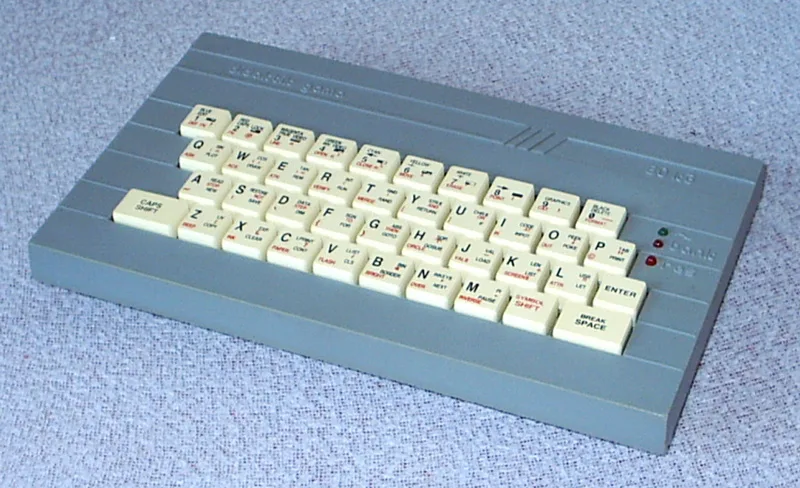
Didaktik Gama '89 home computer in its light grey case

Photo: Karlovarak, Wikimedia Commons (CC BY-SA 4.0)

Released

1987

RAM

80 KB. A fixed 16 KB block (the Spectrum’s slower, contended video RAM) sits at 16384-32767, and two 32 KB banks are switched into 32768-65535 by bit 0 of port C of the 8255, normally with OUT 127,0 or OUT 127,1

CPU

Zilog Z80A-compatible at 3.5 MHz; production machines used the Czechoslovak/East German U880D or UB880D clone

Launch price

6,200 Kčs in 1987

Manufacturer

Didaktik Skalica (a production cooperative in Skalica, Czechoslovakia, and a branch of a Bratislava cooperative until it became independent in 1990)

Form factor

All-in-one keyboard computer in a flat, wedge-shaped case, about A5 in size, with 40 hard plastic keys, a weight of about 750 g and a ‘bank’ indicator LED. The ’87 and ’88 cases are black and the ’89 case is light grey

CPU

Zilog Z80A-compatible at 3.5 MHz; production machines used the Czechoslovak/East German U880D or UB880D clone

Chipset

Genuine Ferranti ULA 6C001E-7, a Z80-family CPU, an Intel 8255 PPI, and an LM1889N used as a TV modulator. The same ULA gives the same timing as a 48K Spectrum until software writes to the 8255

RAM

80 KB. A fixed 16 KB block (the Spectrum’s slower, contended video RAM) sits at 16384-32767, and two 32 KB banks are switched into 32768-65535 by bit 0 of port C of the 8255, normally with OUT 127,0 or OUT 127,1

ROM

16 KB, a modified Sinclair ROM. The ’87 and ’88 ROMs differ in only two bytes, and the ’87 ROM identifies itself as (c) 1987 Didaktik Skalica. The ’89 ROM has a bolder font and a routine that copies memory below RAMTOP when switching banks

Graphics

Spectrum standard: 256×192 pixels, 8 colours with two brightness levels, one colour attribute per 8×8 cell

Audio

One-bit beeper driven by the ULA, as on the 48K Spectrum. The Melodik AY-3-8912 sound interface was a later add-on from the same maker

Storage

Cassette tape. Optional external Didaktik D40 (5.25 inch) and D80 (3.5 inch) disk drives were sold by the maker, though Gama support for them is partly uncertain in the sources

Ports

TV RF output on an IEC 169-2 connector (the ’88 and ’89 add a second connector for composite video), a Spectrum-style edge-connector system bus, an 8255 parallel/IO port, cassette in/out and an external DC power input. There is no dedicated joystick socket: a Kempston joystick adapter plugged into the 8255 port. Printing goes through Centronics via the 8255

OS

Sinclair-derived 16 KB BASIC in ROM (modified), with no separate operating system

PSU

External supply. The board stabilises 12 V for the modulator from an unregulated input that can be 16 to 23 V depending on the adapter. The original adapter’s exact rating is unknown

Units sold

Unknown for the Gama as a whole. Only a few hundred ’87 models were made. The Skalica plant planned 15,000 computers for 1988, but that is a plan, not a count of output, and a figure of 45,000 Gamas circulates as a rumour that its own source doubts

Successors

Didaktik M (1990), then the Didaktik Kompakt with a built-in 3.5-inch drive

  • /ROMCS wired without an isolating resistor
    On the '87 and '88 boards the /ROMCS line reaches the ULA with no 680 ohm isolating resistor, so a peripheral that drives the line can damage the ULA. The '89 board can also be missing the resistor.
    Cygnus: Didaktik Gama 80k, model 87/88 →
  • Overheating 12 V stabiliser and ageing capacitors
    The 12 V Zener stage was built with a 100 ohm resistor where about 1.5 to 1.8 kilohms is appropriate, so the resistor and Zener run hot. A 22 uF electrolytic near it is usually dead after more than 36 years, and the 1000 uF reservoir may be only a 16 V part on an input that can reach 22 to 23 V.
    Cygnus: Didaktik Gama 80k, model 87/88 →
  • Loose I/O connector and keyboard board
    The shortened 8255 I/O connector was soldered and glued, not screwed, so it detaches or tears its pins. The grey '89 keyboard board is held only by melted plastic posts that snap, and a loose board can short against the 12 V area.
    Cygnus: Didaktik Gama 80k, model 87/88 →
  • 1986 Didaktik Skalica launches the Didaktik Alfa, a PMD 85 compatible school computer
  • 1987 The Gama '87 appears shortly before Christmas, a Spectrum clone with 80 KB RAM and an 8255 interface; only a few hundred are made
  • 1988 The '88 model adds a RESET button and a composite video socket, and fixes the memory paging crash by copying memory when banks are switched
  • 1989 The Gama '89 arrives with a fully redesigned board and a light grey case, and ends the Gama line
  • 1990 The Didaktik M replaces it with a cheaper design that drops the banked memory