MACHINE REFERENCE

Elektronika BK-0010

Elektronika BK-0010 ran on a processor copied from a minicomputer, not a microcomputer. Where the West built home computers around 8-bit chips designed for the job, the Soviet Union’s only officially sanctioned home computer used the K1801VM1, a 16-bit clone of the CPU inside DEC’s PDP-11, repurposed for a machine that cost four months of an average wage.

Why it matters

That PDP-11 heritage is the whole story. The K1801VM1 gave the BK-0010 real 16-bit instructions and addressing at a time when Z80 and 6502 machines were the Western norm, and it made the computer genuinely capable once you got past the 16 KiB of RAM left over after the video buffer took its half. It reached serial production in 1985 as the only Soviet home computer design accounted for in state economic planning, which is a very different kind of achievement to topping a sales chart, but a real one: everything else sold as a “home computer” in the USSR at the time was an unofficial clone of somebody else’s design. Three decades later, its straightforward, well-documented hardware gave it an unlikely second life in the post-Soviet demoscene, where programmers could still buy old stock and push it further than its 1983 designers ever planned.

What to check before you buy

  • Confirm the power supply delivers a clean, regulated 5V, since the repair community’s own threads on the BK family link memory instability to drifting voltage regulators
  • Expect the keyboard to feel different to anything Western-built from the same era — the pseudo-membrane design was a contemporary complaint, not just a modern one
  • Check whether it’s a bare BK-0010 or the later 0010.01 revision with the improved keyboard and built-in Vilnius BASIC, since the two are often listed interchangeably
  • Factor in that documentation and spares are overwhelmingly in Russian
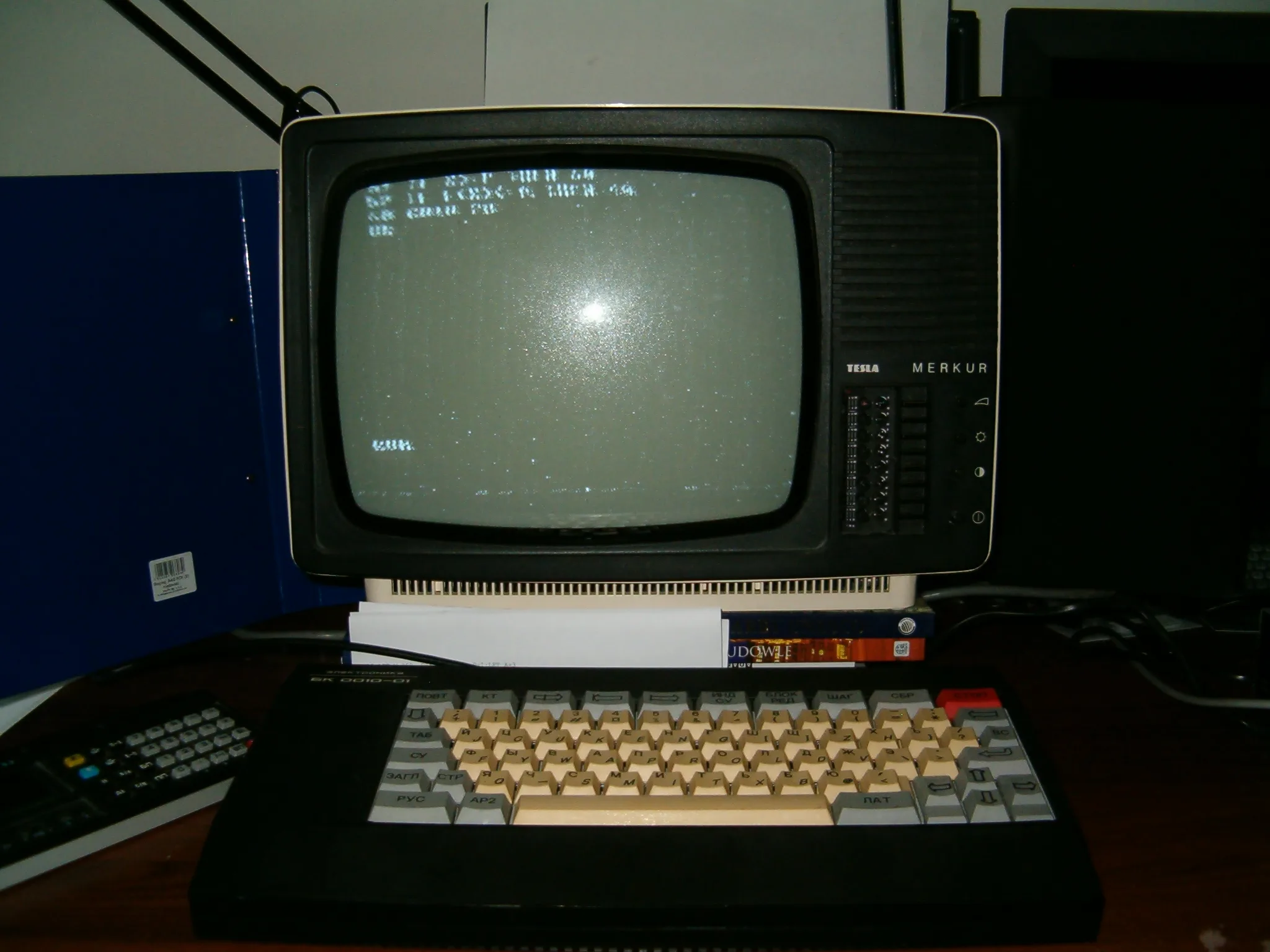
Photo: Jiri Brozovsky, Wikimedia Commons (CC BY 2.0)

Released

1985

RAM

32 KiB total, split down the middle: 16 KiB usable by the programmer and 16 KiB reserved as video memory

CPU

K1801VM1 (a Soviet LSI-11/PDP-11-compatible 16-bit processor), 3 MHz

Launch price

600-650 roubles (against an average Soviet monthly wage of around 150 roubles)

Manufacturer

NPO Elektronika (Soviet state electronics combine)

Form factor

Desktop unit with an integrated keyboard, no monitor or cassette deck included

CPU

K1801VM1 (a Soviet LSI-11/PDP-11-compatible 16-bit processor), 3 MHz

Chipset

K1801VP1-037 video display controller, a 600-gate uncommitted logic array

RAM

32 KiB total, split down the middle: 16 KiB usable by the programmer and 16 KiB reserved as video memory

ROM

24 KiB across three 8 KiB chips (BIOS, FOCAL interpreter, debugger), plus one free ROM socket for an add-on such as Vilnius BASIC

Graphics

High-resolution 512×256 monochrome, or 256×256 in 4 colours; text modes of 32×25 and 64×25 simulated in software via the BIOS

Audio

A simple programmable counter driving an onboard piezo speaker; no dedicated sound chip

Storage

Cassette tape, via a dedicated recorder port

Ports

One Q-Bus-compatible slot (electrically, not mechanically, standard), a 16-bit parallel I/O port, two 5-pin DIN video outputs (monochrome and colour), and the cassette recorder port

OS

BK-11 (a cut-down RT-11 derivative), with FOCAL in ROM as standard and Vilnius BASIC available as an add-on ROM

PSU

External, supplying regulated +5V DC through a 5-pin DIN connector rated at a minimum of 1.5A

Units sold

Unknown; it was, however, the only Soviet-designed home computer that reached official, planned mass production

Successors

BK-0010.01 (revised keyboard and built-in Vilnius BASIC), BK-0010Sh (school variant with a network adapter), BK-0011 (1989, 128 KiB RAM at 4 MHz), BK-0011M (a later compatibility-focused revision)

  • Uncomfortable pseudo-membrane keyboard
    The keyboard uses mechanical microswitches under a flexible membrane overlay rather than real keycaps, which contemporary and retrospective accounts alike describe as giving poor, mushy tactile feedback compared to a conventional keyboard.
  • Power and memory stability issues documented by the repair community
    Russian-language repair forums dedicated to the BK-0010/0011/0011M family document recurring voltage-regulator faults (an onboard regulator drifting well off its 5V specification) and RAM stability problems serious enough that enthusiasts have built dedicated memory-testing routines for the platform.
  • 1983 BK-0010 development completed
  • 1985 Serial production begins — the first Soviet home computer in official, planned mass production
  • 1985-1993 Main production run
  • 1989 BK-0011 follow-up released, with four times the RAM and a faster clock
  • 1990s Adopted by the Eastern Bloc demoscene, thanks to its well-documented, straightforward hardware