MACHINE REFERENCE

PMD 85

The PMD 85 was a Slovak school computer built around a Czechoslovak clone of the Intel 8080, designed by Roman Kišš at Tesla Piešťany and in production from 1985.

Why it matters

It filled Slovak classrooms and Pioneer clubs at a time when a Western computer was out of reach, and it did the job with parts Tesla could actually get: an MHB 8080A clone, domestic TTL logic and plug-in ROM modules in place of a disk drive. The design kept developing for four years, through the PMD 85-2, 2A and 3, and spawned clones such as the Didaktik Alfa and Beta. When Czechoslovakia opened up in 1989, schools could buy an Amiga or an Atari ST instead, and production ended.

What to check before you buy

  • Check the revision first. A PMD 85-1 and a PMD 85-3 differ in keyboard, RAM, ROM size and colour output.
  • Press every key. The first machines used stiff telephone-style switches, and they wear unevenly.
  • Ask whether the ROM modules are included. BASIC-G was the standard one, and without a module the machine does very little.
  • Look for signs of heat damage near the linear power supply.
  • Expect to buy from a Slovak or Czech seller; shipping and customs can cost more than the machine.
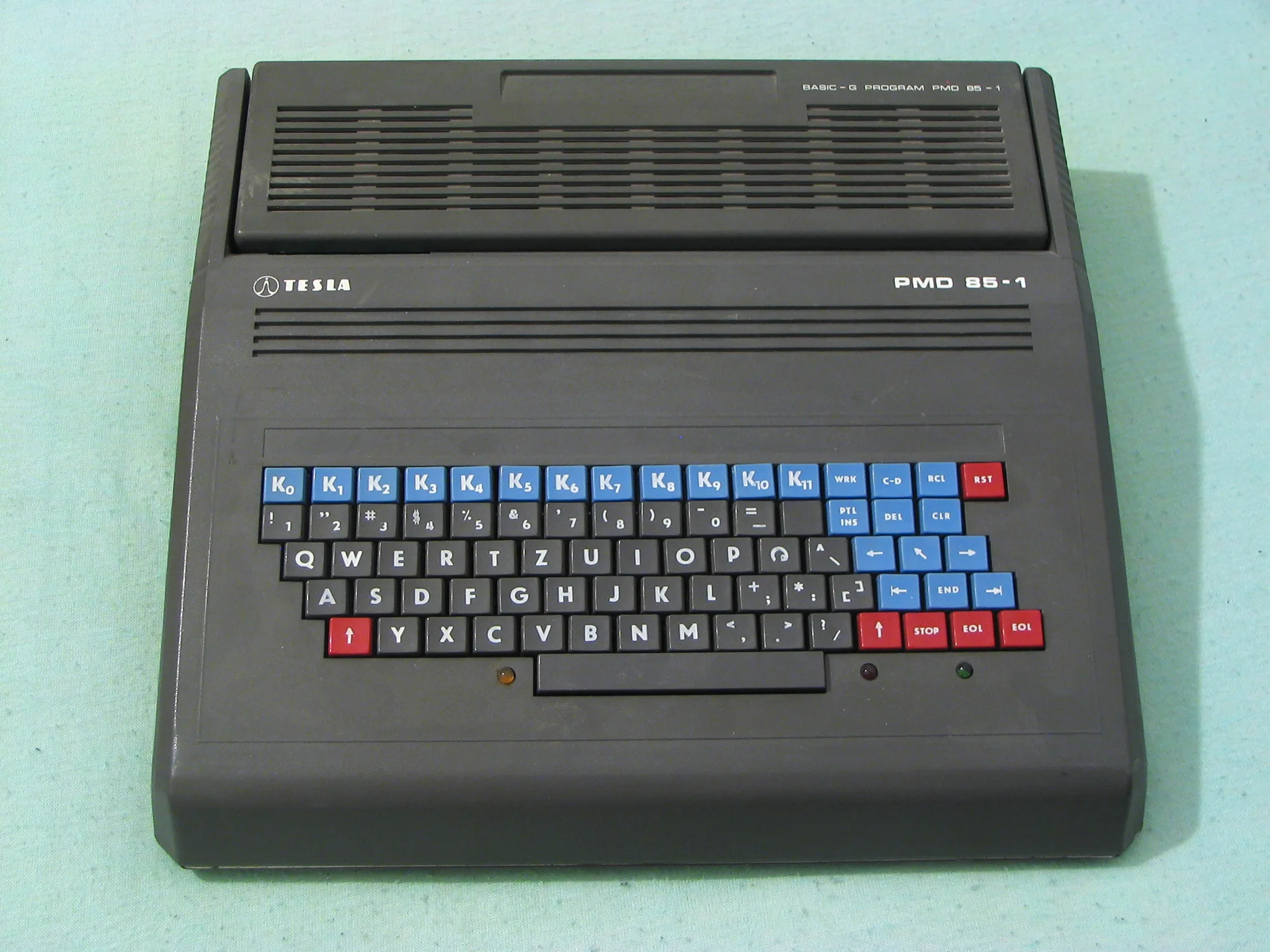
Czechoslovak PMD 85-1 computer

Photo: Zdeněk Starý, Wikimedia Commons (Public domain)

Released

1985

RAM

48 KB (64 KB on the PMD 85-2A and PMD 85-3)

CPU

MHB 8080A (Czechoslovak Intel 8080 clone), 2.048 MHz

Launch price

Unknown

Manufacturer

Tesla Piešťany (later Tesla Bratislava)

Form factor

Keyboard computer in a grey plastic case, with a ROM module slot on top

CPU

MHB 8080A (Czechoslovak Intel 8080 clone), 2.048 MHz

Chipset

Tesla TTL logic with two 8255 peripheral interface chips; no dedicated video or sound chip

RAM

48 KB (64 KB on the PMD 85-2A and PMD 85-3)

ROM

4 KB monitor (8 KB on the PMD 85-3)

Graphics

288 x 256, monochrome with four brightness levels; composite, aerial or RGB output; the PMD 85-3 added colour over PAL

Audio

Unknown

Storage

Cassette tape; BASIC-G and other languages (assembler, Pascal, Logo) on plug-in ROM modules

Ports

Cassette interface, IRPS serial interface (RS-232 variant), IMS-2 interface, two 8-bit parallel ports with handshaking, ROM module slot, application connector

OS

BASIC-G in ROM module

PSU

Internal linear supply (the PMD 85-3 changed to a switching supply)

Units sold

Unknown

Successors

PMD 85-2 (1986), PMD 85-2A (1987), PMD 85-3 (1988); Didaktik Alfa and Beta clones

  • Stiff, power-hungry keyboard
    The PMD 85-1's keys came from telephone switchgear and were described as extremely hard to press. The early keyboard also drew enough current to make the sealed case run warm.
  • Case heat in first-series machines
    A linear supply in a sealed plastic case gave the first machines a reputation for running hot; Slovak pupils nicknamed them 'coffee machines'. Check for heat damage around the supply.
  • PMD 85-2 compatibility changes
    The 1986 PMD 85-2 introduced backward-compatibility problems with PMD 85-1 software, so check which revision a program expects.
  • 1984 The PMD 85-0 prototype is shown by Tesla Piešťany
  • 1985 PMD 85-1 enters serial production
  • 1986 The PMD 85-2 arrives with a better keyboard and software tape handling
  • 1987 The PMD 85-2A follows with 64 KB of RAM; production moves to Tesla Bratislava
  • 1988 The PMD 85-3 adds colour over PAL and a Czech and Slovak character set
  • 1989 Production ends after the Velvet Revolution