Manufacturer
Designed and built by Radofin Electronics, Hong Kong (also the maker of Mattel’s Intellivision consoles), and sold by Mattel Electronics, USA. After Mattel left the computer market in October 1983 the rights went back to Radofin, and other companies including CEZAR Industries, CRIMAC, New Era Incentives and Bentley Industries also marketed the machine and its accessories
Form factor
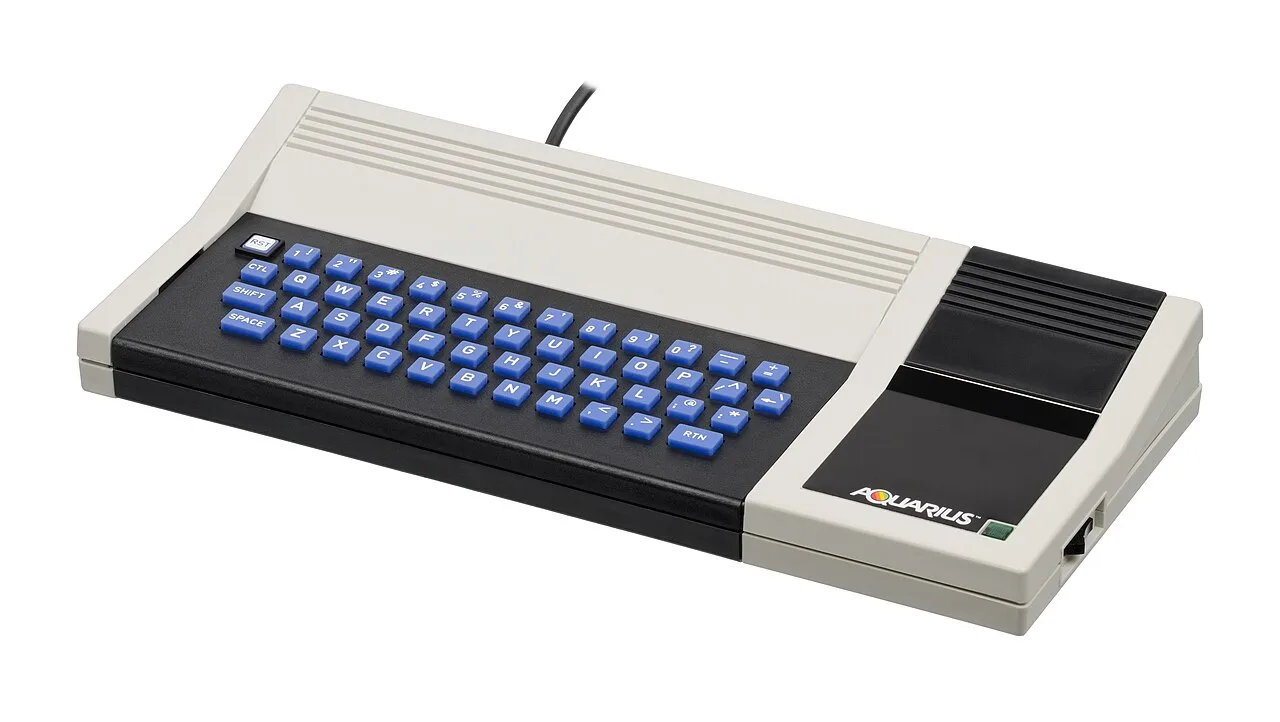
Low wedge-shaped keyboard computer in a long beige plastic case with a black keyboard area and 48 blue rubber chiclet keys (Wikipedia; Gondolin counts 49). Computers Museum gives 340 x 150 x 45 mm and about 1.3 kg, which is the only size and weight figure found. The cartridge slot is on the right of the case and the power switch and indicator are on the machine itself
CPU
Zilog Z80A at 3.5 MHz, made under licence by NEC (The Register). Computers Museum says units were produced with NEC, Hitachi and Zilog CPUs
Chipset
Z80A CPU, two custom ULAs and a character ROM, two 2 KB RAM chips (AtariAge forum), and a TEA1002 colour encoder (Wikipedia). The Mini Expander adds a General Instrument AY-3-8914 sound chip (Wikipedia’s footnote and Computing History; Wikipedia’s text says AY-3-8910, so sources disagree). A PLA between the Z80 and the data bus XORs data with a lock code on the cartridge side, an early form of copy protection (Hackaday)
RAM
4 KB, shared between video and the user. Reviewers found about 1.7 KB (1,731 bytes in one review) free for programs. Upgrades: a 4 KB pack and a 16 KB cartridge via the Mini Expander, giving 18,115 bytes free in one review. The maximum is given as 20 KB (oldcomputers.net), 36 KB (Wikipedia) and 52 KB (a Mattel claim quoted by Your Computer). Wikipedia notes a 32 KB cartridge gives about 34 KB total
ROM
8 KB system ROM holding a subset of Microsoft BASIC, plus a separate character ROM (Computers Museum counts 10 KB in total). The system ROM is pin-compatible with common 2716, 2732 and 2564 EPROMs, according to an AtariAge forum answer
Graphics
One text mode of 40 x 24 characters with an 8 x 8 character cell (equivalent to 320 x 192 pixels), 16 colours. No bitmap or all-points-addressable mode: BASIC offers PSET, PRESET and POINT on an 80 x 72 semigraphics grid, and colour needs POKEs. A character set of 256 predefined characters with no redefinable graphics (Computing History). Outputs through an RF modulator to a TV, with no composite or monitor output
Audio
One channel under CPU control (Computers Museum calls it a beeper). The Mini Expander adds more voices: Wikipedia says up to four voices in total, The Register says three additional channels, and Computers Museum says two
Storage
Cassette via the Aquarius Data Recorder, and ROM cartridges. Computing History also lists a Quick Disk drive, a 300 baud cartridge modem, a 40-column thermal printer and a four-colour plotter. The Register says floppy drives and a modem were announced for 1984 but never appeared, so sources disagree about what shipped
Ports
RF (TV) output; cassette port on a 5-pin DIN; printer port on a 3.5 mm stereo jack (unidirectional serial, fixed at 1200 baud 8N2); cartridge and expansion slot on the right of the case with unbuffered access to the address and data bus. The Mini Expander adds two hand controllers and a second cartridge slot. Wikipedia says the cassette pinout is incompatible with TRS-80 cables, but the 1983 Your Computer review says a Tandy TRS-80 lead worked
OS
A subset of Microsoft BASIC in ROM, called Microsoft Color BASIC by The Register and Aquarius BASIC 1.0 by oldcomputers.net. Keywords are entered with single key presses, and a clip-on overlay helped. Only a single-character delete: existing lines could not be edited in place (The Register)
PSU
Power supply is built into the case and not removable (Wikipedia, The Register). Rails are +8.8 V at 1.2 A, 16 V at 0.15 A and -19 V at 0.01 A (Computers Museum), so the machine cannot be run from a generic single-voltage adapter
Units sold
Unconfirmed. Computers Museum says around 20,000, including 8,000 in the US. oldcomputers.net gives about 8,000, marked as uncertain, for the US and Australia. The Register gives no sales total but says Mattel UK had hoped to sell 100,000 through WHSmith and Boots. The two figures are not independent confirmation of each other, so treat any total as a rough guess
Successors
The Aquarius II, designed by Radofin as the “Chess” project and sold by Radofin in 1984, with a typewriter-style keyboard, more RAM and Extended BASIC. It reached the market only in small numbers. A planned Aquarius III never reached volume production (The Register). Wikipedia’s infobox also lists a modern Aquarius+ as a successor