MACHINE REFERENCE

Philips Videopac+ G7400

The Philips Videopac+ G7400 was the 1983 upgrade to the Videopac G7000, adding a Thomson graphics pair for high-resolution backgrounds while still playing every older cartridge.

Why it matters

Philips kept the G7000’s Intel 8048 and bolted on a Thomson EF9340 and EF9341 pair to draw a high-resolution background behind the old sprites. That is a sensible way to extend a console: every G7000 cartridge still ran, and a few Plus games gained proper scenery, with three titles built only for the G7400. The business side was messier. The Odyssey 3 was announced in 1982, shown at Winter CES 1983 at a planned US$199, delayed that June and never sold in America. Europe got a limited release into a market that was moving to the ColecoVision and to home computers such as the Spectrum and the Commodore 64, and next to those the upgrade looks modest. The software library behind it was small. Today it is a collector’s machine that is awkward to connect, because many units have no SCART port, and its appeal rests on the Plus cartridges and on being the Odyssey that never got out of Europe.

What to check before you buy

  • Check which model you are buying. A SCART model (sometimes called the G7401) has three round DIN-type sockets on the back and gives RGB with the right cable. A non-SCART model needs a composite or RGB modification.
  • Test the power switch and ask whether it has been replaced or bypassed. It is the commonest reported failure, and a failed switch is described as a burn risk.
  • Confirm the mains voltage. The machine was built for 220 V, and the Jopac manual says some versions take 110 to 240 V. Do not plug a European unit into a US socket without a proper converter.
  • Make sure you can display it. The output is PAL, so an NTSC-only screen gives little or no colour, and the 8-pin DIN cable is hard to find. Ask whether a cable is included.
  • Ask what comes with it. Test both joysticks and look for the Plus cartridges, because the high-resolution backgrounds are the reason to own one. The C7420 BASIC module sold poorly and is a bonus.
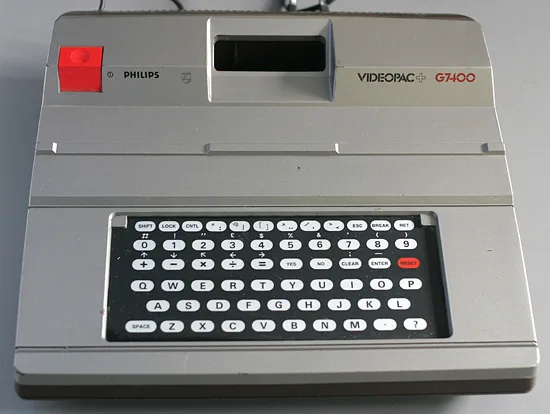
Philips Videopac+ G7400 console with its membrane keyboard and red power button

Photo: Marco van den Hout, Wikimedia Commons (CC BY-SA 3.0)

Released

1983

RAM

6 KB (Wikipedia infobox; its specifications section says 6 KB plus 192 bytes). The optional C7420 module adds 16 KB RAM

CPU

Intel 8048 at 5.91 MHz (Wikipedia, Home Computer Museum). Optional C7420 BASIC module adds a Z80

Launch price

No European launch price was found in the sources read. The planned North American Odyssey 3 was to cost US$199 (Wikipedia), but it never went on sale

Manufacturer

Philips (N.V. Philips Gloeilampenfabrieken), Netherlands. Sold in North America only as a planned Magnavox/N.A.P. Odyssey 3 (Odyssey Command Center), which never shipped. France also got a licensed clone from Thomson-Brandt, the Jopac / J0 7400

Form factor

Flat grey console-computer with a membrane keyboard (the Odyssey 3 prototype was planned with a mechanical keyboard), a cartridge slot on top and a red power button at the top left. Exact dimensions and weight were not found in the sources read

CPU

Intel 8048 at 5.91 MHz (Wikipedia, Home Computer Museum). Optional C7420 BASIC module adds a Z80

Chipset

Intel 8245 video chip for G7000-compatible graphics, plus a Thomson EF9340 (VIN) and EF9341 (GEN) pair that draw the high-resolution background (Wikipedia). Sources read do not explain what each Thomson chip does individually

RAM

6 KB (Wikipedia infobox; its specifications section says 6 KB plus 192 bytes). The optional C7420 module adds 16 KB RAM

ROM

1 KB (Wikipedia infobox). The C7420 module adds 16 KB ROM carrying Microsoft BASIC

Graphics

320 x 238 resolution, 16 colours (Wikipedia). G7000-compatible mode is 128 x 64 with 16 colours. Backgrounds are drawn separately from the game objects and are mostly static, per a poster on videopac.nl; a few games such as Helicopter Rescue scroll the background. Outputs RF, and on SCART models RGB and composite through an 8-pin DIN or Peritel socket

Audio

One channel, eight sounds (Wikipedia)

Storage

ROM cartridges. The C7420 Home Computer Module adds Microsoft BASIC and saves to an optional external cassette recorder. Planned modem, speech synthesiser and laserdisc interface add-ons never reached production (Home Computer Museum)

Ports

Cartridge slot; two joystick sockets (DIN, three round DIN-type sockets on the back of the SCART model, two of them for joysticks); RF output; 8-pin DIN with RGB, composite, status and sound on the SCART model (odyssey2.info pinout: pin 1 RGB status, 2 ground, 3 blue, 4 composite, 5 red, 6 VCR status, 7 sound, 8 green); expansion connection for the C7420 module. Models made outside France lack the SCART port

OS

None built in for games; cartridge programs run directly. The C7420 module provides Microsoft BASIC

PSU

Internal supply. Designed for 220 V in Europe, though the Jopac manual says some versions run from 110 to 240 V. The supply is not isolated from the mains, so odyssey2.info warns to unplug and wait before opening the case. A regulated 12 V and 5 V replacement supply can be fitted

Units sold

Not documented in any source read. Wikipedia says only that it was released in limited quantities. Wikipedia credits the Odyssey 2 family with about 2 million units, citing Winnie Forster (2005), which covers the whole range and not the G7400

Successors

None in the same line. Philips ended the Odyssey brand in March 1984 (Wikipedia). Wikipedia lists the Philips CD-i and Philips MSX computers as successors, although neither is a development of the G7400

  • Failed power switch
    The odyssey2.info G7400 guide calls the power switch notoriously prone to failure, and notes that the original Toshiba part is hard to replace. A poster on videopac.nl estimated that 95 percent of surviving machines have a broken switch, and another warned that a failed switch can cause electrical burns, so it should be bypassed or removed. Treat these as forum estimates, not a measured failure rate.
    G7400 guide (odyssey2.info) →
  • Non-isolated power supply and mains problems
    The internal supply is not isolated from the mains, and odyssey2.info warns owners to unplug the console and wait for the capacitors to discharge before working inside. The same guide records one owner whose G7400 blew a fuse and would not power up after using a particular voltage converter, and describes replacing the supply with a regulated 12 V and 5 V unit.
    Plugging in a G7400 (odyssey2.info) →
  • No usable video output on non-SCART models
    Models made outside France have no SCART port, so owners fit a composite or RGB modification to get a clean picture. The machine outputs PAL, so an NTSC-only display shows little or no colour. The 8-pin DIN cable is scarce, and a 6-pin DIN lead will not carry RGB. Soldering is awkward because the double-sided board has plated-through holes.
    RGB modification for the G7400 (odyssey2.info) →
  • 1982 April: the Odyssey 3 is announced at a press conference, planned for mid-1983
  • 1983 At Winter CES the machine is shown as the Odyssey Command Center, with a July 1983 release planned at a suggested US$199
  • 1983 At Summer CES in June, the North American release is delayed to early 1984. N.A.P. spokesman Jerry Michaelson says the company is leapfrogging to the next generation, and the Odyssey 3 is never released
  • 1983 The Philips Videopac+ G7400 appears in Europe in limited quantities, in France as the Thomson-Brandt Jopac, alongside the C7420 BASIC module
  • 1984 In March Philips discontinues the Odyssey brand, ending the line the G7400 belonged to