MACHINE REFERENCE

Radio-86RK

The Radio-86RK was a Soviet build-it-yourself computer published in Radio magazine in 1986: an 8080-compatible machine with 64 x 25 text output, made from 29 chips and a soldering iron.

Why it matters

A reader with a parts list and a soldering iron could build a working 8080 computer from 29 chips, where its predecessor, the Micro-80, had needed about 200. The video and DMA chips let the CPU run with no dedicated video logic, at the cost of irregular CPU stalls and hissy one-bit sound while the screen is on. The weak point was supply. The KR580VG75 video controller was hard to find outside big cities, readers wrote to the editors about parts, and Alexander Dolgiy published a 19-chip replacement in 1987. The editors then appealed to industry. About ten factories were making ready-built machines by the late 1980s, selling clones at 500 to 650 roubles against roughly 260 roubles in parts.

What to check before you buy

  • Treat it as a one-off. Most surviving units are home-built, so judge the workmanship: neat point-to-point or board soldering, no cold joints, and no stray wire repairs around the edge connector.
  • Ask what memory it has. 16 KB is standard, and 32 KB is made by mounting a second set of chips on the board, which breaks compatibility with some software if done badly.
  • Check the power supply separately from the board. Builders made their own, and a failed supply transistor on a Mikrosha clone destroyed the CPU and several other chips.
  • Test tape loading with a known good recording. The interface needs careful volume setting, and clones such as Mikrosha use different tape speeds from the original.
  • Ask which video controller it has. The KR580VG75 is scarce, and some builds use a rebuilt TTL video section with different behaviour. Also check the keyboard, which builders made themselves.
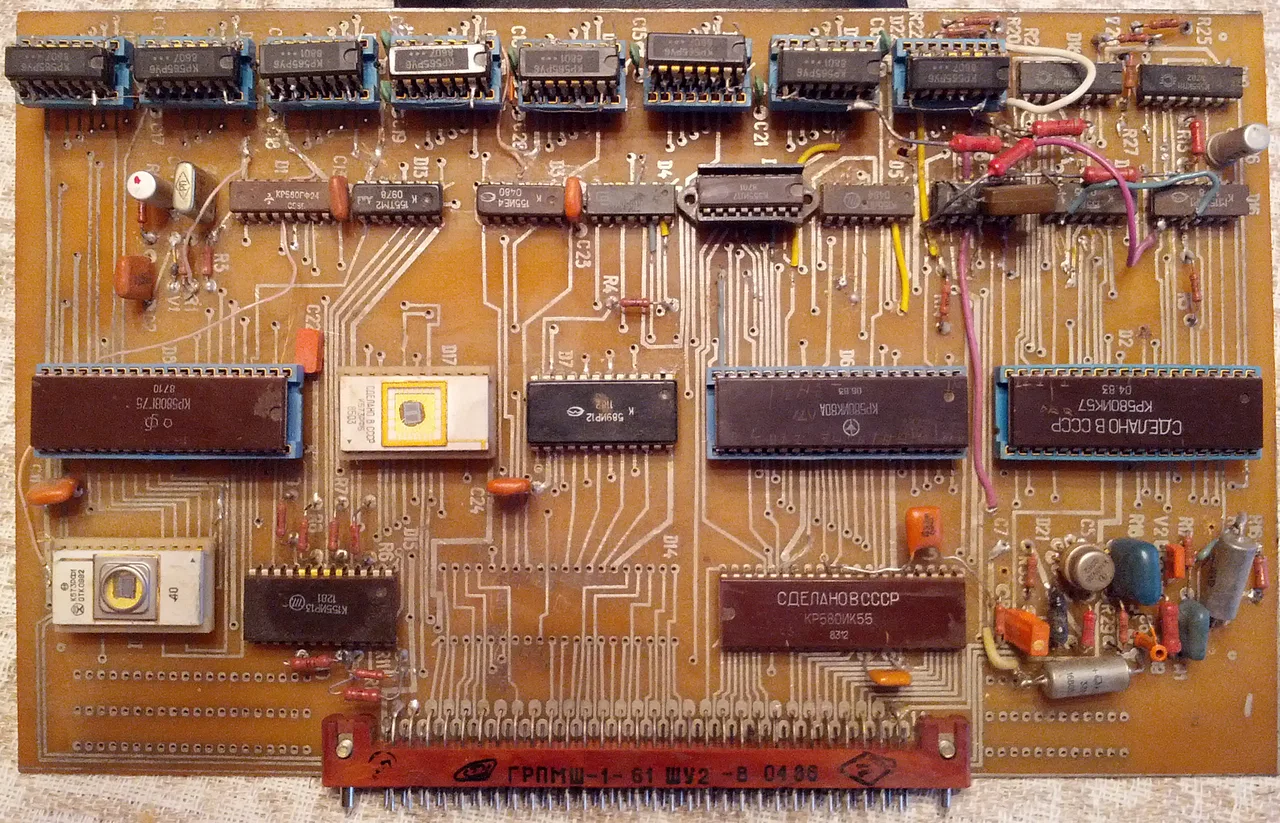
Hand-assembled Radio-86RK main board with Soviet KR580 chips, the large edge connector at the bottom and a second row of RAM chips stacked above the first

Photo: Audriusa, Wikimedia Commons (CC0)

Released

1986

RAM

16 KB of K565RU3 dynamic RAM (4116-type), expandable to 32 KB by mounting a second set of chips. Expansion beyond that needed serious modifications and broke compatibility (English Wikipedia)

CPU

KR580VM80A (Soviet clone of the Intel 8080A), driven at about 1.78 MHz (English Wikipedia 1.777 MHz; Russian Wikipedia 1.77 to 2.00 MHz depending on crystal). Effective speed was about 1.3 MHz in the 25-line video mode and about 750 kHz in the 50-line mode, because the DMA controller halts the CPU while it reads video data (Russian Wikipedia)

Launch price

Not sold as a product. About 260 roubles for the components (English Wikipedia). Russian Wikipedia gives no component price but says the Elektronika KR-04 kit cost 395 roubles against 500 to 650 roubles for ready-built clones. English Wikipedia lists Mikrosha at 500, Krista at 510, and Apogey BK-01 and Partner 01.01 at 650 roubles

Manufacturer

No single manufacturer. A build-it-yourself design by D. Gorshkov, G. Zelenko, Yu. Ozerov and S. Popov, published in the Soviet magazine Radio. Ready-built clones followed from about ten industrial enterprises by the late 1980s, among them Mikrosha, Krista, Apogey BK-01 and Partner 01.01

Form factor

Home-built board computer with a separate 66-key keyboard, no standard case. Builders made their own cases, power supplies and keyboards, and by the end of the 1980s cases, keyboards and motherboards were being produced for sale (Computing History). The main board connects to everything through one large edge connector

CPU

KR580VM80A (Soviet clone of the Intel 8080A), driven at about 1.78 MHz (English Wikipedia 1.777 MHz; Russian Wikipedia 1.77 to 2.00 MHz depending on crystal). Effective speed was about 1.3 MHz in the 25-line video mode and about 750 kHz in the 50-line mode, because the DMA controller halts the CPU while it reads video data (Russian Wikipedia)

Chipset

29 chips in all, against about 200 for the Micro-80 (English Wikipedia, Computing History). KR580VG75 video controller, KR580VT57 DMA controller (also refreshes the memory), KR580VV55 parallel interface for the keyboard and a user port, and KR580GF24 clock generator

RAM

16 KB of K565RU3 dynamic RAM (4116-type), expandable to 32 KB by mounting a second set of chips. Expansion beyond that needed serious modifications and broke compatibility (English Wikipedia)

ROM

2 KB monitor in an erasable ROM (K573RF5 or RF2, 2716-type), with room for a second chip to make 4 KB. Computing History lists 4 KB. A second ROM holds the character set

Graphics

Monochrome text, 64 characters per line and 25 lines as standard (Computing History says 25 x 80, a disagreement). No graphics mode: 16 pseudo-graphic characters give four dots per character cell, for 128 x 50 (English Wikipedia) or 128 x 60 at 30 lines (Russian Wikipedia). Unofficial higher modes existed but were not standardised. Composite video input, which many Soviet TVs lacked, so an adapter module or TV modification was often needed

Audio

One-bit sound from the CPU INTE pin, switched with the EI and DI instructions. Russian Wikipedia says it is hissy while video is running and cleaner with video off

Storage

Cassette tape at about 150 bytes per second, with the screen blanked during transfers (Russian Wikipedia). Each bit is written as a pair of states and the sync byte is E6. A floppy controller with DOS was announced in October 1992 (English Wikipedia)

Ports

One large main connector carrying power, keyboard, tape recorder and video output. A user port off the KR580VV55 and a footprint for a second interface chip beside the connector

OS

2 KB monitor in ROM for viewing and editing memory, tape load and save, and running programs. Programs came as hexadecimal dumps printed in the magazine, with checksums. Two BASIC interpreters followed (an adapted Micro-80 BASIC and Micron BASIC), with an assembler, debugger and editor. RAMDOS (1989) and a floppy DOS (1992) came later

PSU

Not supplied. Builders made their own. A restored Mikrosha clone on oldcomputer.info mentions a -5 V rail, and a failed supply transistor in that machine put -11.5 V where -5 V belonged

Units sold

No reliable figure found. Never sold as a product, and neither Wikipedia article nor Computing History gives a production total. Russian Wikipedia says about ten industrial enterprises were making ready-built computers by the late 1980s

Successors

The Micro-16 (16-bit, with CGA-compatible graphics) was published in Radio, but the editors went back to an 8-bit KR580VM80 design for the Orion-128, which began in Radio in January 1990 (English Wikipedia). The RK-86 family of factory clones includes Mikrosha, Krista, Apogey BK-01, Partner 01.01 and Spektr-001

  • Scarce video controller chip
    The KR580VG75 video controller was hard to find outside big cities, which kept many builders from finishing. English Wikipedia says a 19-chip replacement video board was designed as a result, and the Mikrosha restorer on oldcomputer.info notes hobbyists rebuilt the video section from TTL logic and 2114 RAM. A commenter on Habr says the chip had to be obtained through acquaintances or from speculators at high prices.
    Radio-86RK (English Wikipedia) →
  • Failed supply transistor destroys the board
    A restorer of a factory-built Mikrosha clone found its power supply transistor had failed and put -11.5 V on the -5 V rail. That destroyed the CPU and damaged several RAM chips, an 8255 interface chip, a memory-line multiplexer and the tape-input op-amp. The write-up covers a clone, not a hand-built board, but any build needs its supply rails checked before first power-on.
    Mikrosha restoration (oldcomputer.info) →
  • Tape loading and DMA timing quirks
    Russian Wikipedia documents that the screen blanks during tape input and output, the DMA controller stalls the CPU at irregular intervals so code timing cannot be predicted, and sound is hissy while video is active. The Mikrosha write-up adds that tape loading needs the volume set carefully, and that clones use different tape speeds, so recordings made on one often need adjusting for another. Documented behaviour of the design, not a defect in one unit.
    Radio-86RK (Russian Wikipedia, in Russian) →
  • 1983 Radio magazine publishes the circuit and build notes for the Micro-80, the 8080-based predecessor that needed about 200 chips and was hard to build because many components could not be obtained
  • 1986 The Radio-86RK series begins in Radio, by Gorshkov, Zelenko, Ozerov and Popov. It used 29 chips, and sources disagree on which issues carried it (4 to 6, 4 to 7 or 4 to 9)
  • 1986 The Mikrosha, the first industrial clone, goes into production at LEMZ in late 1986, with English Wikipedia listing it at 500 roubles
  • 1988 Apogey BK-01 and Partner 01.01 start production at 650 roubles each, and commercial software becomes legal to sell after a cooperation law takes effect
  • 1992 A floppy disk controller for the Radio-86RK and Mikrosha is announced in October, with DOS stored in ROM on the board