MACHINE REFERENCE

Sega Saturn

The Sega Saturn launched in Japan on 22 November 1994 with two Hitachi SH-2 processors, two video chips and a double-speed CD-ROM drive.

Why it matters

The Saturn sold 9.26 million units, 5.75 million of them in Japan, and only 1.8 million in North America. It had two main processors and two video chips, which made the design complex. Sega replaced it with the Dreamcast in 1998.

What to check before you buy

  • Check the CD drive reads discs and that the laser is not weak.
  • Ask whether the CR2032 battery has been replaced; a dead one loses saves and the clock.
  • Look at the region; Japanese, US and PAL consoles use different discs without a mod.
  • Test both controller ports and the cartridge slot.
  • Check the case and the power supply for the original parts.
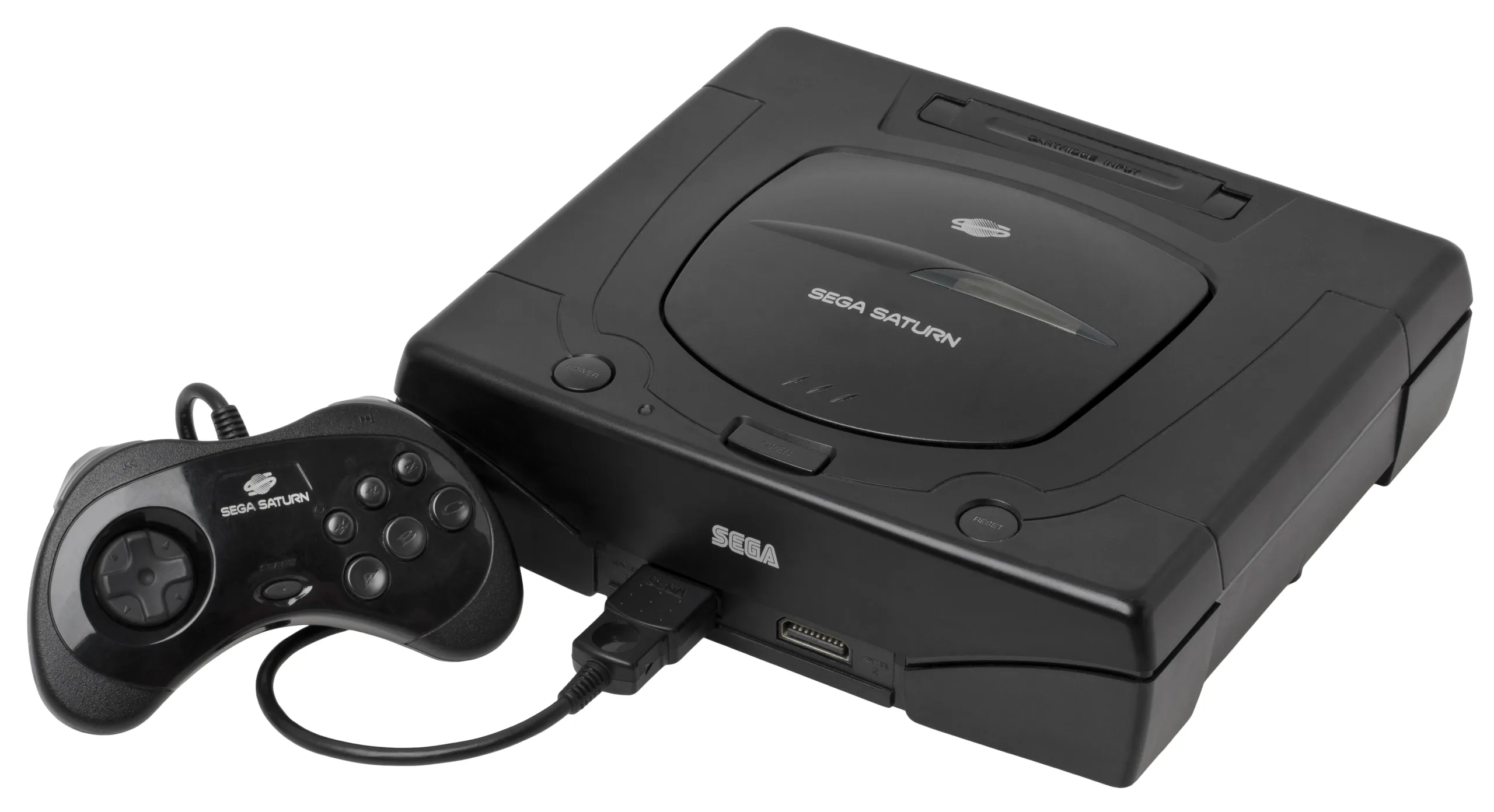
Sega Saturn console with controller

Photo: Evan-Amos, Wikimedia Commons (CC BY-SA 3.0)

Released

1994

RAM

2 MB work RAM, 1.5 MB video RAM, 512 KB sound RAM, 4 Mbit CD buffer, 32 KB battery-backed RAM

CPU

Two Hitachi SH-2 processors at 28.6 MHz each; Motorola 68EC000 at 11.3 MHz for sound

Launch price

¥44,800 (Japan); $399.99 (US); £399.99 (UK)

Manufacturer

Sega

Form factor

Home console, CD-ROM based

CPU

Two Hitachi SH-2 processors at 28.6 MHz each; Motorola 68EC000 at 11.3 MHz for sound

Chipset

VDP1 (sprites and polygons) and VDP2 (backgrounds), both at 28.64 MHz

RAM

2 MB work RAM, 1.5 MB video RAM, 512 KB sound RAM, 4 Mbit CD buffer, 32 KB battery-backed RAM

ROM

Unknown

Graphics

VDP1 and VDP2 handle sprites, polygons and scrolling backgrounds

Audio

Yamaha YMF292 with an FH1 DSP; 32 channels of FM synthesis and 16-bit 44.1 kHz PCM

Storage

Double-speed CD-ROM; also plays Video CD with an adapter, Photo CD and CD+G; cartridge slot for memory and RAM

Ports

Two controller ports, cartridge slot, AV output

OS

Sega system software

PSU

Internal power supply

Units sold

9.26 million worldwide (5.75 million in Japan)

Successors

Sega Dreamcast (1998)

  • Dead backup battery
    The CR2032 battery keeps the clock and saved data, and dead cells are common. The battery can be replaced while the console is powered to keep the saves.
  • Weak CD laser
    The CD-ROM drive is the main point of failure on a Saturn; the laser assembly weakens with age and the drive may need cleaning, adjusting or replacing.
  • Seized motors and cracked flex cable
    Failing spindle and sled motors and a cracked drive flex cable cause intermittent loading and should be checked on any Saturn that will not read discs.
  • 1994 Launches in Japan on 22 November
  • 1995 Launches in North America on 11 May and in Europe on 8 July
  • 1998 Production ends in North America in March and in Europe
  • 2000 Production ends in Japan