MACHINE REFERENCE

Spectravideo SV-318

The Spectravideo SV-318 was a Z80A home computer shown at the Winter CES in Las Vegas in January 1983, built around a Microsoft BASIC in ROM and a red plastic joystick that clips into its keyboard.

Why it matters

The SV-318 packed a Z80A, a TMS9918 video chip with 32 sprites and an AY-3-8910 three-channel sound chip into a $299 machine, and it had a joystick built into the keyboard. That was a competent parts list for 1983. Samdal’s history says Microsoft delivered the BASIC late, so Spectravideo missed the holiday sales period. The company floated at $6.25 a share in May 1983 and was down to 75 cents by December. Its biggest effect was indirect: ASCII’s Kazuhiko Nishi built the MSX standard on the SV-328 design, which shares the SV-318’s hardware. Spectravideo’s own first MSX machine, the SVI-728, followed in May 1984. The SV-318 itself is not MSX-compatible, because its BIOS, I/O ports and disk format differ. Over 130 games were released for it, according to Wikipedia.

What to check before you buy

  • Ask what power supply comes with it. The original gives 9 V AC and 16 V AC on a 4-pin connector, and replacements are hard to find, so a machine with its own adapter is worth more.
  • Check the memory. Failing 4116 RAM chips are a documented fault, and a no-picture machine may only need them replacing. Ask whether any have been swapped for 4164s and who did the work.
  • Press every key. The rubber Chiclet keyboard can be mushy, and cleaning it helps a bit, so some resistance is normal. Dead keys are not.
  • Look at the red joystick stick on the right-hand cursor pad. One restorer called theirs unreliable, so confirm it is present and that the pad itself works in all directions.
  • Confirm the model. The SV-328 looks similar but has a full-travel keyboard and more RAM, and the SVI-728 is an MSX machine, so check the label before paying.
  • Check for the cassette lead and any expansion gear. The SV-603 adapter ($70 when announced) played ColecoVision cartridges, so ask whether one is included.
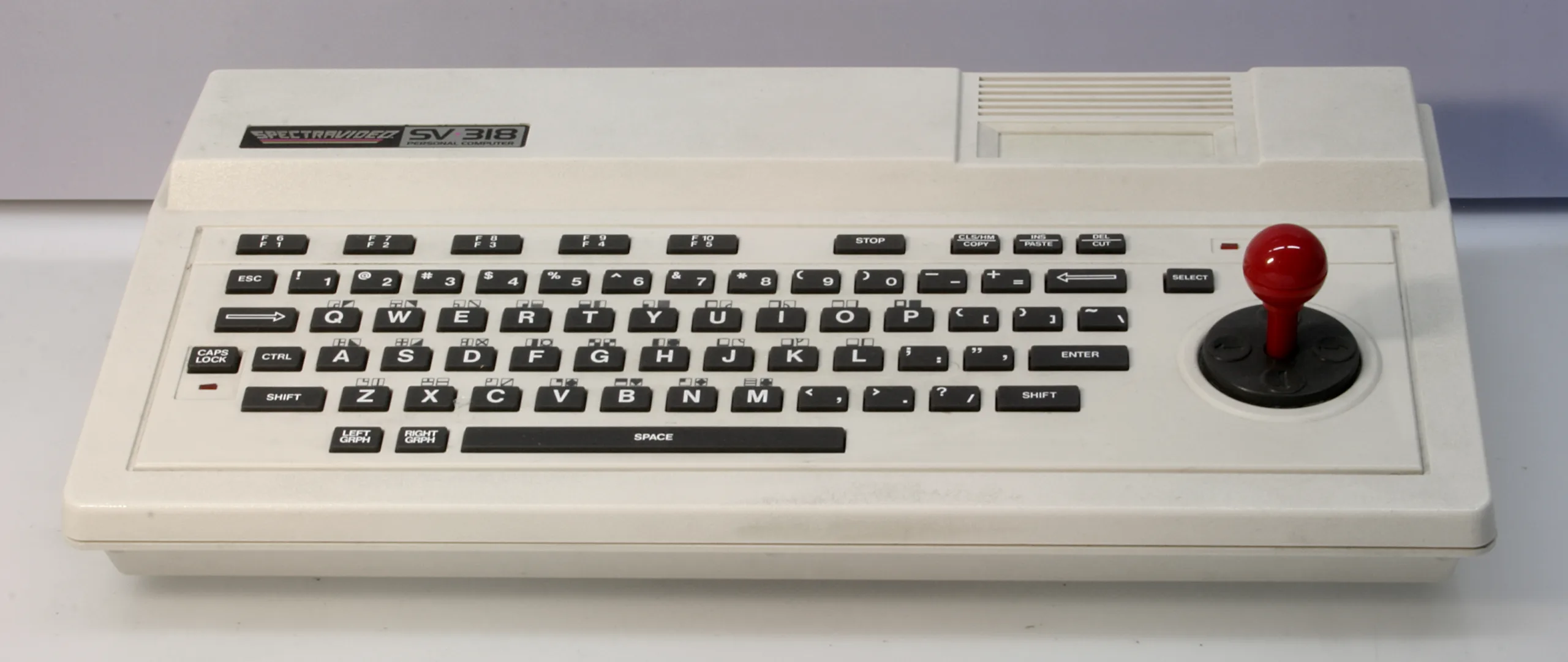
Spectravideo SVI-318 home computer with its Chiclet keyboard and red joystick

Photo: Igor Clukas, Wikimedia Commons (CC BY-SA 3.0)

Released

1983

RAM

16 KB user RAM, plus a separate 16 KB of video RAM (some sources count this as 32 KB total). About 12 KB is free to BASIC. Expandable with external 16 KB or 64 KB packs to a maximum of 256 KB

CPU

Zilog Z80A at about 3.58 MHz (most sources round it to 3.6 MHz)

Launch price

$299 suggested retail for the SV-318 (Creative Computing, September 1983; Samdal agrees). In Sweden it cost SEK 3,490 in December 1983 (Rigpix). No UK launch price was found

Manufacturer

Spectravideo International Ltd, USA (design, management and marketing). Manufactured in Hong Kong by Bondwell, with systems software work by ASCII Corporation of Japan and Microsoft Extended BASIC in ROM

Form factor

Low wedge-shaped all-in-one keyboard computer, 405 x 77 x 215 mm and about 4 kg. Rubber Chiclet-style keyboard (71 keys by Creative Computing, 70 by other sources) with a disc-shaped cursor pad on the right that takes a removable red plastic joystick stick

CPU

Zilog Z80A at about 3.58 MHz (most sources round it to 3.6 MHz)

Chipset

Texas Instruments TMS9918 video display processor, General Instrument AY-3-8910 sound generator, Z80A CPU. No custom chip is named in the sources found

RAM

16 KB user RAM, plus a separate 16 KB of video RAM (some sources count this as 32 KB total). About 12 KB is free to BASIC. Expandable with external 16 KB or 64 KB packs to a maximum of 256 KB

ROM

32 KB: a 16 KB BIOS and 16 KB of Microsoft Extended BASIC

Graphics

TMS9918: 256 x 192 pixels with 15 or 16 colours depending on the source, 32 hardware sprites, 40 x 24 text, plus a low-resolution 64 x 48 mode. Output is composite video or RF to a TV

Audio

AY-3-8910, 3 channels over 8 octaves, mono

Storage

External cassette recorder at 1200 baud. Optional 5.25-inch floppy drives (with optional Disk BASIC and CP/M) and ROM cartridges

Ports

Cartridge slot, two Atari-style DE-9 joystick ports, cassette port, video output, expansion bus (for RAM packs, disk drives and the SV-603 ColecoVision adapter) and a 4-pin power input

OS

SV Extended BASIC v1.1 by Microsoft in ROM. This is not MSX BASIC, and the SV-318 is not fully MSX-compatible. CP/M was available as an option with a floppy drive

PSU

External supply with an unusual dual alternating-current output (9 V AC and 16 V AC) on a 4-pin connector, rated at up to 17 W without options. Replacements are hard to find, and restorers often substitute modern supplies

Units sold

No reliable SV-318 figure found. One history page says Spectravideo had sold over 25,000 computers worldwide by late 1984, but that covers every model and rests on a single source

Successors

The SV-328 (1983, the same machine with more RAM and a full-travel keyboard), then the SVI-728 (May 1984, the first MSX-compatible Spectravideo), the SVI-738 (1985) and the SVI-838 (1986)

  • Failing 4116 RAM chips
    A restorer found a no-display SVI-318 and traced it to faulty Motorola 4116 RAM chips. After he swapped them for 4164s, the Spectravideo logo and start-up beep came back. Another restorer replaced all sixteen 4116s with 4164s. The 4116 needs three supply voltages (-5 V, +5 V and +12 V), which makes the machine awkward to repair.
    Spectravideo SVI-318, saved from the dump (AmiBay) →
  • Hard-to-replace dual AC power supply
    The original supply gives 16 V AC and 9 V AC on a 4-pin connector. Original units are described as nearly impossible to find, and owners have wired in modern supplies. One restorer fitted a 12 V switch-mode supply after changing the RAM to 4164s, and another used an ATX supply on the mainboard.
    The Spectravideo SV-318 (Kernelcrash) →
  • Mushy rubber keyboard and unreliable joystick stick
    The same restorer calls the Chiclet keyboard a sort of mushy rubbery thing that needed finger rolling to register letters, and said the red joystick knob on the right was unreliable. Stripping and cleaning the keyboard helped a bit.
    The Spectravideo SV-318 (Kernelcrash) →
  • 1981 Harry Fox founds SpectraVision, later Spectravideo, initially as a distributor that contracts outside developers to make cartridges for the Atari 2600, ColecoVision and VIC-20
  • 1983 In January the SV-318 and the SV-328 appear at the Winter CES in Las Vegas, with the SV-318 at $299; Microsoft supplies SV Extended BASIC
  • 1983 In May Spectravideo floats on the stock market at $6.25 a share, and by December the shares have fallen to 75 cents
  • 1984 In May the SVI-728 follows as the first MSX-compatible Spectravideo, after ASCII's Kazuhiko Nishi champions a standard based on the SV-328 design
  • 1984 In September Hong Kong maker Bondwell Holding buys over half the company's stock, and the Spectravideo brand name is sold on in 1988