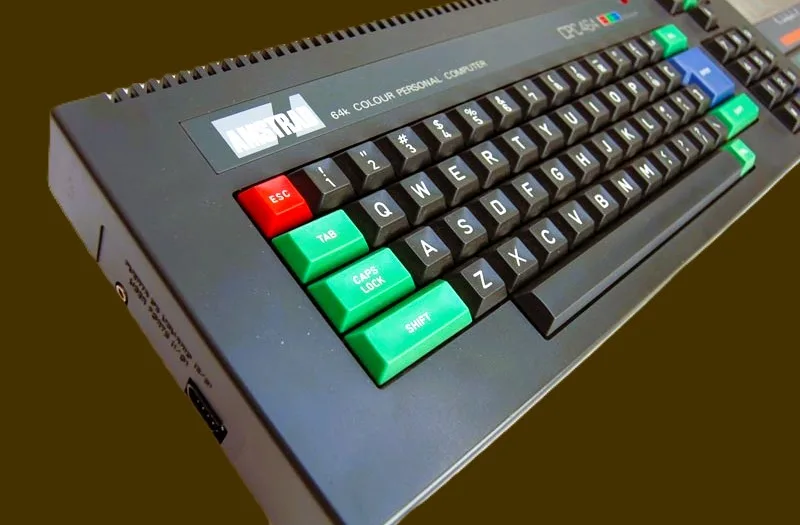
Is the Amstrad CPC 464 just a Spectrum with a monitor bolted on? Sit at the keyboard for five minutes. You stop asking. Power it up and the green monitor hums into life, the whole system running off the one lead out the back of it. No separate brick. No telly commandeered from the living room. The keyboard has actual travel under your fingers rather than a membrane you press through. Load a tape and the deck clunks into gear on its own, no fumbling for a separate cassette recorder’s play button while you hope the volume knob is set right. None of that is spectacular on its own. Put together, on one bench, in 1984, it is a different class of machine to the one most of the country already owned.
Your Computer’s Simon Beesley put it plainly enough at launch, in June of that year: 74 keys with ‘a good springy feel to them’. He was not wrong, and four decades on, a well-kept 464 still feels better under the fingers than most of what Sinclair ever shipped.
The gate array’s actual party trick
The headline spec is a 27-colour palette split across three screen modes, and on paper that reads like a rounding error next to the arguments Spectrum owners were having about their own machine’s sixteen. The number is not the point. The point is what the custom gate array does with a Motorola 6845 CRTC sitting next to it: every pixel gets its own colour, addressed directly, with nothing borrowed from a neighbouring cell.
That single design decision is the whole difference. The Spectrum divides its screen into eight-by-eight attribute blocks, one foreground colour and one background colour per block. The moment two sprites of different colours cross the same block, one of them loses. That is colour clash. Everyone who owned a Spectrum learned to live with it and stopped seeing it, the way you stop noticing a smell in your own house. The CPC never asks you to. Load a game with a decent artist behind it and there is nothing to clash against. Mode 1 gives four colours at 320 by 200. Mode 0 trades resolution for the full sixteen. Mode 2 goes sharper still, 640 by 200 in monochrome, crisp enough that Amstrad could sell the green-screen bundle as a genuine business machine rather than a cut-price toy.
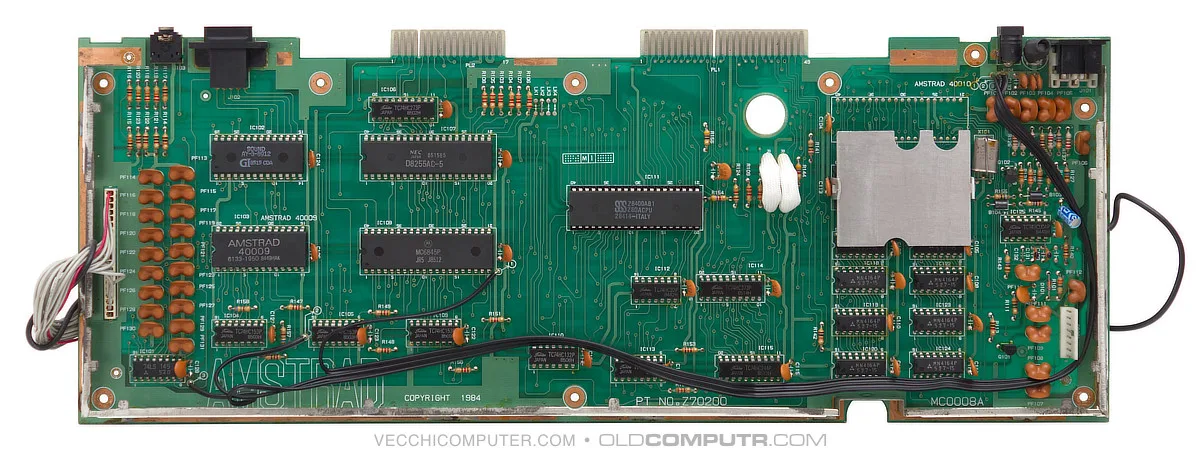
Photo: oldcomputr.com
Three real voices against one blunt beep
The General Instrument AY-3-8912 sitting on the board gives the CPC three tone channels, a noise generator and a hardware envelope shaper, all of it running independently of the CPU once you have told it what to do. Sit two machines side by side. Load the same piece of music on each. The Spectrum’s own chip is the CPU itself, toggling a single output pin fast enough to fake a waveform, which means every note it plays is stealing cycles from whatever else the machine was meant to be doing. The AY chip on the CPC just gets on with it in the background while the Z80 does something else entirely. It is not subtle. It is the difference between a tune and a countdown timer that has learned to whistle.
Locomotive BASIC, and the trick that buys the RAM back
Sixty-four kilobytes sounds generous next to a 48K Spectrum. The firmware has to live somewhere, though. On the CPC that somewhere is a genuinely clever bit of ROM banking: lower ROM over the bottom 16K for the firmware jump blocks, upper ROM over the top 16K for Locomotive BASIC itself. Both switch out once BASIC has booted. The RAM comes back. Type MEMORY at the ready prompt on a stock 464 and what comes back is comfortably north of 40K free to BASIC, out of a machine that only had 64K to give away in the first place. Not bad, for the price.
Locomotive’s BASIC earns the RAM it gets back. PLOT and SOUND commands are the easy part; the real work is in the structured-programming aids and interrupt-driven timers built into the language itself, the kind of thing most home computer BASICs of the period did not bother with, because most home computer BASICs of the period were not written by a company that had shipped its own Z80 interpreter a year earlier and knew exactly where the previous one had been slow. It shipped with at least one honest bug, a broken DEC$() that every owner’s manual and magazine of the era ended up documenting a workaround for, which is worth mentioning precisely because it is the only real blemish on an otherwise sharp piece of software engineering done to a schedule that should have produced something worse.
The corner that got cut for the price
Here is the one design decision on this board that deserves the cynicism, and it belongs nowhere near the engineers who wrote the firmware or laid out the gate array. Sugar’s brief was a price, not a spec. One of the places that price got paid was the expansion port. The CPC’s Z80 address and data bus run straight out to that edge connector. No buffer chip in between. Nothing protecting the processor from whatever you plug in. Fit a badly designed peripheral, or fit a good one with a dry joint on the wrong pin, and you are not looking at a blown fuse. You are looking at a dead CPU. Nothing on that board stands between your homemade expansion and the chip that runs the whole computer. A buffer IC costs pennies. Leaving it off was a business call, made to hit a number on a price sticker. It is the one place where the machine’s whole design philosophy, remove every reason not to buy it, quietly created a new one.
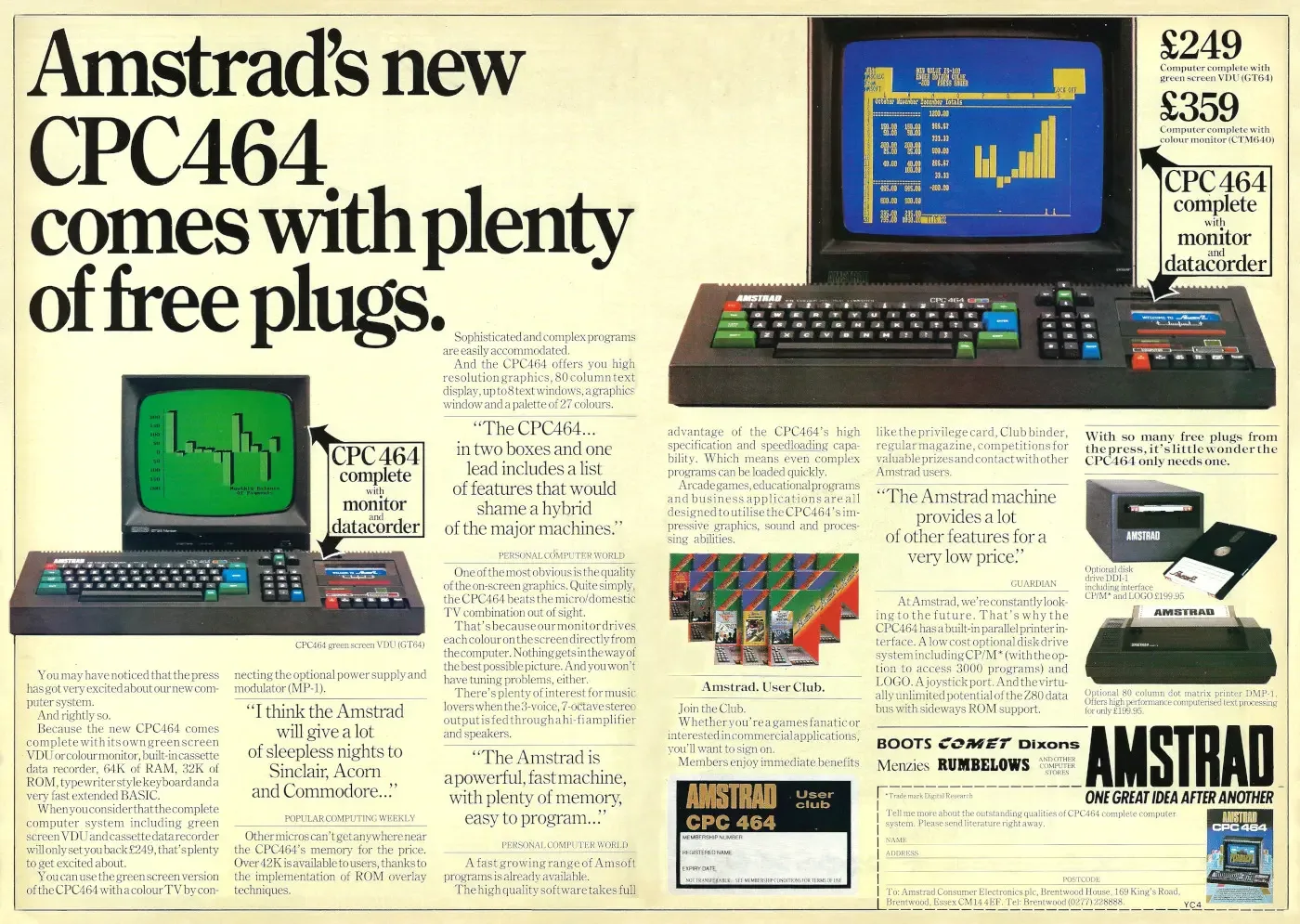
Image: Amstrad CPC464 advertisement, Your Computer, December 1984, scan via nosher.net
One plug, one box
The other place the price sheet shaped the engineering is the monitor itself. This one I will actually defend. The power supply lives inside the monitor casing rather than the computer. One connector feeds the whole system, so the CPC 464 has no mains socket of its own anywhere on the case. No brick to certify. No manual page explaining why the picture looks odd on somebody’s actual television. No hunting for a second free socket on a wall that, in a lot of 1984 British living rooms, did not have one spare. Simple. It is not subtle engineering, and it was never meant to be. It solved the exact problem Sugar had named out loud before a single chip was chosen. Solved it completely. The trade-off only shows up years later. On the bench, with the original monitor dead, you go looking for a cheap replacement CRT and discover there genuinely is not one, because the power supply you also need left the shop soldered inside the one that just failed.
Expandable, if you went looking for it
The 464 had no floppy controller on board. That looks like a false economy until you notice what Amstrad sold to fill the gap. Fit the DDI-1 interface and its companion FD-1 three-inch drive, and the same machine that left the box as a cassette-only home computer will boot CP/M 2.2 off disk, at a price nobody else in Britain was hitting for a CP/M-capable machine that year. A proper business operating system. Running on what most of the trade still treated as a toy. And it worked. The Z80 underneath was always a serious enough chip to carry it. The 664 and 6128 that followed built the disk drive straight into the case. No extra box needed. On the 464 specifically, getting there took an extra interface, an extra cable and an owner who had actually read the small print in the adverts rather than stopped at the price on the sticker.
Where the Commodore still wins
Fairness matters on a workbench as much as anywhere else. The Commodore 64 wins in two places. The SID chip is a genuinely more sophisticated piece of sound silicon than the AY-3-8912, with real analogue filtering and ring modulation. It turned a generation of C64 owners into accidental synthesiser programmers. Then there are the sprites. Independent objects the VIC-II shifts around the screen with collision detection built in. That gave its games a smoothness in fast horizontal scrolling and dense on-screen action that the CPC, doing all of its movement in software against character-mapped screen memory, structurally could not match without a very good programmer and a lot of patience. Fair is fair. Amstrad won the argument on colour and on keyboard feel. Commodore won it on raw arcade motion. Anyone telling you one of these machines simply beat the other has not sat with both of them long enough.
Verdict
For £239 with the green monitor, or £349 for colour, against Sugar’s own original target of £199 that the finished bill of materials never quite hit, the CPC 464 remains a genuinely well-specified machine. Let down in exactly one place. A bean-counter is responsible for that, not an engineer. The gate array’s clash-free colour and the AY chip’s real music still hold up against anything else in this price bracket from the same year. Genuinely. Locomotive’s BASIC is sharper than it had any right to be on that schedule. Just do not build your own expansion cartridge on a Friday night and plug it in without checking every pin twice. Twice. This is one machine where the manual’s warnings about the expansion port were not covering Amstrad’s legal department. They were covering your Z80.