MACHINE REFERENCE

Commodore VIC-20

Commodore VIC-20 — the first computer of any description to sell a million units, and it did it two years before the machine most people actually remember for that.

Why it matters

The VIC-20 was Commodore founder Jack Tramiel’s proof of concept that a real, colour, cartridge-capable computer could be priced like a toy and sold through ordinary shops rather than specialist dealers. William Shatner’s US adverts calling it “the wonder computer of the 1980s” were shameless, but the pricing wasn’t a bluff — at $299.95 it undercut rivals from Texas Instruments and Atari while still running BASIC out of the box. Commodore then used exactly the same playbook, better executed, to sell the C64 that quietly ate the VIC-20’s lunch a year later.

What to check before you buy

  • Ask what RAM expansion, if any, is included — the stock 3.5 KB free is genuinely tight for anything beyond the simplest programs
  • Confirm which PSU revision the board needs before plugging in a spare one; the wrong voltage can take out the motherboard
  • Listen for video garbage on power-up, a common symptom of failing SRAM in the low memory range
  • Check it’s the original 1981 hardware and not a modern mini/reproduction unit sold under a similar name
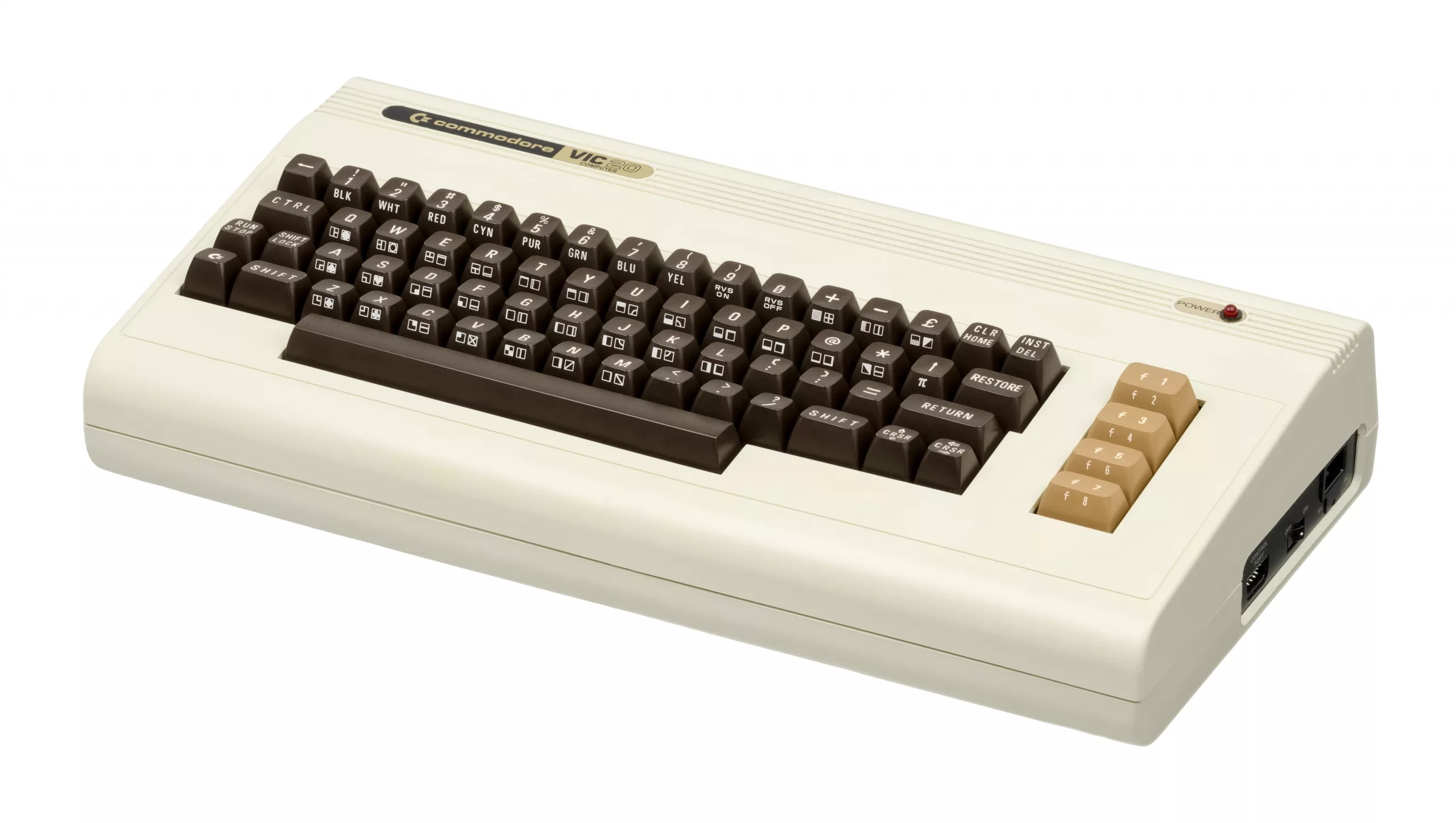
Commodore VIC-20 home computer in a cream case with brown keys

Photo: Evan-Amos, Wikimedia Commons (Public domain)

Released

1981

RAM

5 KB total (approx. 3.5 KB free for BASIC out of the box), expandable to 32 KB via cartridge

CPU

MOS Technology 6502 @ 1.108 MHz (PAL) / 1.02 MHz (NTSC)

Launch price

US$299.95

Manufacturer

Commodore Business Machines

Form factor

Compact home computer with an integrated keyboard, connecting to a television or monitor via composite video

CPU

MOS Technology 6502 @ 1.108 MHz (PAL) / 1.02 MHz (NTSC)

Chipset

MOS Technology VIC (6560 NTSC / 6561 PAL) — combined video and part of the sound generation

RAM

5 KB total (approx. 3.5 KB free for BASIC out of the box), expandable to 32 KB via cartridge

ROM

20 KB (8 KB BASIC 2.0 + 8 KB KERNAL + 4 KB character set)

Graphics

176×184 effective resolution (22×23 characters of 8×8), 16-colour palette, three display modes

Audio

Three pulse-wave tone generators plus a white-noise channel, mono output

Storage

Compact cassette via Datasette; 5.25″ floppy available via the VIC-1540 drive

Ports

ROM cartridge port, Atari-compatible joystick port, CBM-488 serial bus (daisy-chainable), user port (RS-232/Centronics TTL-level), composite video out

OS

Commodore KERNAL + Commodore BASIC 2.0, in ROM

PSU

External brick; early “Revision A” boards use a different connector/voltage arrangement to later “Revision B” boards, which take the same PSU as the Commodore 64

Units sold

2.5 million — the first computer of any kind to sell one million units

Successors

Commodore 64

  • VIC-I chip overheating
    The VIC-I video/sound chip runs hot and was never heatsinked from the factory, making it one of the most common chip failures on the board.
  • SRAM chip degradation (2114 / 6116 families)
    The static RAM chips used for main and colour memory fail with age, producing garbled screen output or memory errors; the video matrix specifically lives at $0400 to $0FFF, so faults there show up immediately as on-screen garbage.
  • Two incompatible PSU generations
    Early Revision A boards use a different power connector and voltage arrangement to later Revision B boards; fitting the wrong external PSU risks damaging the motherboard.
  • 1980 Announced in September, released in Japan as the VIC-1001
  • 1981 Worldwide release as the VIC-20 at $299.95
  • 1981 Becomes the first computer of any kind to sell one million units
  • 1982 Commodore 64 unveiled, beginning to cannibalise VIC-20 sales
  • 1985 Production discontinued in January