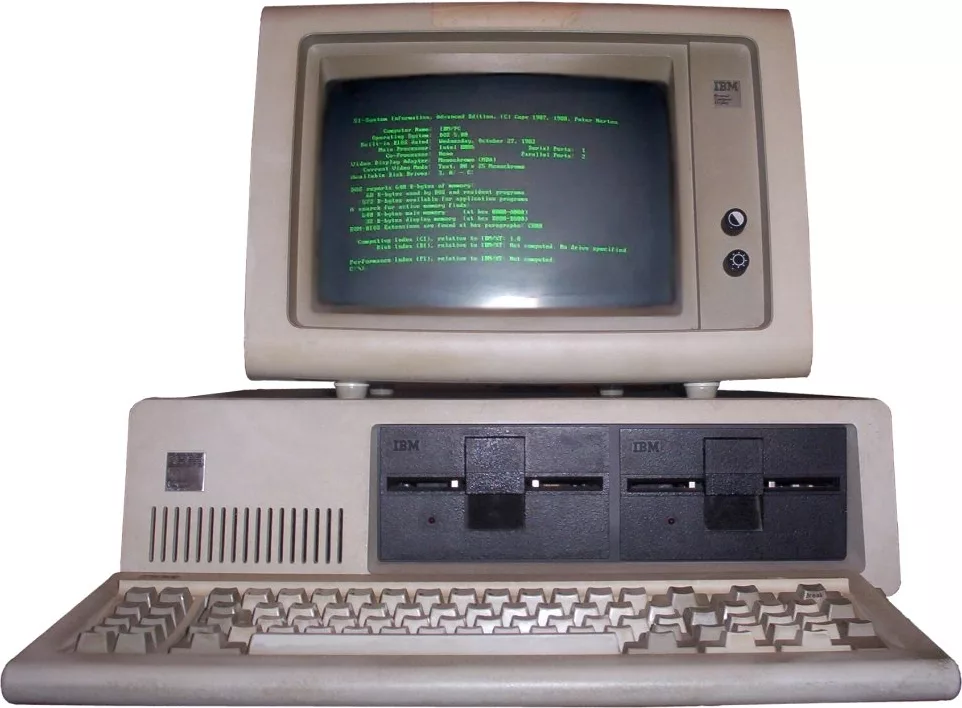
IBM announced the Personal Computer, model 5150, on 12 August 1981 in a ballroom at the Waldorf Astoria in New York, from $1,565. Twelve engineers had put it together in about a year in Boca Raton, Florida, and hardly a component in it was IBM’s own. The processor came from Intel and the operating system from Microsoft. The floppy drives were Tandon’s. Then IBM printed the schematics and the complete ROM BIOS source listing in a reference manual and sold it over the counter to anyone who asked, which is the reason ‘PC’ is a common noun today instead of an IBM trademark.
- Announced: 12 August 1981, Waldorf Astoria, New York. Built by IBM’s Entry Systems Division, Boca Raton, Florida
- CPU: Intel 8088 at 4.77 MHz, 16-bit internally with an 8-bit external data bus
- RAM: 16KB on the earliest ’16KB-64KB’ system boards (later boards took 64KB-256KB), up to 640KB with expansion cards
- Storage: cassette port as standard, plus one or two 5.25in floppy drives, 160KB single-sided at launch
- Launch price: $1,565 for the cassette-only machine, roughly $3,000 for a system you could actually work on
- Operating systems: PC DOS 1.0 at $40, CP/M-86 at $240 and six months late, UCSD p-System
Why IBM could not build a personal computer the IBM way
In July 1980 Bill Lowe, the lab director at Boca Raton, stood in front of IBM’s Corporate Management Committee and told them, in effect, that his own employer was the obstacle. If IBM wanted a personal computer that was profitable and on sale quickly, he argued, it could not do it within the culture of IBM. His way round that was to buy somebody who already knew how: Atari. There was even an industrial design model built to make the case, styled on the Atari 800.
The committee, under chief executive Frank Cary, said no to the acquisition and yes to something stranger. Lowe could have a team of twelve and a year to produce a machine, on a business plan built around open architecture, parts IBM did not make, and sales through shops rather than salesmen. Every one of those ran against the grain of the company approving it.
You can measure how far against the grain by looking at what else IBM was shipping. The 5100 portable, out since 1975, ran from $8,975 to $19,975. The System/23 Datamaster, a small-business machine years in the making, was announced in July 1981, one month before the PC, at around $9,000. IBM knew perfectly well how to build a small computer. It simply took four years over it and charged the price of a car.
How twelve engineers in Boca Raton designed the 5150 in a year
Lowe handed the project, codenamed Chess, to Don Estridge, and Estridge did the one thing that made the schedule survivable: he got permission to run it as a skunkworks, outside IBM’s standard development procedures entirely. No corporate review gates, no in-house component mandates, no committee sign-off on a chip choice. By IBM’s own account, that exemption is the condition on which the year was even attemptable.
The team was small enough to fit round one table. Lewis Eggebrecht was chief designer. David Bradley wrote the ROM BIOS, and he had form: in 1978 he had done the I/O system for the Datamaster, the expensive machine down the corridor, which is exactly why parts of the Datamaster’s design could be lifted and reused rather than invented from nothing. Mark Dean and Dennis Moeller worked on the expansion bus the industry would later christen ISA. The motherboard was designed in forty days. A working prototype ran four months in, and the design was finished and handed to manufacturing by April 1981.
The Intel 8088 is the choice that made all of it hang together. Sixteen-bit registers behind an eight-bit external data bus sounds like a compromise, and it was one, but the payoff was that every cheap, plentiful eight-bit support chip and interface design already on the market still worked. Estridge said as much in Byte in November 1983: ‘The 8-bit I/O architecture makes it simple for users to add equipment to the IBM PC without doing a lot of work or spending a lot of money because the 8-bit interfaces are easy for hobbyists and third-party add-on manufacturers to understand.’
What came out of it was five 62-pin expansion slots, a Monochrome Display Adapter for crisp text or a CGA card if you wanted four colours on screen at once, a 63.5W power supply, and the 83-key Model F keyboard, whose buckling springs announced your typing to everyone else on the floor. The system unit alone weighs 12.7kg. Microsoft Cassette BASIC sat in four ROM chips on the board at U29 to U32, so the cheapest machine did something when you switched it on. That mattered more than it sounds: PC DOS was never sold on tape, so a cassette-only 5150 had nothing else to run.
How Microsoft got the operating system and Digital Research did not
CP/M was the software standard of the day, so CP/M-86 was IBM’s first choice and Gary Kildall’s Digital Research was IBM’s first call. The talks came apart over paperwork and money: IBM’s non-disclosure agreement, and IBM’s insistence on paying a one-off fee where Digital Research licensed on royalties. By November 1980 the operating system business had gone to Microsoft instead, and what Microsoft delivered as PC DOS 1.0 was 86-DOS, bought in from Seattle Computer Products.
IBM then offered all three systems at launch and let the price sheet do the rest. PC DOS was $40. CP/M-86 was $240 and did not appear for six months. One contemporary survey of orders put PC DOS at 96.3 per cent against 3.4 per cent for CP/M-86, which is less a competition than a formality.
The part IBM should have thought harder about was not the price but the contract it had just signed. Microsoft kept the right to sell the same operating system to everybody else, and did, as MS-DOS. That is one giveaway. The second was already at the printers.
The manual that gave the industry away
The IBM Personal Computer Technical Reference, published in August 1981 as document 6025008, contains the schematics, the specifications and the entire ROM BIOS as a commented assembly listing. Anyone could buy it. Students bought it. Competitors certainly bought it.
This was deliberate, and Estridge was open about why. ‘Our judgment was that no single software supplier or single hardware add-on manufacturer could provide the totality of function that customers would want,’ he told Byte. ‘We tried to create a machine, some software offerings, and a set of business practices that made it easy for others to participate.’ He also summed up the whole design philosophy in eleven words: ‘We firmly believed that being different was the most incorrect thing we could do.’
The listing was copyrighted, so nobody could legally copy it. What they could do was read it, work out precisely what every routine had to accomplish, then hand that behavioural description to a second team who had never seen a line of IBM’s code and let them write a fresh implementation. Clean room. Columbia Data Products got there first with the MPC 1600 in June 1982. Compaq announced its Portable that November and shipped it in March 1983. Then Phoenix, AMI and Award began selling compatible BIOS chips off the shelf, and the hardest legal-engineering problem in the industry turned into a purchase order.
I think the Technical Reference is the most consequential thing IBM produced in 1981, and it was not a machine. It was a document, and it converted IBM’s product into everybody’s platform. The engineering judgement behind it, that a standard other people can build on beats a standard you own alone, was correct. What IBM did next was the mistake. When the clones took the volume, the answer in April 1987 was the PS/2 and Micro Channel Architecture, a bus with licensing terms attached, an attempt to shut a door that IBM’s own manual had taken off its hinges six years earlier.
What the IBM PC cost a British buyer in 1983
Britain waited. The official UK launch came on 18 January 1983, seventeen months after New York, and by then the machine had been arriving through the grey market since the summer of 1982, imported by outfits like Microcomputerland. An advert in Personal Computer World in July 1982 offered an IBM PC at £2,890, with what the copy described as some sort of dealer warranty, a phrase that tells you everything about buying a 5150 in Britain before IBM would sell you one.
Once IBM did, it was not cheap. An IBM advert in Personal Computer World in March 1983 quoted £3,442 plus VAT for the recommended business system: 128K, two 320K drives and a printer. That same spring a 48K ZX Spectrum cost £175. The two machines were never chasing the same customer and never pretended to, but the gap is worth sitting with, because it explains why the British home computer boom and the PC ran on parallel tracks for years before one of them quietly ate the other.
The British connection goes deeper than a price list. IBM built PCs at Greenock on the Clyde, and the 5150 in the Science Museum’s Information Age gallery is a Greenock-made 1983 machine, printer and manuals and all. The computer that finished off Britain’s home-grown computer industry was, in part, assembled in Inverclyde.
What the 5150 actually left behind
IBM’s own business plan estimated 220,000 units over three years. More than 750,000 had gone by 1983, and at the peak IBM was shipping 40,000 a month, running at something like eight times what the plan allowed for. In the issue dated 3 January 1983, Time gave up on Man of the Year and put the personal computer on the cover as Machine of the Year. Estridge was made president of the Entry Systems Division in August 1983, and within two years that division had close to 10,000 people and had sold over a million machines.
He saw very little of what followed. Don Estridge died on 2 August 1985, aged 48, alongside his wife Mary Ann, in the crash of Delta Air Lines Flight 191 at Dallas/Fort Worth. IBM sold the PC business to Lenovo twenty years later, in 2005.
The machine itself is not the part that survived. A 4.77 MHz 8088 with 16KB of RAM was unremarkable in 1981 and is a curiosity now. What survived is the shape of it: five slots and a published pinout, a BIOS anyone could reimplement, an operating system its author was free to sell to IBM’s rivals. Every beige box on every British desk for the next twenty years is downstream of a manual IBM printed itself and sold for the price of a textbook. ‘IBM compatible’ outlasted IBM’s interest in being compatible with anything.