
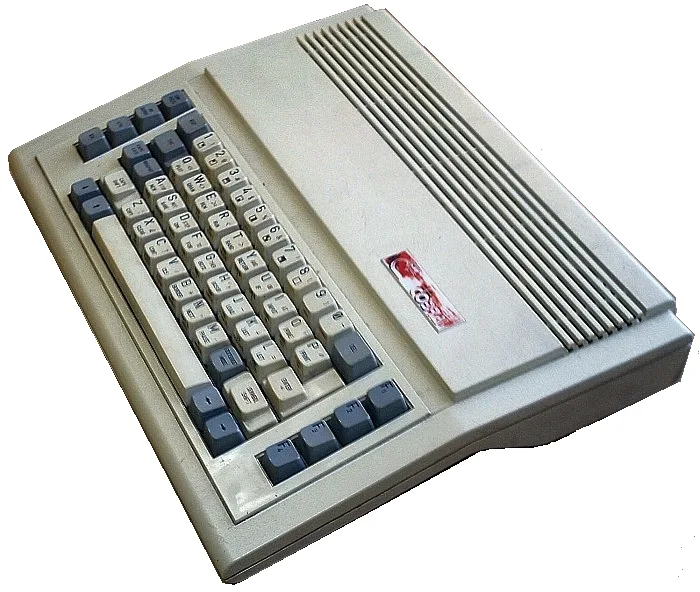
The Central Pavilion in Moscow, late August 1988. Engineer Adrian Maxim had already done the sensible, faintly absurd thing: he’d fixed the CoBra’s case to its display pedestal with ordinary furniture screws, then sealed the whole assembly shut. Romanian state security had warned the delegation before they left Brașov that a home computer good enough to represent the country at the “România 88” exhibition was also good enough to attract the wrong sort of attention. Screws seemed like a reasonable precaution. They were not enough. The next morning, hours before the doors opened, the machine on the pedestal was dead. Someone had opened the sealed case anyway, lifted out the motherboard, stripped every “intelligent” integrated circuit from it, and copied the software for good measure. Maxim and his colleagues had, fortunately, packed a spare board. They had the CoBra running again before a single visitor noticed anything had happened.
It is a genuinely strange thing to have to say about a Z80-based ZX Spectrum clone from a country better known, in most retro-computing circles, for not having a computer industry at all: the CoBra was good enough that the Soviets stole it.
A computer built from someone else’s mistakes
The CoBra (the name is a contraction of “COmputer BRAșov”) started four years earlier as a grassroots project inside ITCI, the local Institute for Computing Technology and Informatics, coordinated by Prof. Dr. Gheorghe Toacșe. The brief, in effect, was to build Romania’s own Sinclair ZX Spectrum. The team had one problem before they’d so much as touched a soldering iron: the only technical reference they could get hold of was a German-language book about the Spectrum, and its printed code listings were riddled with errors.
So the engineering started with translation, not design. Before Vasile Prodan and the rest of the hardware team could lay out a single trace, they had to hand-translate the German book’s BASIC and assembly listings back into working Z80 code, fixing the typos as they went, just to establish a baseline firmware that actually ran. It is the kind of unglamorous, invisible labour that never makes it into a spec sheet, and it is also exactly the sort of problem that either kills a project outright or produces engineers who understand a system far more intimately than anyone who’d simply been handed a working reference design.
The diode that kept the memory alive
What they built without a Sinclair ULA to lean on was, if anything, more ambitious than the original. The genuine Ferranti ULA, the single custom chip doing most of the Spectrum’s video and logic work, wasn’t available to a state institute in communist Romania, so the team reverse-engineered its timing behaviour from scratch and rebuilt it as a dense thicket of discrete 7400-series TTL logic chips. It worked. It also meant the CoBra’s board was considerably busier than the machine it was cloning, running a Z80A at 3.5 MHz alongside 64 KB of RAM split across four banks of 4116 memory chips.
Those 4116s were the real hazard. They needed three separate voltage rails, minus five, plus five and plus twelve volts, brought up in a strict sequence, and getting that sequence wrong meant instantly and permanently frying the memory. Prodan’s fix was almost embarrassingly cheap for how much it protected: a single diode wired into the ground rail, generating an artificial baseline voltage that kept the startup sequence honest no matter what the power supply itself did. One component, and a chip failure mode that could have sunk the whole project quietly disappears. That is the sort of decision that deserves real respect, not a shrug. A problem most engineers would have solved with an extra regulator IC and a bigger bill of materials was solved instead with a two-lei part and a genuinely clever piece of circuit thinking.
A machine for hospitals, not homes
None of this cleverness was aimed at ordinary Romanians, because ordinary Romanians were not allowed to own one. Private computer ownership sat awkwardly with a regime that treated information technology as a state concern, so the roughly 1,000 official CoBra units assembled at the SPIACT railway workshops in Brașov between 1988 and 1990 went to factories, hospitals and accounting departments, never to a private buyer. Not that many private buyers could have stretched to it anyway: a complete, factory-assembled CoBra retailed at 35,000 lei, about half the price of a Dacia car.
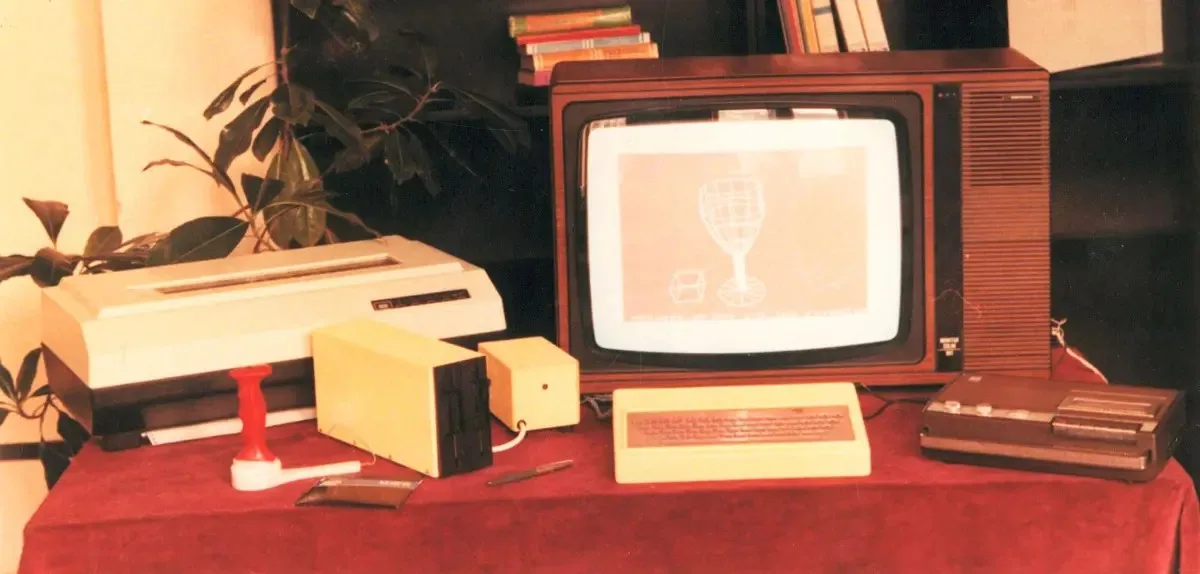
That combination, a genuinely capable home computer that only institutions were allowed to buy, did exactly what it always does. It created a black market.
Cigarettes, tin foil and a television standing in for an oscilloscope
Students at the Politehnica University of Bucharest, many with family connections inside the factories that made the parts nobody could legally sell them, built their own CoBras from smuggled components, sometimes, by report, for nothing more than a pack of cigarettes passed to the right person on a factory floor. None of the resulting machines looked much like the official version, or much like each other. Builders improvised relentlessly: with the right chip unavailable at any price, they’d wire together thirty ordinary logic ICs to do the job one specialised ten-dollar part was supposed to do. Keyboards came from scrapped mainframe terminals, sanded down and relabelled key by key. One student is on record using a television’s own video circuitry as an improvised oscilloscope, reading the set’s 50 Hz sync pulse as a crude logic probe to check DRAM timing on a board running at 3.5 MHz. It was the kind of substitution you only reach for when a real oscilloscope simply isn’t a thing you can buy, borrow or steal.
In Bucharest’s Regie student dormitories, this went from individual hacking to something closer to a cottage industry. One student, remembered by his dormitory nickname “Calu”, ran what amounted to a one-room assembly line out of his room, keeping an actual quality-control notebook to track which unreliable Soviet-sourced ICs kept failing and why. A rival operator, “Alex”, subcontracted the fiddly soldering work to architecture students from a neighbouring faculty, a decision “Calu” apparently never let him forget, given how often those joints came back cold. A third student, “Andrei”, solved the black market’s worst-plated circuit boards, riddled with hairline shorts from poor through-hole plating, by sliding a sheet of tin foil underneath the bare board, letting him run every continuity test from one side only with a homemade multimeter, cutting the diagnostic time in half. None of this is documented with the rigour of a museum catalogue; it survives mostly in first-hand memoirs written decades later. But the specificity is hard to invent, and it is the part of the CoBra’s story that has nothing to do with the state programme at all.
The night in Moscow
Which brings the story back to that pedestal in the Central Pavilion. The “România 88” exhibition ran from 30 August to 3 September 1988, and the CoBra (the official, state-sanctioned version, not one of the Regie dormitory specials) was one of the machines chosen to represent Romanian engineering to the Soviet Union. It sat in a raised display booth, drawing a genuine crowd for its capability and its modern-for-1988 design. Security had already flagged the risk of industrial espionage before the team left Brașov, which is precisely why the case ended up bolted down and sealed in the first place.
It wasn’t enough, and the theft wasn’t subtle once you knew to look for it: opened case, missing motherboard, every “intelligent” chip stripped out, the software copied for whatever use anyone thought a cloned Spectrum ROM might be. What actually saved the exhibit was preparation that had nothing to do with the screws: a spare motherboard packed on the assumption that something, somehow, might go wrong. It did, and the CoBra was back on its pedestal, running, before the doors opened to the public that morning. There is something almost too neat about a computer designed to prove socialist Romania could match Western technology getting robbed by its own socialist allies rather than any capitalist rival — the compliment, in the end, was paid by the people it was never trying to impress.
What was left afterwards
The CoBra didn’t survive long past the system that built it. A parallel project, nicknamed “Turbo Spectrum” or CoBra-2, tried to push the design further. Engineers Nicolae Muntean and Sorin Cismaș leaned hard on undocumented Z80 opcodes and self-modifying code to cut the component count roughly in half, but it never left the prototype stage in any numbers worth calling production. When state funding for the programme dried up after 1990, official manufacturing stopped for good, leaving perhaps a thousand factory units and an uncountable, unofficial multiple of that scattered through dormitories, garages and back rooms across the country.
That second number is arguably the more honest measure of what the CoBra actually was. A state institute built roughly a thousand of them, under a government that treated a home computer as too sensitive an object for a private citizen to own. Everyone that restriction was supposed to stop built their own anyway, out of stolen parts and mainframe scrap and a television’s video circuit, in dormitory rooms the state wasn’t watching quite as closely as a Moscow exhibition hall. Neither the case screws nor the ownership ban held.
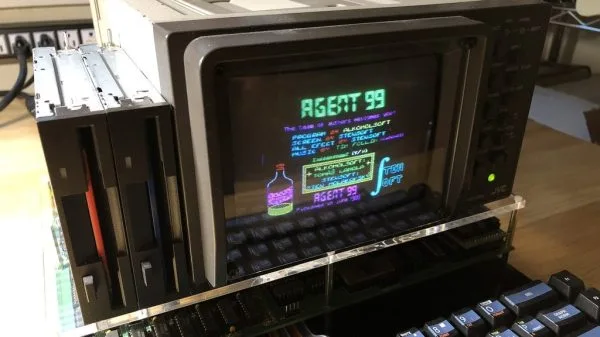
That refusal to stay dead didn’t end with communism. In 2022, a hobbyist working under the handle Thomas Sowell built a fresh CoBra from scratch, sourcing period-correct Eastern Bloc ICs from the former USSR, East Germany, Czechoslovakia and Romania rather than reach for anything modern, and pulling the board layout straight from photographs on the cobrasov.com preservation project. He hit the same wall Prodan’s team hit in 1986: an overheating video IC and a set of memory glitches that needed tweaking out one at a time. Nearly forty years on, the CoBra is still teaching people the same lessons it taught the first time round.
Related reading: “Replacing the Spectrum’s dead-flesh keyboard membrane”
