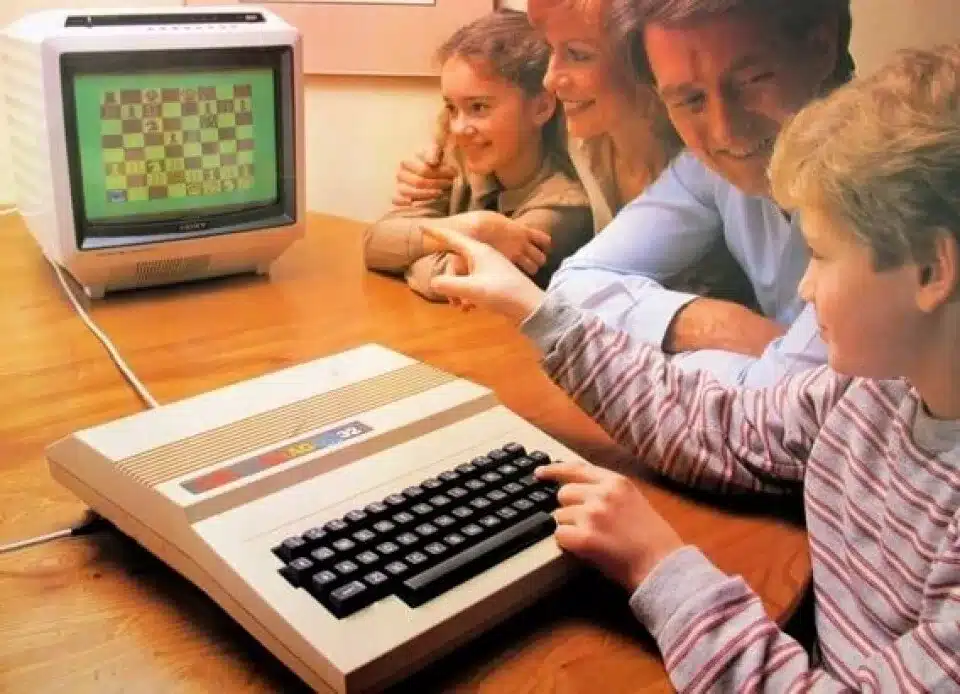
Open the case of a Dragon 32 and the first thing that hits you is the smell: hot dust, warm ferrite, a trace of PVC that never quite left the ribbon cable. The second thing is the chip sitting dead centre of the board. A 40-pin Motorola MC6809E. Clocked at a modest 0.89 MHz. Dragon Data of Wales put that chip in a beige, olive-trimmed case in August 1982 and asked £199 for it. Every serious rival on the shelf that Christmas ran a Zilog Z80 or a MOS 6502. Dragon Data did not. That single decision is the most interesting thing about this machine.
- CPU: Motorola 6809E @ 0.89 MHz
- RAM: 32KB (Dragon 32), expandable by owners to 64KB and beyond
- Video: Motorola MC6847 Video Display Generator, up to 256×192 in two colours
- Sound: 6-bit DAC driven through the PIA, no dedicated sound chip
- Launch price: £199 (August 1982)
- Successor: Dragon 64 (1983) — doubled the RAM and added a working serial port
A processor built for people who wanted to write real software
By 1981 a single 6809E cost Dragon Data around $37 in volume. A Z80 cost $9. A 6502 cost $6. Every accountant in the building had grounds to ask why the design team hadn’t just used what everyone else was using. The answer, if you actually look at what the 6809 does under the hood, is that Motorola built something closer to a minicomputer’s instruction set than an 8-bit microprocessor’s.
Two 8-bit accumulators that combine into a 16-bit D register. Two full 16-bit index registers. Two separate stack pointers, one for the system and one for the user. Small detail. It turns out to be what makes proper re-entrant and recursive code possible on 8-bit silicon. Position-independent addressing meant code could be relocated in memory without rewriting a single jump target. Useful for cartridges. A genuine hardware multiply instruction, at a time when most of the competition was still doing it in software, one shift-and-add loop at a time.
None of that came free. Most of the 6809’s instructions were hardwired rather than microcoded, so where a Z80 needed seven clock cycles to add an immediate value to the accumulator, the 6809 needed three. Three cycles, not seven. Fewer cycles per instruction, at a lower clock speed, closed a gap that looked far bigger on paper than it ever did on a real machine. Worth pausing on that. Somebody on that design team understood the 6809’s reentrant, position-independent code was the only realistic foundation for a proper multi-tasking operating system on 8-bit silicon. Not a small ambition. They built the platform around that bet rather than around the cheapest bill of materials, and when OS-9 eventually arrived it ran rings around anything the Z80 world could offer at the price. Four times the cost of a Z80. Chosen anyway. That’s the nerve nobody gives Dragon Data enough credit for.
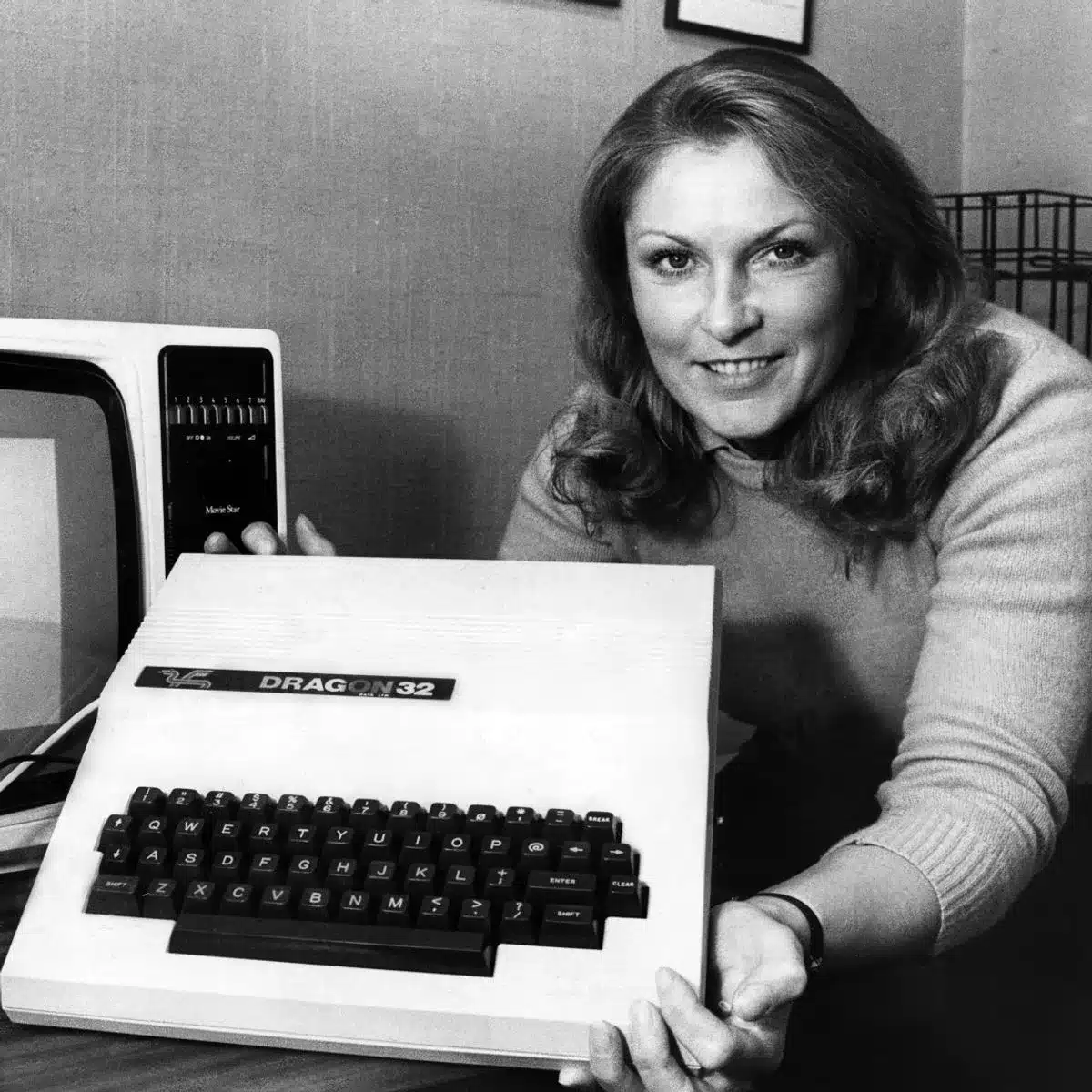
One reference design, two computers that never quite got along
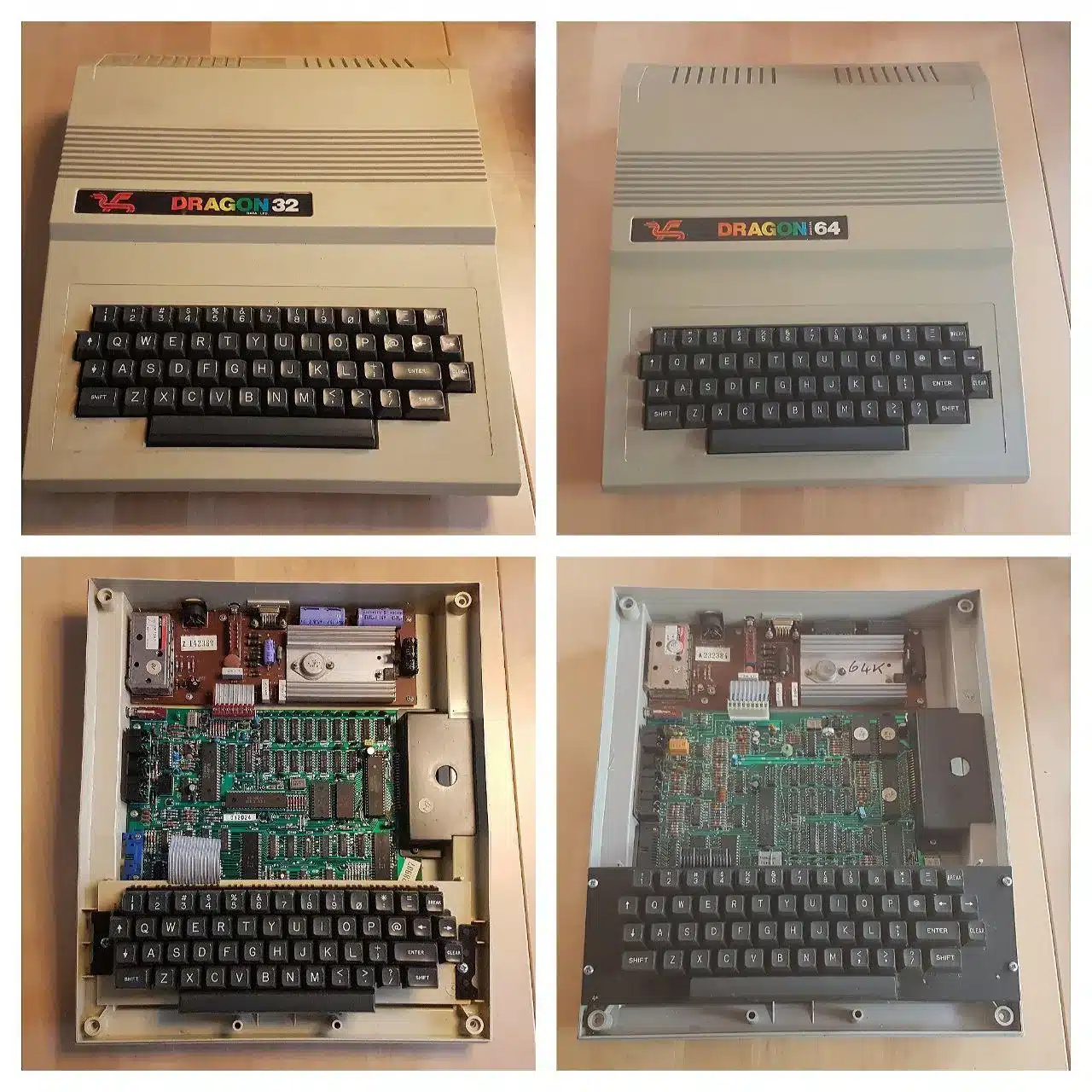
Here is the claim that gets repeated so often it has calcified into fact: that the Dragon 32 was “closely related” to Tandy’s TRS-80 Color Computer. True. Not in the way people usually mean it. Dragon Data didn’t license anything from Tandy, and Tandy had no hand in the Welsh machine’s design. What both companies actually used was Motorola’s own reference design for a colour home computer: the 6809E, the MC6883 Synchronous Address Multiplexer and the MC6847 Video Display Generator. A complete blueprint. Any manufacturer could take it to market fast. Dragon Data and Tandy both took it. Neither copied the other. They are siblings raised by the same silicon parent, not one machine wearing the other’s coat.
The kinship shows in practice. A significant amount of compiled machine code runs interchangeably between a Dragon and a Color Computer. You can even convert a Color Computer into a Dragon by swapping the ROM and rewiring the keyboard cable. That’s how close the hardware really sits. BASIC programs are a different story. Dragon Data’s engineers reassigned the token numbers Extended Colour BASIC uses to store keywords, so a saved program that looks identical on screen is stored as different bytes on tape. Cross the Atlantic and it stops loading. There’s another fight buried in this machine, too: the MC6847 was built for America’s 525-line NTSC broadcast standard, and Wales runs on 625-line PAL. Extra circuitry had to go in just to keep the picture stable on a British television. Not glamorous work. Getting a Motorola evaluation kit to a shipping product, for a market Motorola never designed it for, is not a small piece of engineering. It rarely gets mentioned in the “it’s just a CoCo clone” version of this story.
The keyboard doesn’t flex, and neither does the case
Pick a Dragon 32 up and the plastic doesn’t creak the way a contemporary Spectrum’s does. The keyboard is full-size and full-travel. Proper keys. Proper switches. Not the flat rubber membrane Sinclair shipped a few months earlier at a lower price. It’s still the thing that surprises people picking one up for the first time. This doesn’t feel like a toy. It feels like a machine somebody intended you to sit down and actually type on for an evening.
That solidity came at a cost. A heavier case, more injection-moulded plastic, a keyboard assembly that wasn’t cheap to source, all stacked on top of a processor that was already the most expensive part on the board. The accountants would have noticed. Every one of those decisions reads, in isolation, as somebody trying to build a computer people would actually want to keep. Stacked together, they explain rather a lot about why that £199 price tag sat where it did.
Where the chipset ran out of road
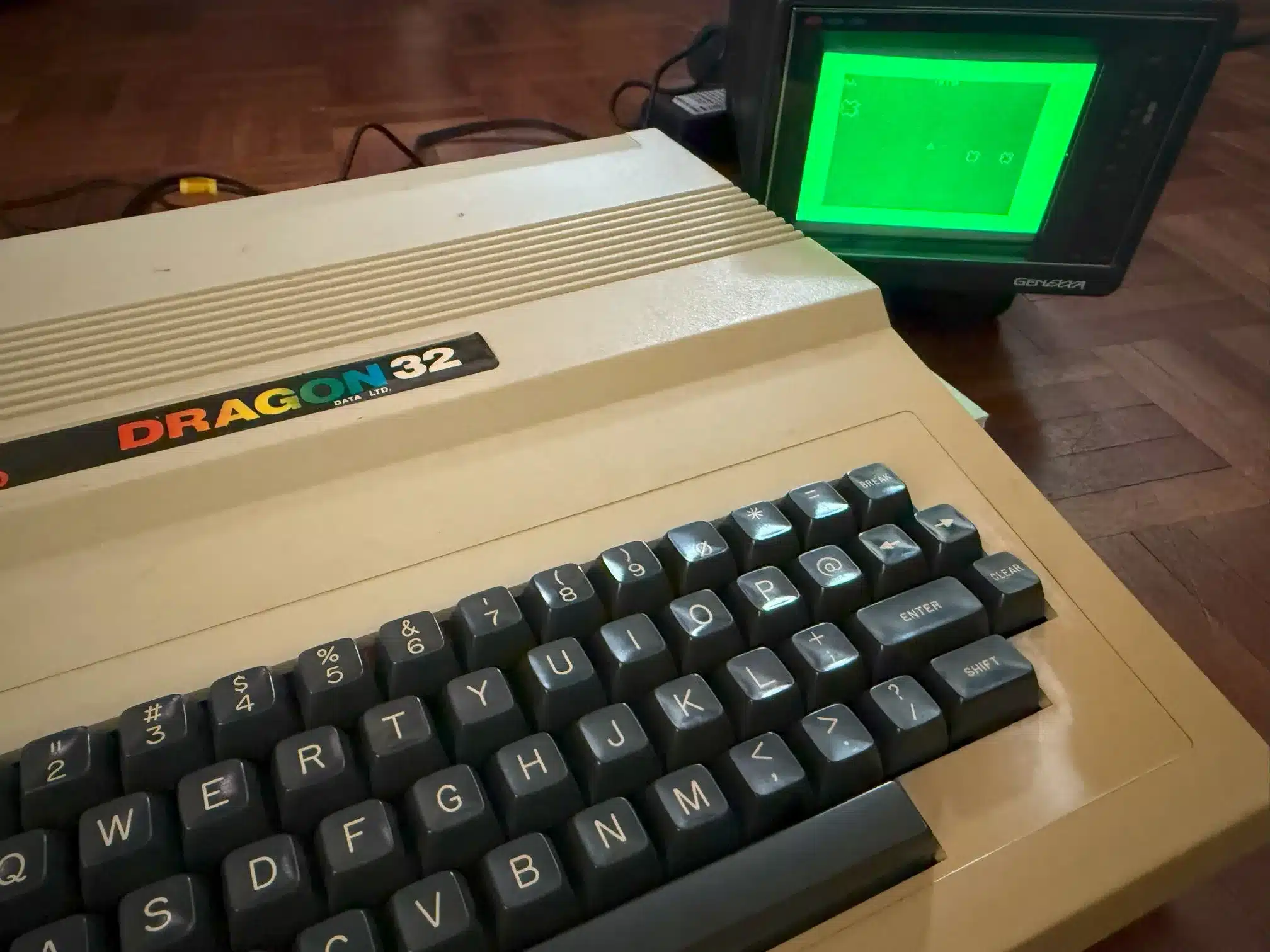
Credit where it’s due doesn’t mean pretending the Dragon 32 was flawless. The MC6847 is where the limits show fastest. Its best colour graphics mode tops out at 128×192 with four colours. Push for 256×192 and you’re down to two. Not much room to work with. Sinclair’s attribute-clash palette looked garish next to it, but it packed more colours onto the screen at once. Commodore’s VIC-II beat them both. Hardware sprites, no less, and the 6847 had no answer for those. Text defaults to white or green on black. Readable, once your eyes adjust. It was never going to win a shelf comparison against a machine promising sixteen colours in the window.
Sound fares worse. There’s no dedicated sound chip on the board. Just a 6-bit DAC hanging off the peripheral interface adapter. Every note of every tune has to be pushed out by the CPU itself, cycle by cycle, stealing time from whatever the game was actually meant to be doing while it plays. Software sound, on a software budget. Commodore’s SID chip, sitting on a machine that launched the same year, must have felt like it arrived from a different decade. None of this is a failure of nerve on Dragon Data’s part. Worth saying plainly. It’s what happens when a company builds around Motorola’s reference chipset instead of commissioning bespoke silicon it couldn’t remotely have afforded. A trade worth naming honestly, not glossing over.
A cartridge port that punished curiosity
Expansion runs through a single ROM cartridge port on the right-hand edge, mapped straight into the memory map rather than sitting behind any clever bank-switching logic. It works. DragonDOS, when it finally arrived, plugged its WD2797 floppy disk controller cartridge into exactly that slot. Fine, so far. What it doesn’t do is tolerate being touched while the machine is switched on. Insert or remove a cartridge live and you risk locking the computer up. Sometimes worse than that. There are enough accounts of damaged hardware that nobody sensible tried it twice. One expansion route. Unforgiving. On a computer whose most exciting future software was always going to arrive on cartridge or disk, that was never going to be a minor inconvenience.
The boardroom that undid the engineers’ work
None of the engineering above explains why Dragon Data collapsed in June 1984, less than two years after launch. That’s a different story. It belongs to the people running the company, not the people designing the board. Dragon Data started life as a division of Mettoy, the toy manufacturer behind Corgi die-cast cars. Not exactly a vote of confidence. Early financing brought in Prutec and Hill Samuel alongside the Welsh Development Agency, diluting Mettoy down to a 20 per cent stake. WDA backing then funded a purpose-built factory at Kenfig, near Port Talbot, which opened in spring 1983.
What followed was a run of decisions that had nothing to do with silicon. The 64KB Dragon 64 arrived late. The promised disk drive and OS-9 support, the very software the 6809’s architecture had been chosen to make possible, arrived even later. Nobody was still waiting by then.
Managing director Tony Clarke, who’d negotiated the company’s early financing, was pushed out in September 1983. Out he went. In his place: a GEC executive with no background in the industry Dragon Data was competing in. Sales projections had been pitched high enough to justify the factory investment. Then the market saturated. By Christmas 1983 the Spectrum, the Commodore 64 and the BBC Micro were squeezing from every direction, and there was no cushion left to absorb the shortfall.
As design consultant Duncan Smeed put it of the machine’s earliest days, “there were three drivers behind the Dragon’s early development: time to market, time to market, time to market.” That pressure produced a genuinely clever computer. It’s the years after launch, not the design brief before it, where the company lost its nerve.
Receivers were called in that June. The Spanish firm Eurohard bought the remains for just over £1 million and moved production to Spain. Not the end, quite. A version of the machine soldiered on there as the Dragon 200 for another year or so, before Eurohard went bankrupt too, in 1987, and that finished the story for good.
Verdict
Strip away everything that happened to Dragon Data as a business and you’re left with a machine that, chip for chip, out-engineered most of what sat beside it on the shelf in 1982. No small claim. The 6809E was the most sophisticated 8-bit processor anyone put inside a British home computer that year, chosen by people who understood exactly what it would let them build and were willing to pay four times the going rate for the privilege. That’s not a small thing either. The Dragon 32 is remembered today as a footnote to the Spectrum and the Commodore 64, rather than as the machine that nearly brought proper multi-tasking software to a British living room. Not the silicon’s fault. It has everything to do with a letter from the receivers that arrived in June 1984. No amount of clever instruction-set design was ever going to stop that letter being written.