MACHINE REFERENCE

Commodore PET 2001

The Commodore PET 2001 put a 9-inch screen, a cassette deck and a keyboard of 73 tiny calculator keys into one sheet-metal box. Switch on the 8 KB model and it announces ‘7167 BYTES FREE’. Commodore’s launch prices were US$595 for the 4 KB machine and US$795 for the 8 KB one.

Why it matters

Commodore showed the PET at the Consumer Electronics Show in January 1977, ahead of the Apple II and the TRS-80 going on sale. The first production units did not ship until October, and only about 500 machines were built in the first year, at roughly 30 a day. It ran a 6502 at about 1 MHz, came with Microsoft BASIC and had an IEEE-488 bus for disk drives and printers. The keyboard drew the complaints, and Commodore swapped it for a conventional one within about a year, taking the built-in cassette deck with it. The whole PET line sold about 219,000 units.

What to check before you buy

  • Keyboard: press every key. The chiclet keys were criticised from the start and the printed legends wear off, so check both feel and legibility.
  • ROM version: find out whether it is BASIC 1.0 or the fixed BASIC 2.0. Early ROMs have known bugs and you may want a replacement set.
  • Screen: switch it on and let it warm up. Look for a stable 40×25 picture with no flicker or dark patches.
  • Cassette deck: on the original model it is built in. Check the mechanism is present and turns freely.
  • Case and connectors: look for dents in the sheet metal and test the IEEE-488, user port and expansion connectors for damage.
  • Provenance: early serial numbers are worth far more. An untested unit from the first hundred made US$6,784 at auction in 2022, so ask what you are paying for.
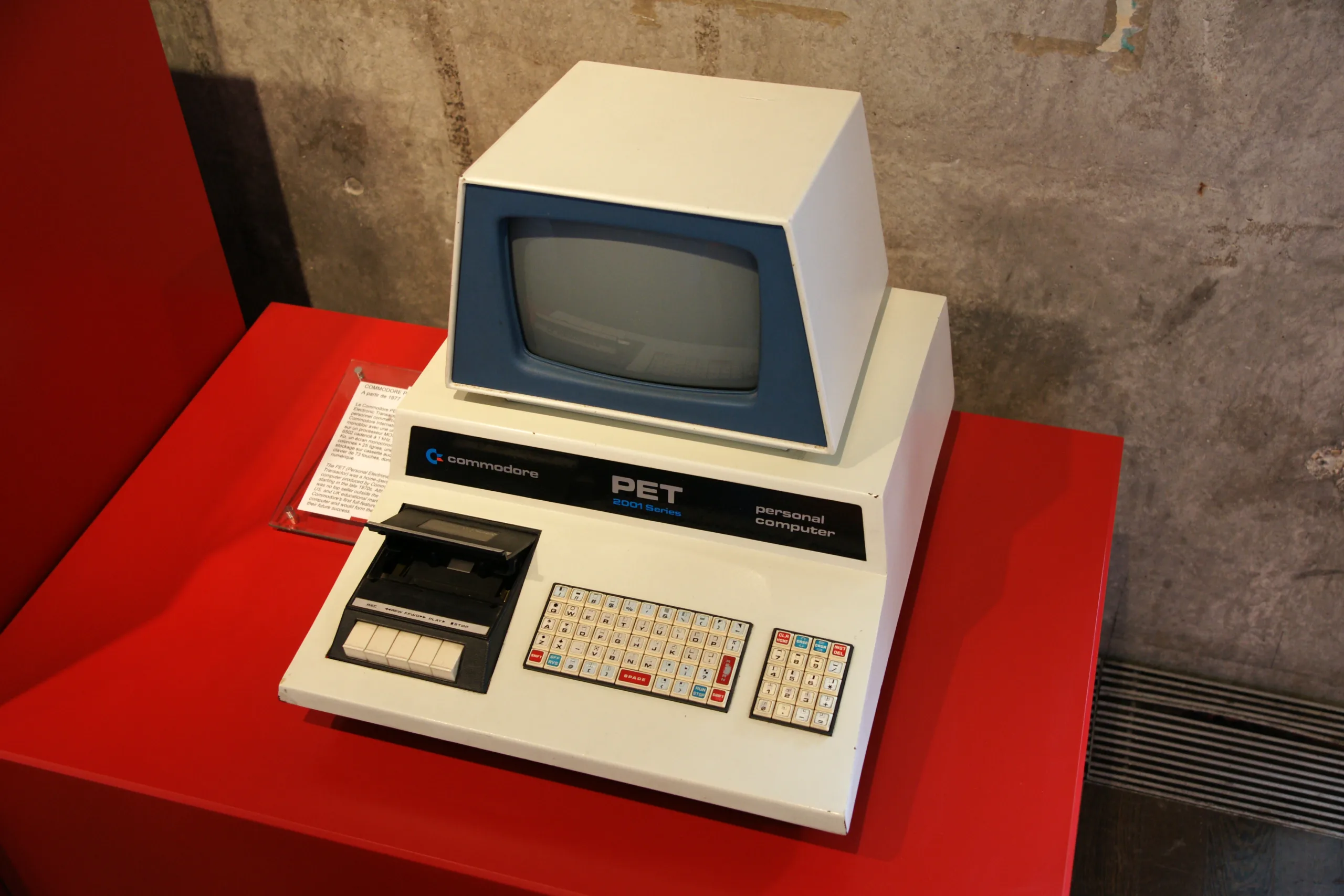
Commodore PET 2001

Photo: Jean-Christophe BENOIST, Wikimedia Commons (CC BY 3.0)

Released

1977

RAM

4 KB (2001-4) or 8 KB (2001-8), expandable to 32 KB through the memory expansion port. The 8 KB machine starts up with a “7167 BYTES FREE” message

CPU

MOS Technology 6502 at about 1 MHz

Launch price

Sources disagree slightly. The best-supported figures are US$595 for the 4 KB model and US$795 for the 8 KB model (Wikipedia gives US$795; C64-Wiki about US$800; Commodore.ca says the 4 KB was sold by mail order at US$495 before rising to US$595)

Manufacturer

Commodore Business Machines (Commodore International), USA

Form factor

All-in-one desktop: sheet-metal case with a 9-inch monochrome screen, an integrated 73-key calculator-style (“chiclet”) keyboard and a built-in cassette deck

CPU

MOS Technology 6502 at about 1 MHz

Chipset

Two MOS 6520 PIAs and one MOS 6522 VIA, with discrete TTL video logic (no dedicated video chip)

RAM

4 KB (2001-4) or 8 KB (2001-8), expandable to 32 KB through the memory expansion port. The 8 KB machine starts up with a “7167 BYTES FREE” message

ROM

Roughly 14 KB to 18 KB of BASIC, screen editor and kernal, depending on the source and the ROM set. BASIC 1.0 (“Old ROM”) on early machines, BASIC 2.0 (“New ROM”) from 1979

Graphics

Built-in 9-inch monochrome display (green phosphor per C64-Wiki; some sources say white), 40×25 text using the PETSCII character set with graphics symbols. No bitmap graphics mode

Audio

No sound chip. A minimal beeper capability driven from the VIA

Storage

Built-in Commodore cassette deck (about 750 baud effective), a second cassette port, and an IEEE-488 bus for external disk drives and printers

Ports

IEEE-488 bus, user port (6522 VIA), second cassette connector, memory expansion port

OS

Commodore BASIC 1.0, licensed from Microsoft. BASIC 2.0 fixed most of its bugs from 1979

PSU

Internal linear supply with the mains transformer inside the case. Output ratings not confirmed in the sources checked: Unknown

Units sold

About 219,000 for the whole PET line (Wikipedia). No separate figure for the 2001 alone was found. Commodore.ca says only about 500 machines were built in the first year, at roughly 30 a day

Successors

PET 4000 series (summer 1980), 8000 series (80 columns, from 1981), then the CBM-II line

  • Chiclet keyboard unreliability
    The small calculator-style keys were widely criticised as poor to type on and unreliable in use. Commodore replaced the keyboard with a conventional one within about a year, and the built-in cassette deck went with it.
  • Legends rubbing off the keys
    The key tops tended to rub off easily, so worn machines often have blank or faded keycaps.
  • BASIC 1.0 ('Old ROM') bugs
    The original ROM contained numerous documented errors. Commodore fixed most of them with BASIC 2.0 in 1979, so an Old ROM machine may need a ROM swap to behave.
  • 1977 PET 2001 shown at the January Consumer Electronics Show in Chicago; first units ship in October
  • 1977 Production is tiny: about 30 machines a day, roughly 500 in the first year
  • 1978 A conventional-keyboard version replaces the chiclet design, dropping the integrated cassette drive
  • 1979 BASIC 2.0 ("New ROM") corrects most Old ROM bugs
  • 1980 PET 4000 series arrives in the summer