MACHINE REFERENCE

Enterprise 64

The Enterprise 64 put a small joystick where the cursor keys should be, and a custom graphics chip called Nick that let every scanline of the screen choose its own resolution and colour depth. It was announced in September 1983 and had about 80,000 pre-orders by April 1984, and then it took until 1985 to reach shops.

Why it matters

The Enterprise had a 4 MHz Z80A, two custom chips (Nick for video, Dave for sound and memory paging), three sound channels plus noise and a 256-colour palette, all in a slim case. The chips were late, though. The machine did not ship until 1985, and Enterprise Computers collapsed in 1986 before its planned business machine, the PW360, could appear. Somewhere between 70,000 and 80,000 were built, and Wikipedia says the UK took no more than 25,000 of them. Most of the rest were 128K models sold overseas, and unsold stock reached Hungary in 1987, where the machine stayed on sale until about 1992.

What to check before you buy

  • Confirm the BASIC cartridge is included. The machine has no BASIC in ROM, so without the 16 KB cartridge you get very little.
  • Power it up and look for a picture on both RGB and RF outputs. Video failures are the best-documented fault, and the 78L12 regulator and nearby capacitors are the first suspects.
  • Press every key. The membrane wears, and there are no separate cursor keys to fall back on, only the integrated joystick.
  • Ask whether it is a 64K or a 128K machine. The 128 has twice the RAM and is the more common model on the continent.
  • Check the expansion slot and the non-standard joystick ports for damage, and ask what peripherals come with it.
  • Prefer a seller who can show it running a game or a BASIC program from cassette, given how few working units are listed.
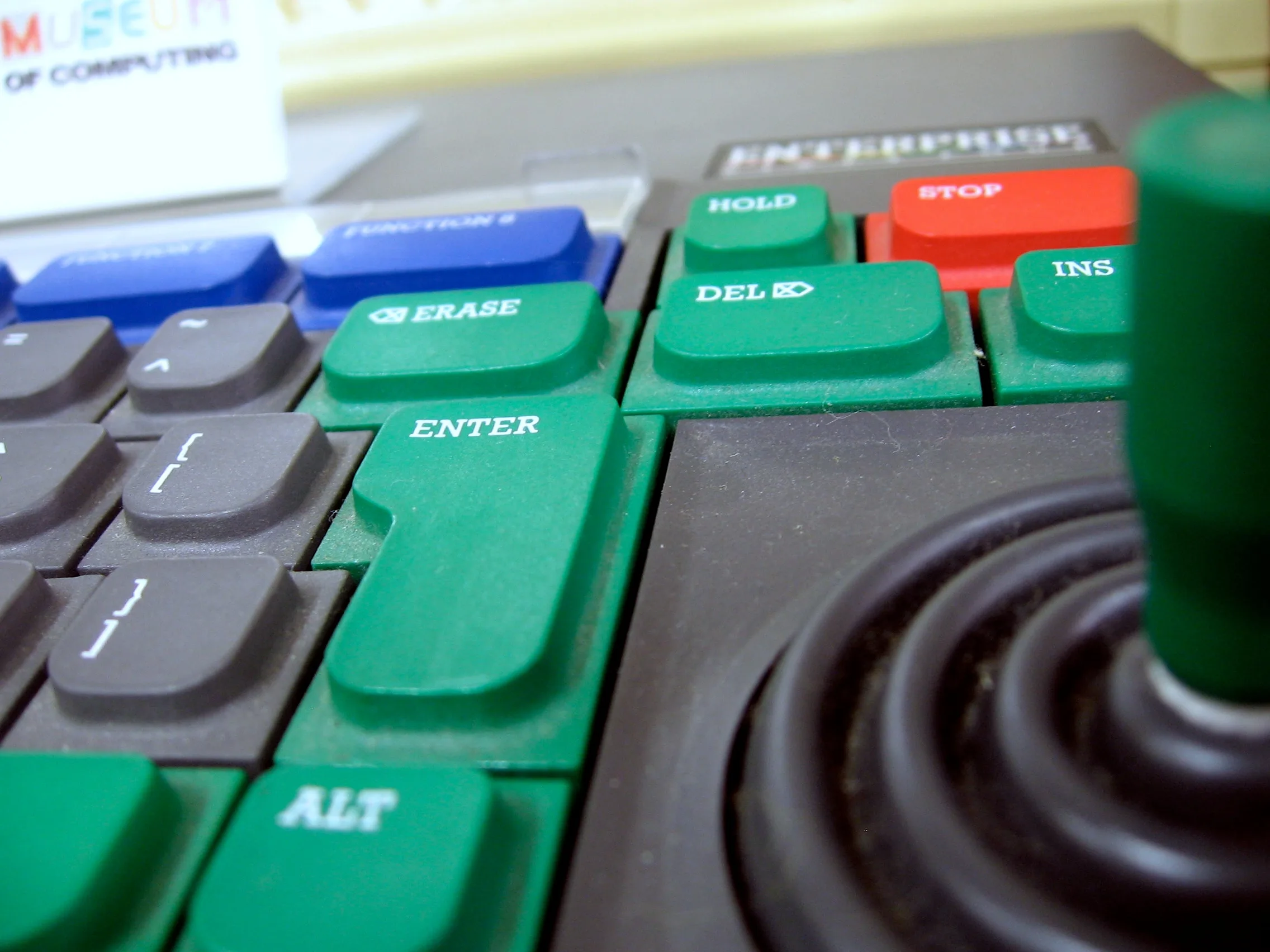
Enterprise 64 keyboard and integrated joystick, close-up

Photo: Marcin Wichary, Wikimedia Commons (CC BY 2.0)

Released

1985

RAM

64 KB (Enterprise 64). The Enterprise 128 has 128 KB. Wikipedia says bank switching allows expansion up to 4 MB

CPU

Zilog Z80A at 4 MHz

Launch price

Sources disagree. The Register says £199 originally, dropped to £180 in June 1985. Nosher.net (a Your Computer advert, April 1985) says £250 at launch against a promised £200. Best supported: about £199 to £250, with £180 after June 1985

Manufacturer

Enterprise Computers Ltd (UK). Hardware and software designed by Intelligent Software; the machine was known as the Elan in early plans

Form factor

Slim desktop home computer with an integrated keyboard, in a dark grey case with red, green and blue keys and a small joystick in place of cursor keys

CPU

Zilog Z80A at 4 MHz

Chipset

Z80A plus two custom ASICs: Nick (video, designed by Nick Toop) and Dave (sound, memory paging, keyboard scanning and serial/tape I/O, designed by Dave Woodfield)

RAM

64 KB (Enterprise 64). The Enterprise 128 has 128 KB. Wikipedia says bank switching allows expansion up to 4 MB

ROM

32 KB internal (EXOS and editor). The BASIC interpreter came on a separate 16 KB cartridge

Graphics

Nick supports a 256-colour palette. Modes include 320×256 in 16 colours and 640×256 or 640×512 interlaced in 2 colours. Each scanline can have its own resolution and colour depth. RGB and RF outputs

Audio

Three sound channels plus noise, with envelopes, ring modulation and filters

Storage

Cassette (two cassette ports). Wikipedia mentions an optional external floppy drive, but The Register says the floppy housings designed for it were never mass-produced, so disk availability at launch is unclear

Ports

RGB and RF video, Centronics printer, RS-232/RS-423 serial, two joystick ports (non-standard), two cassette ports, ROM cartridge slot and an expansion slot

OS

EXOS (Enterprise Expandable Operating System) in ROM, with IS-BASIC on cartridge

PSU

Unknown. No source found states its voltage or whether it was external

Units sold

About 80,000 shipped (Wikipedia and the Home Computer Museum). The Register says fewer than 70,000 were built, mostly 128K models sold overseas. Wikipedia says the UK took no more than 25,000. Roughly 70,000 to 80,000 is a fair range

Successors

None released. The PW360, planned as a rival to the Amstrad PCW, did not appear because the company failed in 1986. The Enterprise 128 is the sibling model

  • Black screen or no video
    One repair guide (Retro Fixer) traces a dead display to the voltage regulation: a 78L12 outputting 7 to 8 V instead of 12 V, with capacitor C9 (100 uF) and transistor TR2 most prone to failure. It also lists suspect 74LS32, 74LS86 and 74LS244 logic chips affecting RGB sync.
  • No signal on RGB or RF output
    The same site's review unit arrived with no signal on either the RGB connector or the RF output. Its fix involved checking the 8 MHz and 4 MHz clock signals around the Z80 and video logic.
  • Membrane keyboard degradation
    The low-profile membrane keyboard was criticised as uncomfortable to type on ("squishy", per Wikipedia), and the repair guide reports membrane wear as a problem. There are no dedicated cursor keys, only the integrated joystick.
  • 1983 Enterprise announced to the press in September, as a rival to the ZX Spectrum
  • 1984 About 80,000 pre-orders by the April sales launch, though the machine did not ship because the Nick and Dave chips were late
  • 1985 The 64K model ships in early 1985, followed by the 128K model in May or June. The 64K price falls to £180
  • 1986 Enterprise Computers collapses before the PW360 can appear
  • 1987 Unsold Enterprise 128 stock is imported into Hungary, where the machine stays on sale until about 1992