MACHINE REFERENCE

Texas Instruments TI-99/4A

The TI-99/4A went on sale in June 1981 at $525, half the price of the TI-99/4 it replaced, with a full-travel keyboard swapped in for the calculator-style pad that had put buyers off the original. Under the hood it was still running a TMS9900, the same 16-bit processor family Texas Instruments used in its minicomputers, at a time when most home computers on the shelf next to it were built around 8-bit chips.

Why it matters

The 99/4A was TI’s second attempt at solving a problem entirely of its own making: a genuinely capable 16-bit CPU wrapped in a console TI had deliberately hobbled with GROM-based software and a closed cartridge system, sold at a price nobody wanted to pay. Cutting the price and fixing the keyboard worked. TI was shipping around 5,000 consoles a day from its Lubbock, Texas plant by late 1982, chasing Commodore’s VIC-20 and then the C64 down to street prices under $100. It shipped roughly 2.8 million units before TI pulled out of the home computer business in March 1984, having taken a $111 million loss in a single quarter getting there.

What to check before you buy

  • Power it from a known-good original brick or a verified modern replacement. The internal PSU board expects 8V and 16V AC input, and wrong voltages have taken out logic chips on more than one forum thread.
  • Ask about a recap. The power supply board's electrolytic capacitors are original-spec 1981-83 parts and a common source of no-power or wrong-voltage faults after four decades.
  • Check for screen corruption or a picture that degrades after the first minute of use. Both point at either failing 4116 DRAM or a drifting video clock capacitor, two of the most commonly reported faults.
  • If unlicensed or homebrew cartridges matter to you, check the title screen: consoles marked "(C)1983 TEXAS INSTRUMENTS V2.2" carry the later cartridge lockout chip.
  • Cartridge and Peripheral Expansion Box card contacts oxidise with age; a "no response" cartridge is often a cleaning job, not a dead board.
  • If buying a Peripheral Expansion Box setup rather than a bare console, confirm which cards are fitted and tested. The box and its disk/memory expansion cards are sold and priced separately from the console itself, and a bare console won't get you past 8 KB of usable RAM.
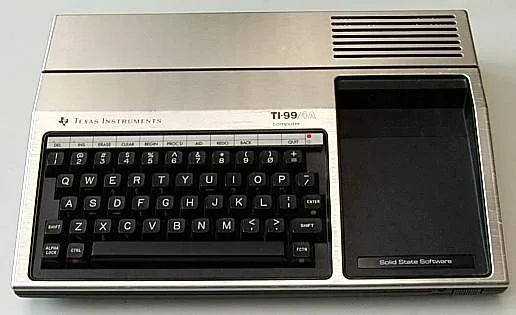
Texas Instruments TI-99/4A

Photo: SanderK, Wikimedia Commons (Public domain)

Released

1981

RAM

16 KB VDP RAM plus 256 bytes of 16-bit scratchpad RAM built into the CPU; 8 KB of general RAM as shipped, expandable to 24 KB (some sources say up to 52 KB) with a 32 KB memory expansion card fitted to the Peripheral Expansion Box

CPU

TMS9900, 16-bit. Sources give both 3.0 and 3.3 MHz; 3 MHz is the figure most consistently cited by Wikipedia and technical references, so treated as best-supported

Launch price

US$525 (June 1981)

Manufacturer

Texas Instruments

Form factor

All-in-one keyboard console (no built-in display or storage), external RF/composite video out

CPU

TMS9900, 16-bit. Sources give both 3.0 and 3.3 MHz; 3 MHz is the figure most consistently cited by Wikipedia and technical references, so treated as best-supported

Chipset

TMS9918A (NTSC) / TMS9929A (PAL) video display processor; TMS9919 sound generator (later revisions used the pin-compatible SN94624, electrically identical to the SN76489)

RAM

16 KB VDP RAM plus 256 bytes of 16-bit scratchpad RAM built into the CPU; 8 KB of general RAM as shipped, expandable to 24 KB (some sources say up to 52 KB) with a 32 KB memory expansion card fitted to the Peripheral Expansion Box

ROM

8 KB console ROM (monitor and GPL interpreter) plus 18 KB of GROM (6 KB OS support, 12 KB TI BASIC)

Graphics

16 fixed colours (15 visible plus transparent); text mode 40×24 characters; graphics mode 32×24 with full palette; bitmap mode 256×192 pixels; 32 single-colour hardware sprites, 8×8 or 16×16 pixels, maximum 4 per scanline

Audio

3 square-wave tone channels plus 1 noise channel, roughly 110 Hz to 115 kHz range

Storage

Cassette tape via a custom format (supports two drives for verify/backup), ROM cartridges, and 5.25-inch floppy disk via an add-on disk controller card and the Peripheral Expansion Box

Ports

Single 9-pin joystick port (splits to two joysticks), 9-pin DIN cassette port, 5-pin DIN video out on NTSC units (7-pin DIN on PAL units), external PSU input, cartridge slot on the console top, 44-pin side expansion port for the Peripheral Expansion Box

OS

TI BASIC, a GPL-based interpreter built into ROM/GROM; Extended BASIC, UCSD Pascal (via a P-code card) and assembly (via the Editor/Assembler cartridge, 1982) available as add-ons

PSU

External transformer brick supplying 8V AC and 16V AC to an internal power supply board, which regulates this to +12V DC, +5V DC and -5V DC for the logic board

Units sold

Approximately 2.8 million units shipped worldwide before discontinuation

Successors

None released. The TI-99/2 and TI-99/8 were both developed but cancelled in 1983 before launch, and TI exited the home computer market in March 1984

  • Video clock capacitor drift
    A ceramic capacitor in the video clock circuit goes out of tolerance as it warms up, producing a clear picture for the first 30-45 seconds after power-on before the image breaks up or rolls.
  • 4116 DRAM failure
    The 4116 dynamic RAM chips are a common failure point with age, causing screen corruption, "dirty" or garbled characters, or a console that will not boot past a blank or distorted screen.
  • Power supply capacitor ageing
    The electrolytic capacitors on the internal power supply board degrade over decades, leading to incorrect regulated voltages, a console that will not power up, or, in worse cases, damage to logic chips from an out-of-spec rail. A "recap" of the PSU board is a common preventative repair.
  • 1979 The original TI-99/4 launches at $1,150 with a calculator-style keyboard and poor sales, around 20,000 units
  • 1981 The TI-99/4A launches in June at $525, with a full-travel keyboard and a simplified, cheaper internal design
  • 1982 A price war with Commodore's VIC-20 and C64 drives the console's price down from $449.95 to under $100, with TI shipping around 5,000 units a day from its Lubbock, Texas factory at the peak
  • 1983 TI adds a cartridge lockout chip to late-production consoles and posts a $111 million quarterly loss
  • 1984 TI discontinues the TI-99/4A in March, having shipped roughly 2.8 million units and abandoned the planned TI-99/2 and TI-99/8 successors