There was a dog in the building before there was a computer. Jay Miner’s cockapoo, Mitchy, had the run of Atari’s engineering labs through 1977 and into 1978, trotting between desks while her owner designed the chips for what was supposed to be a simple enough job: a successor to the Atari 2600, something to keep the games coming once the VCS started to look old. Nobody in that lab set out to build a home computer. That decision got made somewhere else entirely, by a man who had spent his career in towels.
A textile man walks into a chip lab
Ray Kassar arrived at Atari in 1978 from Burlington Industries, brought in by Warner Communications not long after Warner eased founder Nolan Bushnell out the door. The culture clash was immediate. Engineers who wore jeans and kept their own hours now answered to a textile executive. In his opening speech Kassar said he had worked with designers for years, and Craig Maloney’s history of Atari has an engineer whispering ‘towel designers’. Kassar soon branded them ‘high-strung primadonnas’. The engineers printed the phrase on T-shirts.
Whatever Kassar said in those first weeks, what he did is well documented: he looked at a console project already well underway and told the team to turn it into a full computer.
Candy, Colleen and a rumour that wouldn’t die
That console project already had names. Jay Miner, Joe Decuir, Steve Mayer and Larry Nicholson had spent months on custom silicon for two machines, internally codenamed Candy and Colleen after two of Atari’s administrative assistants. For decades afterwards, a rumour did the rounds that the names had been picked for rather less professional reasons. Joe Decuir eventually put that to rest himself, in a 2015 interview with Kevin Savetz: Atari’s marketing department had simply supplied the two names to engineering as project labels, nothing more. Two women worked in the building, somebody needed a pair of codenames, and that was that.
Management had identified two market segments and gave each a codename: Candy for the low end, Colleen for the higher. Colleen was always going to be a computer. It had expansion slots and a full keyboard. Candy began as a game machine, and the plan changed during development.
The computer nobody in the building wanted to build
Turning Candy and Colleen into computers rather than glorified game players was not a popular order. Kassar wanted them built to go head-to-head with the Apple II, the TRS-80 and the Commodore PET, serious machines sold into a market Atari had never touched. Plenty of engineers on the project thought it was the wrong fight. Games were the business that had made the company’s name. Computers belonged to somebody else’s industry, one with its own software, its own retailers, its own idea of what a customer wanted. Kassar had no real interest in that argument. He wanted Atari into computers, and he wanted it before the window closed.
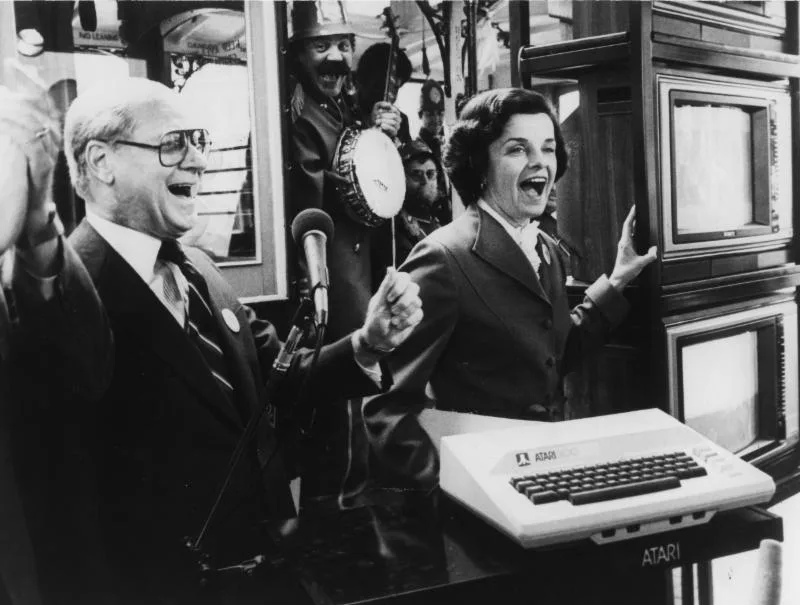
Atari showed preliminary prototypes at a press conference in December 1978 and again at the Winter CES the following January, well before either machine was ready to sell. Journalists who saw them came away unconvinced that a games company could be taken seriously next to Apple’s and Commodore’s existing computer lines. Atari shipped anyway, nearly a year later, betting that custom silicon would do the convincing that the company name couldn’t.
A date in December and a delay to November
The announcement itself was a New York press conference on 14 December 1978, with a game of Basketball as the hands-on demonstration. The 400 was quoted at $500 with 4 KB of RAM. The 800 was $1,000 and came as a bundle: an 8 KB operating system module, a 4 KB RAM module, the 410 program recorder, four joystick controllers, Basketball and BASIC cartridges. Printers and disk drives were already designed, and Atari was talking about hooking the machines up to Warner Amex’s QUBE cable television system in Columbus, Ohio.
Atari pitched the 400 at the home, with a touch keyboard, and the 800 at business, with a standard ASCII keyboard. Shipping was pencilled in for 1 August 1979. It happened in November. In between, the Atari booth at the West Coast Computer Faire in May 1979 was described as ‘perpetually mobbed’, so the shortage of interest wasn’t the problem. The sources I’ve read don’t explain the delay, and I’d rather say so than invent a reason.
Elizabeth, the machine that never was
Before the line settled into just two machines, there was briefly a third. Codenamed Elizabeth, it would have shared Colleen’s electronics but lived inside a cabinet with its own built-in 13-inch colour monitor, a genuine all-in-one computer years before that idea felt remotely ordinary. Elizabeth never made it off the drawing board, and whatever killed it left behind nothing but a name and a spec sheet.
Two machines, two very different promises
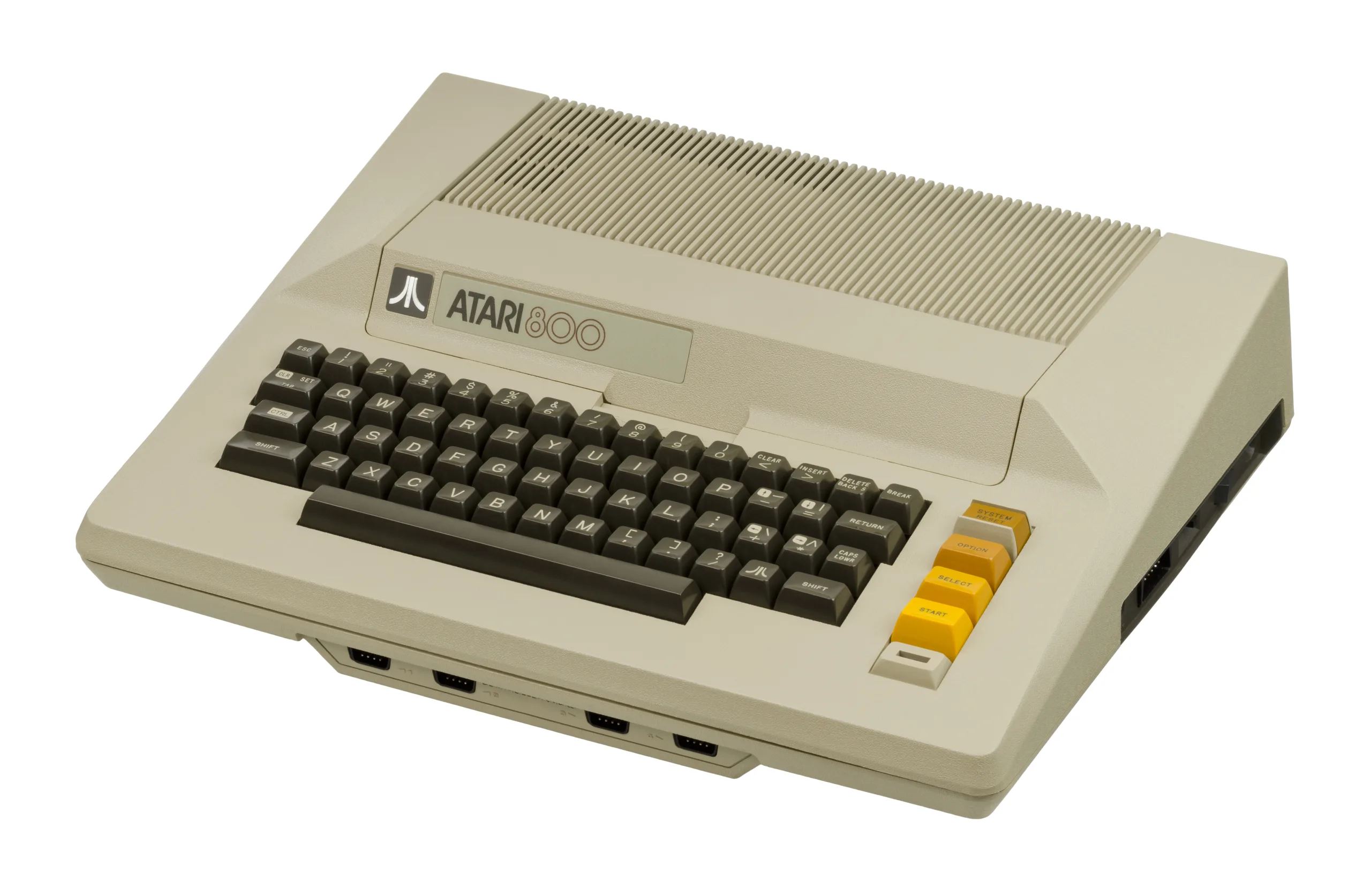
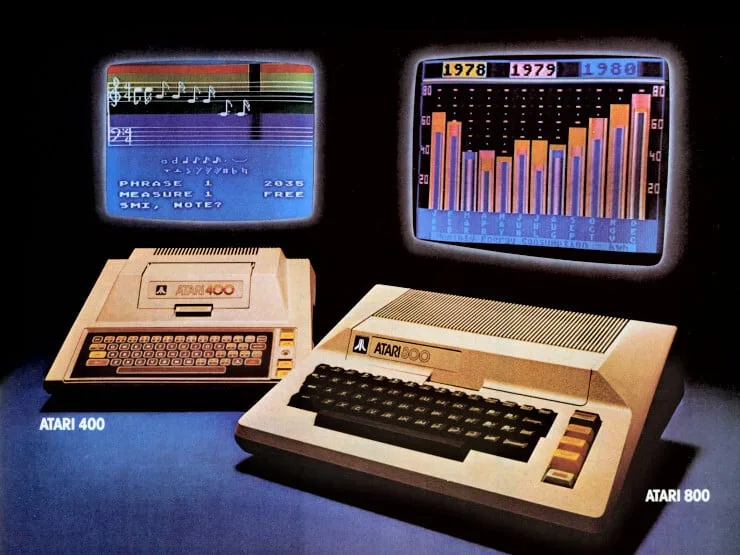
What actually reached shops in late 1979 was the Atari 400 and the Atari 800, and each one wore its audience on its casing. The 400 was the cheap one. It had a membrane keyboard sealed against spilt drinks and memory fixed at 8K or 16K, and it was built for a coffee table, not a desk. The 800 was the serious one. It had a full mechanical keyboard, two internal expansion slots that took it to 48K and an operating system in a cartridge slot under the lid. Both ran on a 6502, the same chip family as the Apple II. The computer had to earn its place elsewhere.
The numbers on the casing have two explanations, and the sources don’t settle which came first. Wikipedia says the model numbers originally reflected memory, 4 KB for the 400 and 8 KB for the 800, until falling RAM prices put 8 KB in both by release. A second version, repeated in several retellings I couldn’t trace to a primary source, ties them to the price tags, $400 and $800. Neither survived contact with the shops. At the December 1978 announcement the quoted prices were about $500 and $1,000, and when the machines shipped in November 1979 they cost around $550 and $1,000.
The machines were still on sale in Britain in 1983. In June of that year A.G.F. Hardware ran a mail-order advert in Your Computer listing the 400 with 16K at £159, the 400 with 48K at £228 and the 800 with 48K at £349.
Three chips doing the work of one
The reason the 400 and 800 felt like more than a dressed-up console was custom silicon, not raw processor speed. ANTIC managed the display. It pulled graphics straight out of memory on its own and left the 6502 free to get on with everything else. CTIA, and later the improved GTIA on later production runs, turned that data into colour and ran the hardware sprites that made Atari’s arcade conversions look like arcade conversions. POKEY did sound, paddles and the keyboard. Miner’s reasoning was simple. If the main processor can’t outrun the competition, stop asking it to do the competition’s job.
What the casing hid
The hardware around those chips aged less gracefully. The 800’s mechanical keyboard had a habit, years on, of sticking under the QWERTY row, because the plastic key sleeves split at the corners from ordinary use. The 400’s spill-proof membrane keyboard cracked along its mylar ribbon with age, and whole rows of keys stopped registering. Dried-out capacitors are common on the bench.
The silicon kept its own secrets too. Somewhere inside the Atari 800 port of Donkey Kong, programmer Landon Dyer buried his initials, activated only by an absurdly specific chain of conditions involving an exact score, a particular way of losing the final life, and a difficulty switch set just so. Nobody found it until 2009, 26 years later.
The dog that outlived the console
Warner’s management style did not improve with time, and by 1979 several of Atari’s best chip designers had had enough of being treated as interchangeable with anyone else who could hold a soldering iron. Jay Miner was one of them. He left, and years later did it again at a company most readers will already know, designing the custom chips behind the Commodore Amiga. He brought the same philosophy that had shaped Colleen and Candy, dedicated silicon doing the heavy lifting so the main processor didn’t have to, and built something that would go on to make Atari’s own machines look slow.
Mitchy made the trip too, in spirit if not literally. Open the case of an original Amiga 1000 and, on the underside of the lid, alongside the engineers’ own signatures, there’s a small paw print pressed into the plastic. It’s hers. The dog that watched Atari talk itself into building a computer it never planned on making ended up, years later, signing off on the machine that would embarrass it.
Atari’s pivot worked, in the narrow sense that an order from the top of a company tends to ‘work’ once nobody is left with the option to refuse. The 400 and 800 sold. The 400 outsold the 800 two to one. Wikipedia puts the family’s total at two million machines between late 1979 and mid-1985. They carved out a real slice of a market Atari had no business being good at. The cost was its engineers. More than one walked straight out of the door to a rival that would do it all again, better.