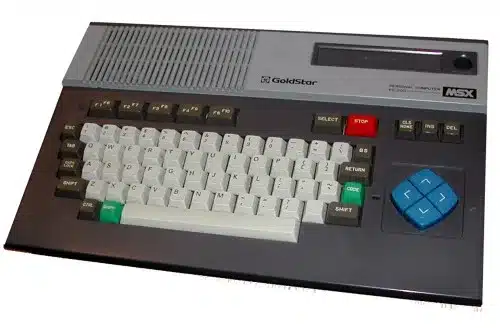
Sat in a display case in Cambridge, wedged between a Dragon 32 and a machine nobody can quite place, there’s a computer wearing a logo you already know. It isn’t red. It doesn’t fold in half or stream anything. But the confident little wordmark stencilled across the lid reads, unmistakably, GoldStar. Squint a little and that’s basically LG wearing a different jacket.
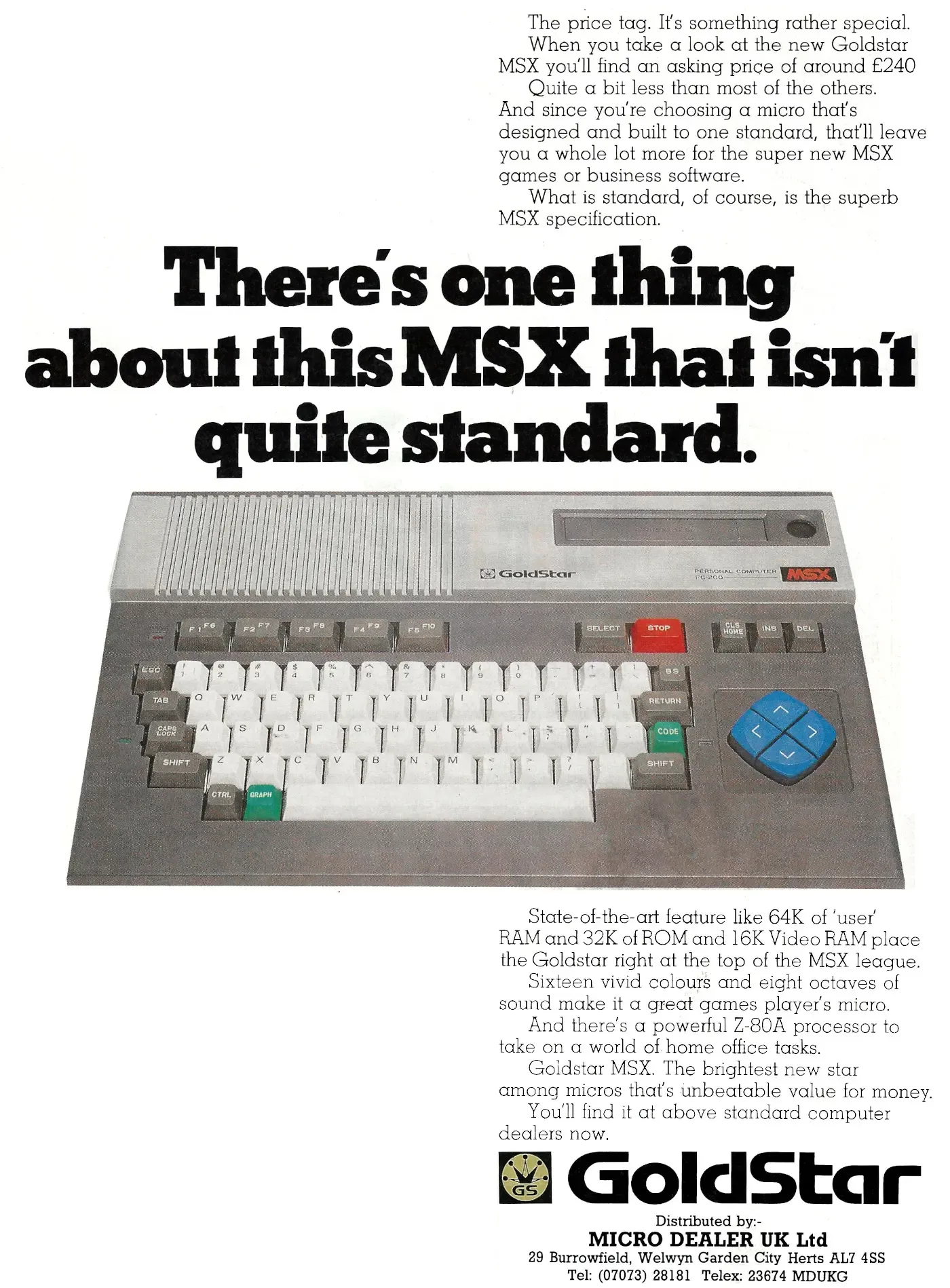
Except in May 1984, when this thing went on sale in Britain for £230, there was no LG. There was only Goldstar, a Korean radio-and-television manufacturer trying to prove it could build a home computer good enough to sell into a continent that had never heard of it.
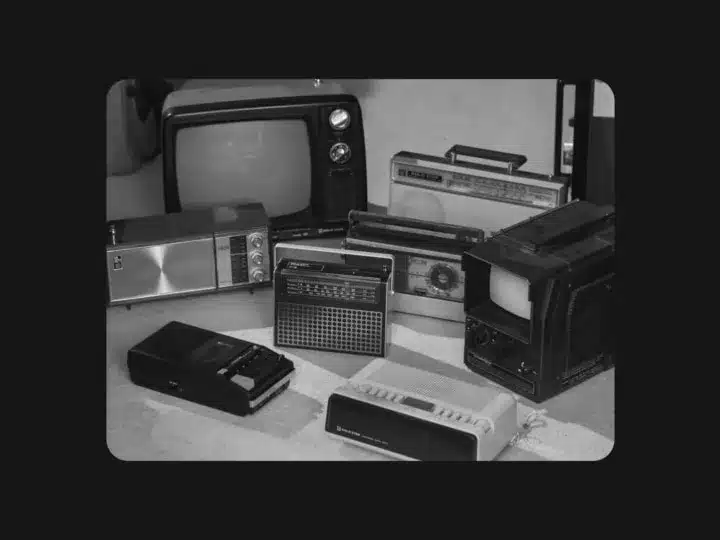
A logo you’d recognise, on a machine you wouldn’t
Goldstar had been around since 1958, building radios in Seoul before working its way up through televisions, air conditioners and the kind of consumer electronics that made it a household name across Asia and, increasingly, the United States. By the early 1980s it was one half of the Lucky-Goldstar group, a sprawling South Korean conglomerate with chemicals, cables and consumer goods all under one roof.
The rename most people remember happened on 28 February 1995, when Lucky-Goldstar restructured itself into LG Group. But the GoldStar brand itself didn’t vanish overnight. It kept turning up on products for years afterwards, and the original corporate entity wasn’t formally wound up until 2002. It was less a rebrand than a slow fade, the sort of thing that happens gradually and then, looking back, seems to have happened all at once.
Which makes the FC-200 a genuinely odd artefact: a computer built by a company you’d now call one of the longest-surviving names in consumer electronics, sold under a brand it would spend the best part of two decades quietly retiring.
Korea’s answer to a Japanese standard
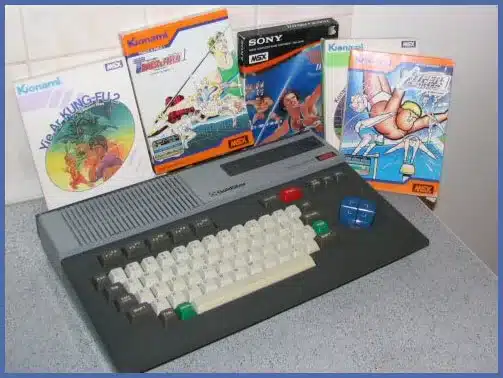
By 1983, Goldstar had a problem shared by half the electronics industry: Japan had just agreed on MSX, a common hardware standard backed by Microsoft and Kazuhiko Nishi, and every manufacturer with a stake in home computing needed a machine that spoke it. Goldstar’s answer started at home with the FC-80, a Korean-market MSX1 machine with a Hangul indicator LED and a silver case built for a domestic audience.
The FC-200 was what happened when that machine got a passport. Strip out the Hangul LED, swap the case colour, add an international QWERTY layout, and you had a computer ready to sell into Europe: first through a Dutch distributor, then, by the summer of 1984, into Britain.
What’s actually inside the box
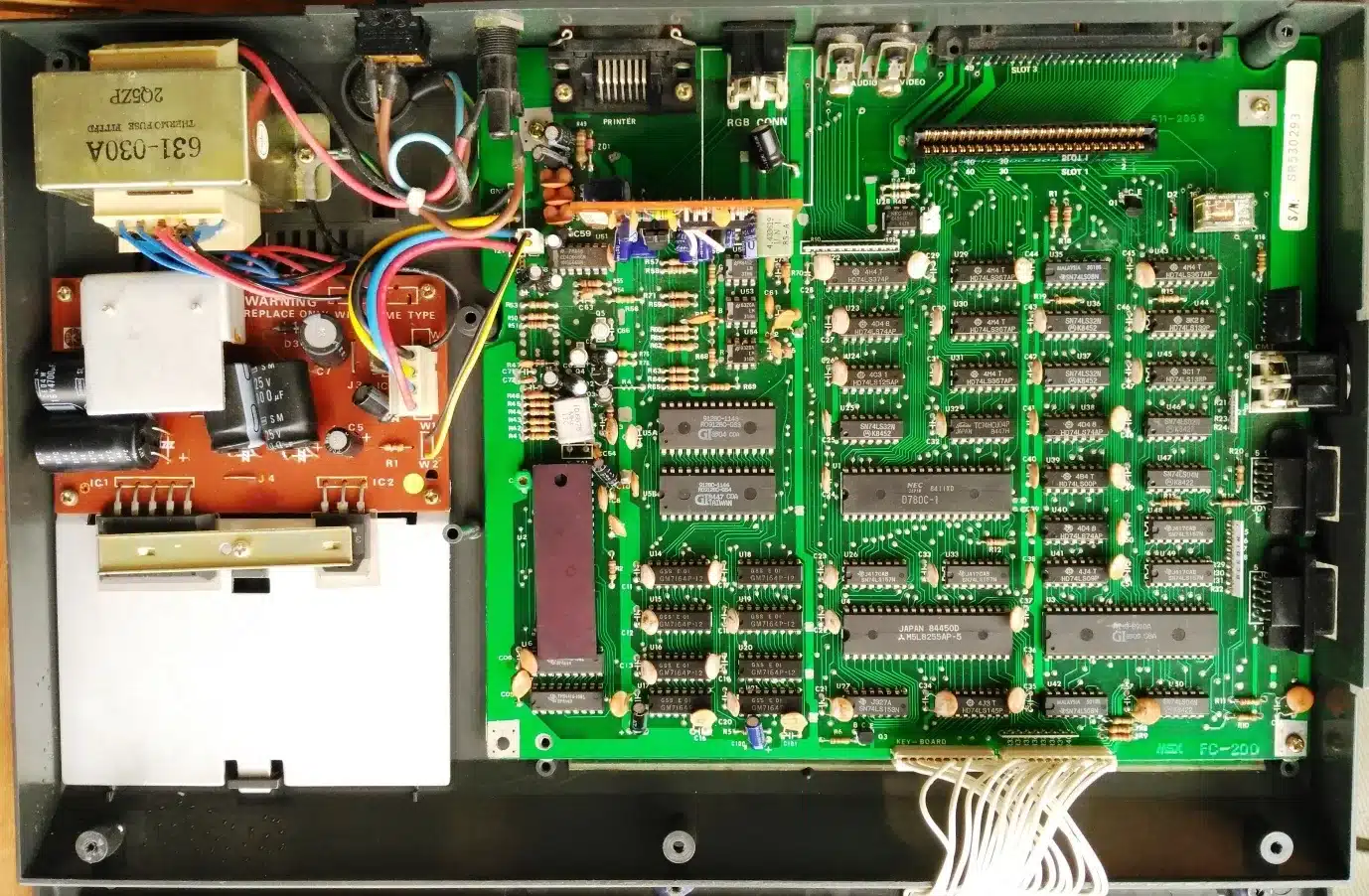
Open the case and the FC-200 reads like a fairly textbook MSX1 machine, which is rather the point of a standard. A Goldstar-badged Z80A clone, the GSS Z8400A PS, runs the show at 3.58 MHz. Graphics come from a Texas Instruments TMS9929NL, giving the usual MSX1 spread of 256 by 192 pixels, sixteen colours and thirty-two hardware sprites. Sound is a General Instrument AY-3-8910, three channels plus noise, the same chip doing duty in half the machines of the era.
Memory is where the FC-200 gets slightly eccentric: 64 kilobytes of RAM spread across eight separate chips, 16 kilobytes of dedicated video RAM on two more, and 32 kilobytes of ROM holding Microsoft’s MSX BASIC 1.0. Nothing here needed eight RAM chips. Somebody at Goldstar simply built it that way, and it worked, so nobody changed it.
The keyboard is a proper mechanical affair, 73 keys, with five function keys and five dedicated BASIC command keys — SELECT, STOP, CLS/HOME, INS, DEL — lined up along the top like a row of shortcuts nobody today would think to include.
A power supply built like it’s expecting trouble
Pop the lid and the first thing that strikes you is the power supply, which is enormous: a fully internal mains unit that dwarfs the equivalent components in rival MSX machines. Whatever the press made of it at the time, it’s the kind of decision that reads two ways: either nobody at Goldstar trusted the mains supply they were plugging into, or nobody had told the power supply team to be economical with space. Both are entirely plausible for a Korean export product landing in an unfamiliar market.
The cartridge slot, mounted on top rather than the side, has its own small piece of over-engineering: automatic cut-out switches wired to the rear expansion bus, there specifically to stop you shorting anything if you swapped cartridges with the machine powered on. And digging into the ROM itself turns up something else: MSX preservation and emulation projects have found the FC-200’s firmware differs from a Casio MX-15’s by just eleven bytes, and sits close enough to a Panasonic CF-2700’s to suggest all three were built from the same underlying OEM firmware. Three different badges, one shared brain.
Cheap, and not embarrassed about it
At £230, the FC-200 undercut plenty of the MSX competition without much fuss. Yamaha’s CX5M, for comparison, ran to £534, more than double the price for a machine chasing the same standard. It made its European debut through the Dutch distributor AVT Electronics, briefly wearing an AVT badge before Goldstar’s own name went back on the case, and by late 1984 it had found its way into British shops too.
Whatever the exact date, the pitch was straightforward: a genuine 64-kilobyte MSX machine, built by a company that already knew how to manufacture consumer electronics at scale, for less money than almost anyone else was asking.
The lightpen that never turned up
Look at the case next to the cartridge slot and you’ll find a moulded compartment that serves no purpose whatsoever on any surviving FC-200. It’s a dock, shaped and ready, for a lightpen that Goldstar apparently planned and then simply never released. Nobody photographed a prototype. Nobody wrote a review of it. It just sits there today, a small architectural promise the company never got around to keeping. It’s the sort of detail that would be a footnote on a bigger machine, and is instead one of the more charming things about a small one.
Where it actually landed
In Britain the FC-200 did what most also-ran MSX machines did: sold in modest numbers to buyers who’d decided the standard itself was worth backing, then got quietly overtaken as the market’s attention drifted towards 16-bit machines that didn’t exist yet but were already being talked about.
Turkey tells a more interesting version of the same story. Rebadged as the Vestel GoldStar FC-200 by the local electronics firm Vestel, the machine turned up in Turkish homes and school labs at exactly the moment two homegrown computers, the Uslu and the Boncuk 09, were losing their fight to survive. As the software engineer and retro-computing collector Koray Biçer recalled in a 2025 essay about his own childhood introduction to computing, the FC-200 arrived in Turkey as part of the same wave that ended that fight for good, alongside the ZX Spectrum 48K, the Commodore 64 and the Atari 800XL: cheap mass-produced imports that buried the dream of Turkish-designed computers under sheer volume. This time, the FC-200 won. It was one of the imports doing the burying, not one of the machines buried.
The company that outgrew its own computer
Nobody at Goldstar in 1984 was thinking about legacy. They were thinking about shifting units of a Korean-built MSX machine into a European market that didn’t much care where its computers came from, as long as the price was right and the BASIC worked. They succeeded, modestly, and moved on.
Four decades later, the company is one of the oldest continuously operating names in consumer electronics anywhere in the world, and almost nobody buying an LG television has the faintest idea it once built a beige computer with a mechanical keyboard and a power supply the size of a house brick. The FC-200 didn’t change anything. It’s just proof that the company behind your fridge magnet spent its adolescence doing exactly what every other electronics manufacturer of the era was doing: trying to work out what a home computer was even for, one cheap, over-engineered box at a time.