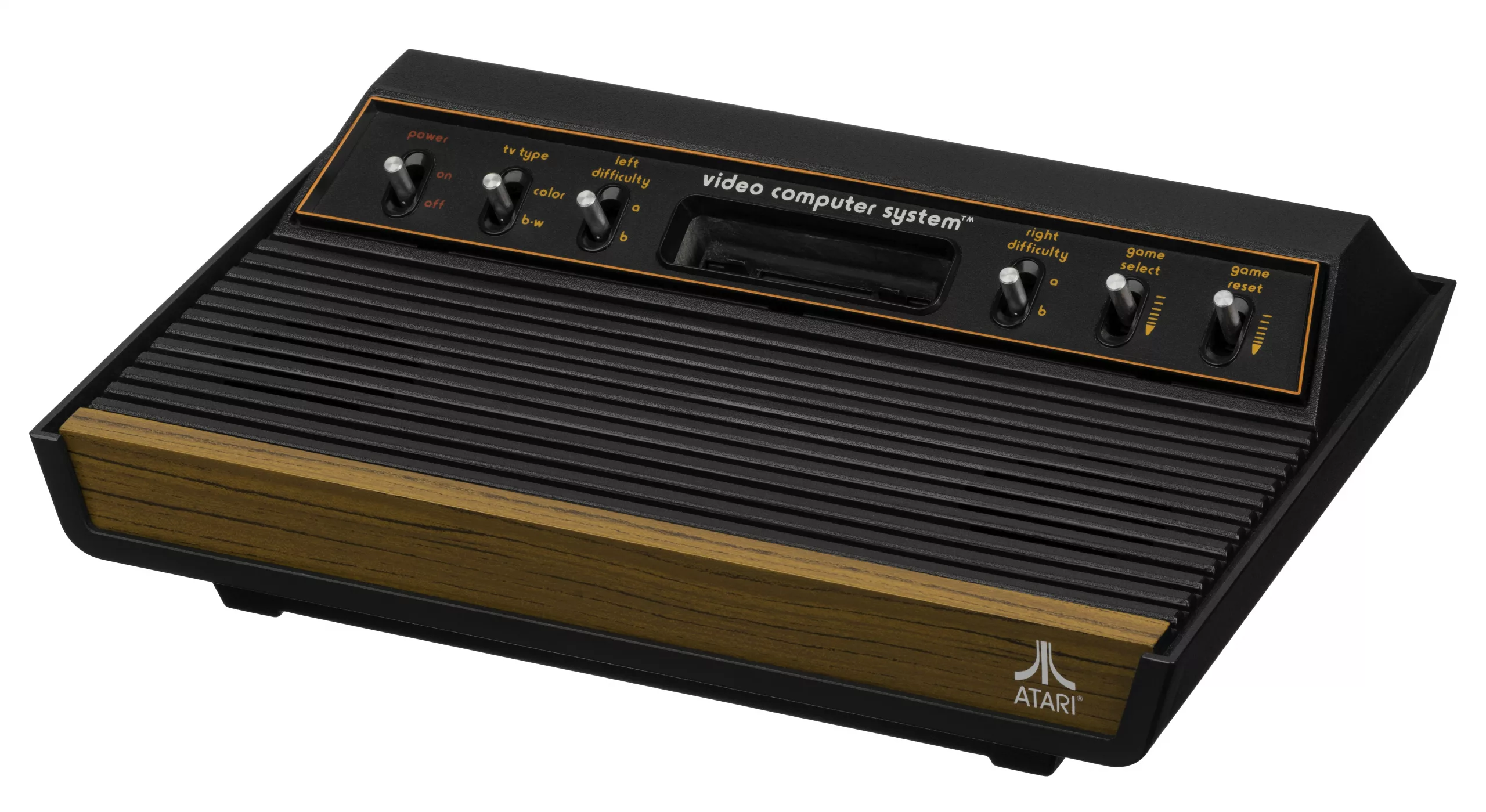
Atari released the Video Computer System in September 1977 at $199. It was a cartridge-based home console built on a cost-reduced MOS Technology 6507 and 128 bytes of RAM, sold with two joysticks, a pair of paddles and a copy of Combat. For two years it sold badly enough that Atari’s own founder wanted it scrapped. Then Rick Maurer’s conversion of Space Invaders reached shops in March 1980, console sales quadrupled, and the cartridge slot became the shape of home gaming for the next twenty years.
- CPU: MOS Technology 6507 at 1.19 MHz (NTSC)
- RAM: 128 bytes, held in the RIOT chip
- Graphics and sound: Television Interface Adaptor (TIA), designed by Jay Miner
- Launch price: $199 USD (1977), including Combat and four controllers
- Production run: 1977 to 1992, roughly 30 million units sold
The sums that kept coming out wrong in Grass Valley
A couple of hours from Atari’s Sunnyvale offices, up in the Sierra foothills, sat a small electronics outfit called Cyan Engineering. Steve Mayer and Larry Emmons had founded it. Atari bought it in 1974 and used it as a private research shop, far enough away from the arcade business that the people there could think about something other than the next coin-op cabinet.
What Mayer and Ron Milner wanted to think about was a console you could reprogram. Every home video game machine on the market in 1975 played whatever had been soldered into it and nothing else. Put a microprocessor in the box instead and the box could play anything anyone cared to write for it. The idea was obvious. The arithmetic was brutal: microprocessors ran from $100 to $300 each, which was more than Atari intended to charge for the entire finished product.
Then, in September 1975, MOS Technology put the 6502 on the table at $25 and the sums changed overnight.
Mayer and Milner went to see Chuck Peddle, who had designed the thing, and did what engineers do in front of a whiteboard. Peddle then did what good chip salesmen do, which is offer them something cheaper than the part they came in asking for. The 6507 was a 6502 with its legs cut off: twenty-eight pins rather than forty, thirteen address lines rather than sixteen, no interrupt pins at all. It could see 8KB of address space and not a byte more. Paired with a RIOT chip carrying the RAM, the timer and the I/O, Peddle quoted the two together at around $12.
By December 1975 Atari had hired Joe Decuir, fresh out of Berkeley, to debug the first prototype. That prototype acquired a codename the way most prototypes do, which is to say carelessly and then permanently. Decuir rode a Stella bicycle to work, so the machine became Stella. People were still calling it Stella fifteen years later.
In March 1976 Jay Miner delivered the part that made the whole thing possible, and the part that would torment everyone who ever wrote code for it.
Why the TIA had no screen, and what that did to the people who wrote for it
RAM in 1976 cost tens of thousands of dollars per megabyte. A frame buffer, a block of memory holding a picture of what the television should display, simply could not be bought at a $199 price point. Even a two-colour 80 by 48 display would have run to thousands of dollars in memory alone.
So Miner built a chip that holds no picture at all. The Television Interface Adaptor draws one scanline, right now, from whatever values happen to be sitting in its registers at the instant the beam passes. What it hands the programmer is thin: two eight-pixel player sprites, two missiles, one ball, and a twenty-bit playfield register that can be mirrored or repeated to fill forty bits of screen width. Two sound channels, each with a five-bit frequency divider and four-bit volume control. 128 colours on NTSC, 104 on PAL.
The consequence is the thing 2600 programmers still sound faintly haunted about. There is no screen inside a 2600. There is a beam crossing a television, and a processor with a few dozen machine cycles of horizontal blanking in which to load the right values into the right registers before the next line starts. The TIA holds the 6507 on its RDY pin until that line begins, which keeps everything in step but also means the CPU spends much of its life waiting for a television set to catch up. Miss the window and the picture tears in front of the customer.
Rick Maurer, who later wrote the port that rescued the machine, described programming it as having to unlearn every good programming practice you have learned. He was not being unkind. Games on the 2600 have no main loop in any sense a modern developer would recognise. They have a display kernel that must be cycle-counted by hand, and the actual game logic gets whatever cycles are left over during vertical blank. That anyone got Adventure or Pitfall out of 128 bytes of RAM and a chip with no memory of what it had just drawn is, to me, the most impressive thing about the entire machine, and it is worth saying plainly before any of the boardroom business that follows.
Fairchild got there first, and Jerry Lawson rarely got the credit
Atari did not invent the cartridge. Fairchild did, and it shipped in November 1976, nine months ahead of the VCS.
The Channel F was designed under Jerry Lawson, Fairchild’s head of engineering for video games and one of very few Black engineers working in semiconductors at the time. Lawson’s team put game code on ROM chips inside removable plastic housings they called Videocarts, and built a console around a Fairchild F8 processor to read them. Everything the 2600 is architecturally famous for, Lawson’s machine had already done.
What Fairchild did not have was Atari’s software catalogue, or Atari’s name on a decade of arcade cabinets. The Channel F lost ground steadily through the late seventies and never recovered it. The cartridge slot on the front of the VCS was Atari’s answer to a question Fairchild had already asked, answered, and largely failed to profit from. There is a small irony in the fact that Rick Maurer came to Atari from Fairchild Semiconductor.
Warner bought the company, then had to keep paying for it
Atari came out of 1974 in poor financial shape, and the Magnavox patent litigation did not help. Settling it cost money Atari did not comfortably have. In October 1976, with Stella still a prototype, Nolan Bushnell sold Atari to Warner Communications for $28 million.
Warner then put an estimated $120 million behind the console to get it out of the door on schedule. This is the part of the story where the corporate money is genuinely the hero, which happens rarely enough that it is worth stopping on. Cyan’s engineers had the idea and the silicon. What they did not have was the tooling budget or the retail muscle to put a microprocessor in a wood-veneer box on an American shop shelf by the autumn of 1977. Warner did.
What Atari actually put on the shelf in September 1977
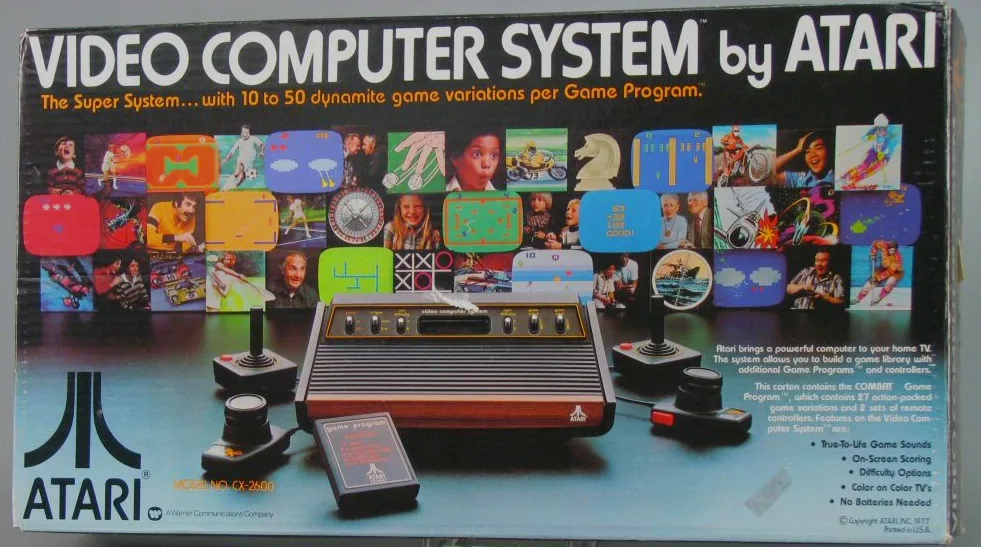
$199, and for that you got the console, two joysticks, a pair of paddle controllers and a cartridge of Combat.
The launch catalogue ran to nine titles: Air-Sea Battle, Basic Math, Blackjack, Combat, Indy 500, Star Ship, Street Racer, Surround and Video Olympics. A line-up containing a game called Basic Math tells you how uncertain everybody still was about what this machine was for. The word ‘Computer’ in ‘Video Computer System’ was doing real marketing work. In 1977 nobody was confident a games-only device could justify $199 to a parent, so the box hinted at homework.
Sears got its own badge-engineered version, the Tele-Games Video Arcade, and Sears units were in production from July 1977.
The two Christmases that nearly finished the VCS
It did not work. Not at first, and not for long enough that reasonable people inside Atari concluded it never would.
The 1977 season moved somewhere between 350,000 and 400,000 units. Retailers did not understand cartridges, and neither did customers, who had been trained by a decade of Pong clones to expect the games to be inside the machine already. 1978 was worse in the way that matters to a balance sheet. Atari manufactured around 800,000 consoles and sold about 550,000 of them. That leaves a quarter of a million wood-veneer boxes sitting in warehouses over Christmas, and Warner writing more cheques.
Nolan Bushnell drew the obvious conclusion. He argued that the VCS had missed its moment, that Atari should stop pouring money into it and build a successor instead. Warner disagreed, loudly. Ray Kassar, who had spent twenty-six years in textiles at Burlington Industries before joining Atari’s consumer division as president in February 1978, thought the machine had simply not been given the right software yet.
Bushnell was gone by the end of 1978, and Kassar took the chief executive’s chair in November of that year.
Here is the uncomfortable part for anyone who likes their history tidy. The founder, the engineer, the man who built Pong, was wrong. The textiles executive was right.
How Space Invaders quadrupled Atari’s console sales
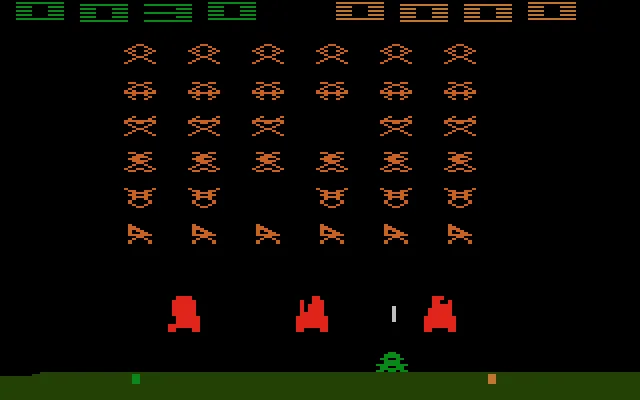
Kassar’s answer was to stop treating Atari’s own games as the whole proposition and start buying other people’s. In 1979 he secured the home rights to Taito’s Space Invaders, Toshihiro Nishikado’s 1978 arcade machine, which by then had become a genuine cultural event rather than merely a popular cabinet.
Rick Maurer had begun writing a version on his own initiative in 1978, having been floored by the original. His conversion reached shops on 10 March 1980 as the first officially licensed arcade game on a home console, and the effect was immediate and enormous. Console sales quadrupled. Atari shifted roughly 1.25 million Space Invaders cartridges in 1980 and over a million consoles, close to doubling the installed base to around two million machines. The game brought in more than $100 million that year.
The lesson Atari took from it was correct: people would buy a console in order to get one specific game, and arcade licences were therefore how you sold hardware. Deals with Namco and Centuri followed. 1981 moved around 3.1 million consoles. By the end of 1982, InfoWorld reported worldwide VCS sales of 12 million units, with Pac-Man alone doing over seven million cartridges on the strength of the name, despite a conversion that fell some way short of the arcade version it was imitating.
Maurer’s bonus for the game that rescued the company was $11,000. He left Atari and never wrote another 2600 game. Warner’s chequebook, so decisive in 1976 when it was buying tooling and chip orders, turned out to have a rather firmer lid on it when the person due to be paid was the programmer.
What Britain paid for one
The VCS reached Europe in 1978, and in Britain it arrived through importers rather than through Atari directly. Ingersoll Electronics and Cherry Leisure both brought it in. Early UK consoles shipped with Ingersoll-branded power supplies, and Ingersoll was still publishing its own catalogue of the cartridge range for British buyers in 1981. Atari UK took the business over later.
By August 1983, with the American market already coming apart, a 2600 on a British high street had fallen close to £69.99.
The format outlived the company that fumbled it
The hardware did not kill Atari. What killed Atari was the conviction, arrived at some time during 1982, that the market would absorb whatever the company chose to print.
E.T. the Extra-Terrestrial was written in about six weeks to make Christmas. Atari manufactured four million cartridges and sold roughly 1.5 million of them. Pac-Man had already demonstrated that a licence could shift a mediocre conversion. E.T. demonstrated where that road ended. In December 1982 Warner revised its earnings guidance from an expected 50 per cent growth down to 10 or 15 per cent, the stock fell, and the video game crash of 1983 had its opening scene. Kassar was fired in July 1983.
The machine, though, kept going. The last licensed 2600 game was a PAL-only conversion of Klax in 1990, and production finally stopped in 1992, fifteen years and around thirty million units after that first September. Every console that followed took the same basic bargain: cheap hardware sold close to cost, a slot on the front, and a catalogue of software that keeps earning long after the box has left the warehouse. Fairchild proved the idea worked. Atari proved it could be sold.
Nolan Bushnell told Warner at the end of 1978 that the VCS was finished. It outlasted his tenure by fourteen years.