
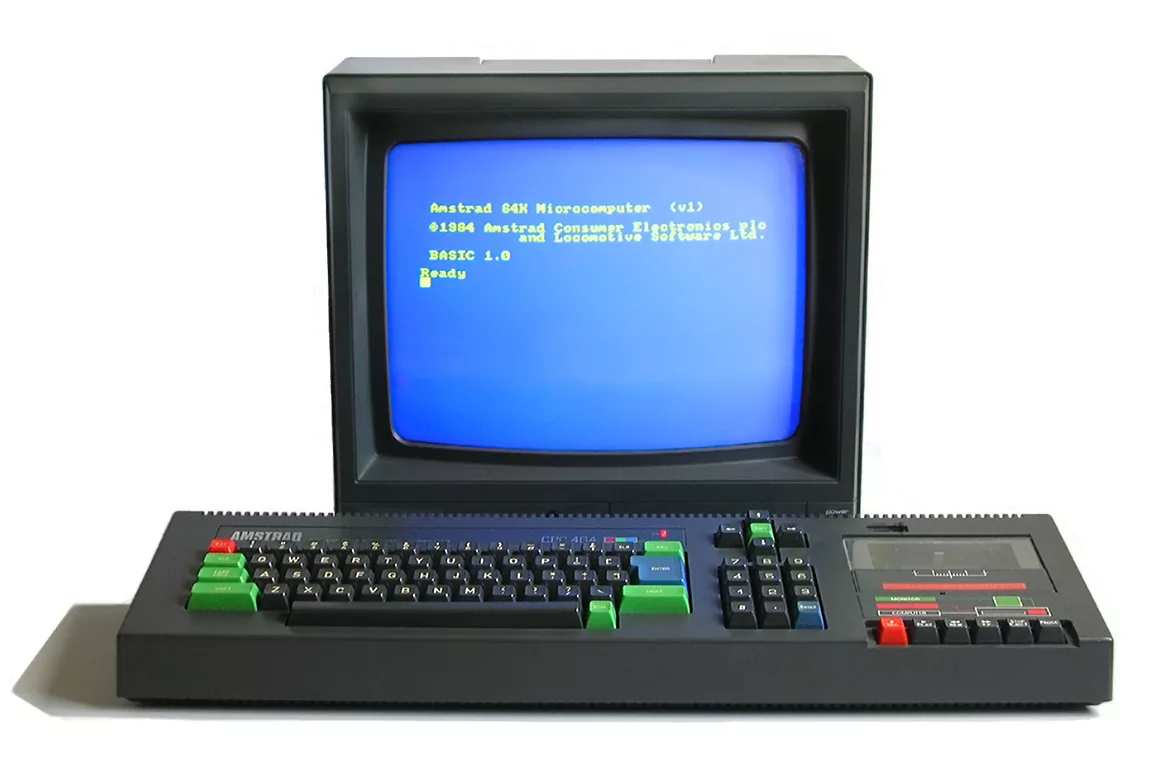
On 21 June 1984 a home computer went on sale in Britain that you could carry to the till, take home, plug into a single wall socket and actually use that evening. No borrowing the family telly. No separate cassette recorder wired in with a fistful of leads, no argument about who got the living room. The Amstrad CPC 464 was an all-in-one 8-bit machine: full-travel keyboard, a cassette deck built into the case, and its own monitor in the box. It ran a 4 MHz Zilog Z80 with 64KB of RAM, and it started at £239 with a green screen. Alan Sugar had looked at the home-computer boom and decided the gap in it was a spare television.
- Released: 21 June 1984 (shown to the press on 12 April 1984, at Westminster School)
- Manufacturer: Amstrad (Alan Michael Sugar Trading)
- CPU: Zilog Z80 at 4 MHz
- RAM: 64KB. ROM: 32KB (firmware plus Locomotive BASIC)
- Sound: General Instrument AY-3-8912, three channels
- Video: Motorola 6845 CRTC with a custom gate array; 27-colour palette, three screen modes (160×200/16 colours, 320×200/4, 640×200/2)
- Launch price: £239 with green monitor, £349 with colour monitor
Why Amstrad built a computer with its own monitor
Sugar was not a computer man and never pretended to be. By 1983 the trade he did understand, hi-fi towers and cheap audio stacked high in Rumbelows and Comet, had gone flat. Margins were thinning, the shelves were full, and he needed a new sort of box to sell through the same shops. The Sinclair Spectrum had shown him the size of the prize. What it had also shown him, as a parent, was the friction: a computer that hijacked the television and buried the carpet under leads was a computer the rest of the household resented.
His fix was less a specification than a shopping list, and he set it out plainly. ‘Mum and Dad don’t want little Johnny taking over the TV set,’ he said, ‘so our computer should come with its own monitor, have a full-sized keyboard and a built-in cassette mechanism for loading software and hit a target price of £199.’ Everything a family found annoying about owning a home computer, Sugar proposed to remove and put in a single carton. That was the whole idea. The engineering would have to be bent to fit it, rather than the other way round.
The groundwork was done by Ivor Spital, an Amstrad man from the early days, who was sent out to buy the competition and take it apart. He looked at what each rival cost to make, what came in the box, how long it took to get a picture on screen, and reported back that Sugar’s instinct held up. Amstrad’s strength had always been packaging cheap parts into a product that felt complete on the shop floor. A computer could be exactly that, if someone could actually build one in time.
The machine that had everything except a motherboard
Here is where the story stops being a business plan and becomes a genuine scramble. Amstrad worked back to front, on purpose. Bob Watkins, the technical and manufacturing director, had the case designed, the keyboard specified, the cassette deck chosen and the production tooling committed before there was a working motherboard to put inside any of it. Sugar was that confident about the timing, and that willing to gamble the tooling money on it.
The first attempt to fill the empty case fell apart. A small outside team was set to design a 6502-based board, promised it quickly, and then ran straight into how hard the job actually was. By the summer of 1983 there was no working hardware and no ROM, because there was no finished software to burn into one. The pressure broke at least one developer. What came back afterwards was code written to look like progress, not to do anything real. The deception only surfaced when the ROM went to Toshiba to be manufactured. It is an ugly little episode, and worth being fair about: the people involved were handed a brief that would have frightened a far bigger team, on a clock nobody could have met. The failure was in the promising, not in the trying.
Roland Perry’s memory of walking into Amstrad captures the absurdity of it. ‘They’d got a fully finished keyboard in a case, they’d got monitors, they’d got a cassette drive all fitted – you pressed the Eject button and out popped the tape – all like a completely finished computer,’ he recalled. ‘The only problem was, they didn’t have the motherboard.’ The most important component in a computer, and it was the one part that didn’t exist.
How Roland Perry recruited the CPC 464 in a fortnight
Watkins turned to William Poel of Ambit International, a Brentwood parts-and-design outfit Amstrad already dealt with. Poel and Perry, childhood friends, offered to become consultants and deliver the whole thing, hardware and software both, inside a window that on paper was impossible. Perry took the finished-but-hollow prototype on a recruiting run up to Cambridge, where he knew the right sort of people.
The prototype travelled under a codename with a joke folded into it: Arnold, an anagram of Roland. Poel had picked it deliberately to nudge anyone who glimpsed the box towards thinking of Arnold Weinstock, then running the industrial giant GEC, so a competitor might assume GEC had quietly got into home computers and relax. Misdirection dressed up as a name badge.
In Cambridge Perry pulled in Mark-Eric Jones of MEJ Electronics for the hardware, and Richard Clayton and Chris Hall of Locomotive Software for the code. Locomotive had been going since February 1983, barely a year, and already had a Z80 BASIC interpreter of their own. That last detail turned out to decide the shape of the whole machine.
Why the CPC 464 runs a Z80 and not a 6502
The failed first board was built around a 6502, the same family of processor as the Commodore 64 and the BBC Micro. When Jones examined it he found something worse than slow progress. ‘Some of the chips didn’t have the power supply connected to them,’ he said, ‘and I thought, well, this is not going to be able to work.’ The board was not behind schedule so much as never going to run.
The way out was to change processor entirely. Locomotive’s BASIC was already written for the Z80, so keeping the 6502 meant rewriting the software from scratch, while switching to a Z80 meant the software was mostly done and only the hardware had to catch up. Jones had no reason to argue. ‘I had no 6502 experience but had done many Z80 designs,’ he said, ‘so as far as I was concerned it was a no-brainer to switch to the Z80.’ Sugar had already killed off any thought of licensing Microsoft BASIC to save the fee, so a home-grown interpreter running on a chip its authors already knew was the cheap answer and the fast one at the same time. For once those two pulled in the same direction.
Twelve weeks, frozen pizza and a whiteboard counting down
From the start of September 1983, Locomotive had a shade over twelve weeks to hand over working code. They ran the deadline like a countdown, out in the open where nobody could look away from it. ‘We had a whiteboard and each week we changed the number of weeks to go,’ Clayton remembered, ‘so we knew exactly where we stood.’ Perry did the chasing in person, on foot, at the weekend.
‘I’d go out on a Friday evening and pace up and down on someone’s premises and say, have you finished? I want this ROM or this chip layout,’ he said. ‘Our timetable was so tight everyone was working weekends.’ Jones’s account of the hardware end is the one that sticks, because it is so ordinary and so telling at once. There was no schematic-capture software then, so the board was drawn by hand. ‘We were living off frozen pizzas more or less, and every evening working late into the night,’ he said. ‘We had a drawing board out … it was all drawn with pencil on paper. My wife, she was my girlfriend at the time, was hauled in to solder prototype PCBs.’
They made it. Chris Hall put the finish line at a distance that ought to be impossible for a launch of this size: ‘We handed over our finished software 14 weeks ago. The machines at the launch had finished ROMs in them.’ The machines the press pawed at in April 1984 were not mock-ups with a video loop running behind a dead keyboard. They were real, running the real firmware, weeks early. Anyone who has watched a modern product launch demo something that does not exist yet should sit with that for a moment.
What £239 actually bought you
For the money you got a proper computer, not a toy. The Z80 ran at 4 MHz, there was a full 64KB of RAM, and the AY-3-8912 sound chip gave three channels of tone and noise, which put the 464 comfortably ahead of the Spectrum’s single-channel beeper for anyone who cared about sound. The display ran in three modes off a Motorola 6845 and a custom gate array, from a chunky 16-colour mode good for games up to a crisp 80-column two-colour mode that made the thing usable for actual text. The palette held 27 colours.
Chris Hall was blunt about what drove those numbers, and it was not engineering ambition. ‘Amstrad was basically saying, we want to get this thing into production quickly, and we have certain key requirements,’ he said. ‘They decided for marketing reasons the most important thing was to say that it had 64KB of memory and that it had lots of colours.’ The spec sheet was written by the sales pitch. That is the one place the cynicism is earned: the CPC 464 was specified to win an argument on a shop-floor sticker against a Commodore 64, not to satisfy anyone’s idea of a balanced design. It happened to produce a good machine anyway, which says more about the people who built it than the people who briefed it.
And the monitor did more than end the fight over the television. It housed the power supply, and fed the computer through a single connector, so the whole system ran off one plug. That is why the 464 has no mains socket of its own. It also meant Amstrad never had to certify a separate power brick, and never had to explain to a customer why the picture looked wrong on their particular telly. The green-screen version at £239 undercut the room a colour machine needed; the £349 colour bundle was there for the households that wanted games to look like games.
Two million boxes, and the telly set free
It worked. The CPC 464 sold in numbers that vindicated the gamble, well over two million on its own, and the wider CPC line that followed, the 664, the 6128 and their continental Schneider-badged cousins, ran to around three million machines before Amstrad moved on.
The lesson of the 464 is not about the Z80 or the gate array, good as they were. It is that Sugar sold a computer by removing the reasons not to buy one, and then trusted a scratch team of Cambridge contractors to make the inside live up to the outside on a clock that should have beaten them. They built a real motherboard, in pencil, over frozen pizza, in twelve weeks, to fill a case that had been waiting empty for it. The bloke down the shop never knew any of that. He just saw a computer with a screen and a tape deck and a price he could say yes to, and carried it home under one arm. Which, if you ask Alan Sugar, was always the entire point.
