MACHINE REFERENCE

Amstrad GX4000

The Amstrad GX4000 was a games console built on CPC Plus computer hardware, launched in Britain, France, Spain and Italy in September 1990 at £99.99 with Burnin’ Rubber and two pads in the box.

Why it matters

The GX4000 shared its architecture with the CPC Plus computers, and Roland Perry has said Amstrad finished the case first and adapted the internals to fit, as it had with the CPC 464. The hardware was better than the sales suggest: a Z80A at 4 MHz with a custom ASIC gave it hardware sprites, smooth scrolling and a 4,096-colour palette, and designer Cliff Lawson later claimed it was at least as good as a SNES. The trouble was the business around it. Many games were CPC ports at £25 a cartridge when the cassette cost £3.99, and publishers complained that duplication took months instead of weeks, a delay put down to Amstrad’s control of cartridge manufacture. Wikipedia gives fewer than 15,000 sold and marks the figure as disputed, while two other sources say about 15,000. Amstrad spent £20 million on European marketing, yet by July 1991 some shops were selling the console at £29.99. Lawson’s own diagnosis was a lack of games and not enough money to persuade publishers to write them.

What to check before you buy

  • Ask what power supply has been used. The console wants 11 V DC with a positive centre pin, and a wrong adaptor or reversed polarity is documented to damage the regulator, a diode and the RAM.
  • Run it for a few minutes and feel the two RAM chips. Failing 41464-type chips get very hot and cause the classic black screen. Replacement chips and a socket are the usual cure, so ask whether that repair has been done.
  • Try more than one cartridge. A dirty cartridge port is the first thing to rule out when a console shows nothing or a distorted picture, and contact cleaner often solves it.
  • Ask whether the board has been recapped. A capacitor kit exists with 20 capacitors listed, and a recapped machine is a better bet than one with its original ones.
  • Check the video lead, the two original pads and any cartridges. Some unofficial or bootleg titles exist, and genuine rarities such as Chase HQ II are priced far above common games.
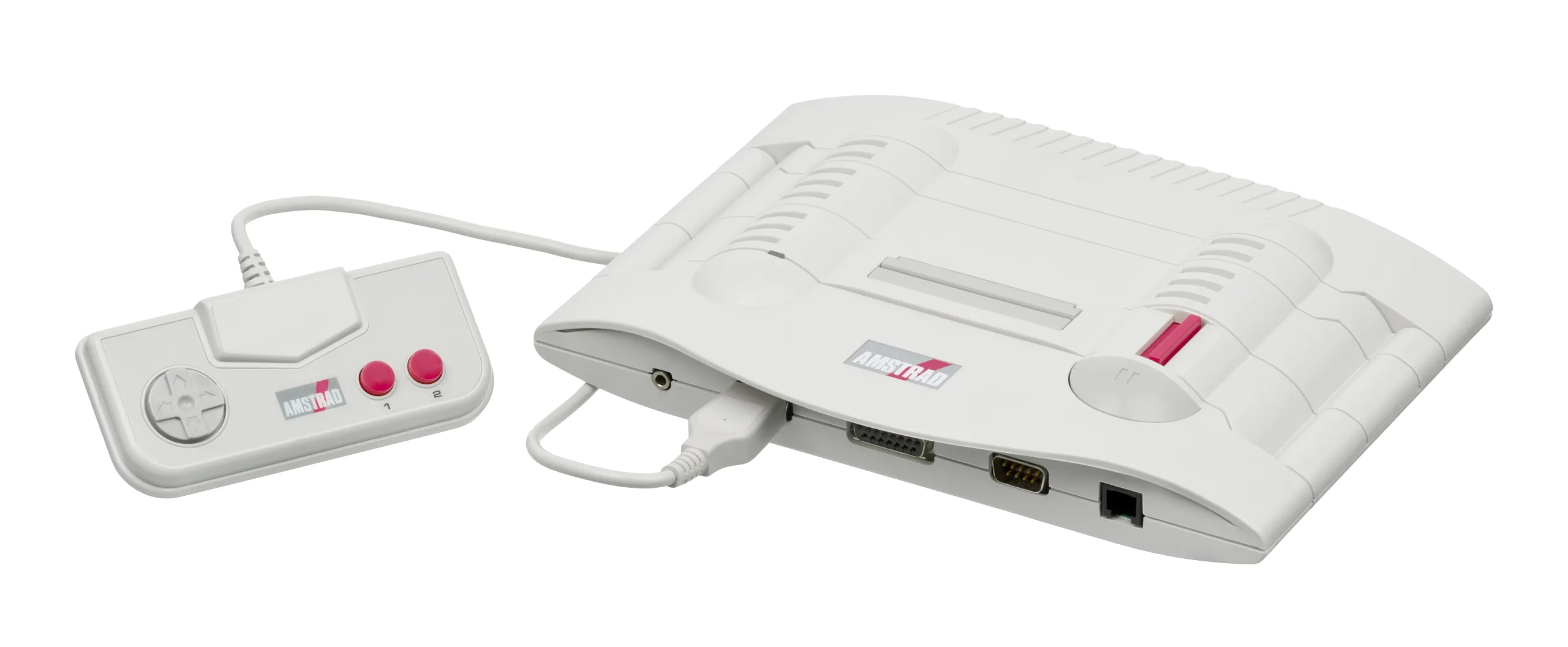
Amstrad GX4000 games console with its gamepad

Photo: Evan-Amos, Wikimedia Commons (public domain)

Released

1990

RAM

64 KB RAM, of which 16 KB acts as video RAM. The board carries two 41464-type 64K x 4 DRAM chips (IC10 and IC11)

CPU

Zilog Z80A at 4 MHz

Launch price

£99.99 in Britain and 990 francs in France, with Burnin’ Rubber, two pads and a power adaptor in the box. Most games cost £25. Two sources give the UK price as £99

Manufacturer

Amstrad plc, UK

Form factor

Low, sleek white home games console with a ROM cartridge slot, a pause button on the case and two custom two-button gamepads. Designed case-first, with the internals fitted into the finished shell. No keyboard and no monitor needed (it has RGB output on a SCART connector)

CPU

Zilog Z80A at 4 MHz

Chipset

Z80A CPU, a custom Amstrad ASIC (hardware sprites, smooth scrolling, programmable interrupts, DMA sound) and a General Instrument AY-3-8912 sound chip. The design is shared with the CPC Plus computer range

RAM

64 KB RAM, of which 16 KB acts as video RAM. The board carries two 41464-type 64K x 4 DRAM chips (IC10 and IC11)

ROM

Cartridges of up to 512 KB. One Polish source gives 32 KB of system ROM; no second source for that figure was found

Graphics

Three modes: 160×200 in 16 colours, 320×200 in 4 colours and 640×200 in 2 colours. Palette of 4,096 colours (12-bit RGB), with up to 32 on screen (16 background, 15 sprite, 1 border). Up to 16 sprites per line, each 16×16 pixels and magnifiable by 2 or 4

Audio

AY-3-8912, three channels, with DMA sound processing. Wikipedia describes the output as stereo; a Polish source describes it as mono and names the AY-3-8910, so the sources disagree

Storage

ROM cartridge only

Ports

Two digital controller ports, an IBM-standard analogue controller port (little supported by software), an RJ11 light gun connector, an 8-pin DIN audio and RGB output with a SCART connector, and a DC power input. A UHF coaxial lead was supplied in the box. Power can also come from a compatible Amstrad monitor

OS

None offered to the user in the sources found. Games run from the cartridge on power-up

PSU

External mains adaptor, 11 V DC with the centre pin positive (per a Delta Island repair guide). A second 5 V input exists for powering the console from a compatible monitor. Wrong voltage, reversed polarity or AC input is reported to damage the board. The adaptor current rating was not confirmed from a readable source

Units sold

Fewer than 15,000, according to Wikipedia, which flags the figure as disputed. Two other sources say approximately 15,000. They may share an origin, so treat it as approximate; no sales ledger was found

Successors

None. It was Amstrad’s only games console, and the CPC Plus computers (464 plus and 6128 plus) that shared its hardware launched with it

  • Burnt-out RAM and a black screen
    A common failure is a black screen caused by the two RAM chips (KM41464AP-12) burning out, which the Amstrad.eu repair guide blames on poor quality power supplies. A failed chip becomes very hot to the touch within a couple of minutes. The standard repair is to replace both and fit sockets.
    GX4000 (écran noir), Amstrad.eu →
  • Wrong power supply damages the regulator and diode
    The console takes 11 V DC with a positive centre pin. A wrong voltage, reversed polarity or AC input can destroy several components. Delta Island advises testing the regulator output (it should be 5 V), checking diode D183 and, in most cases, replacing D183, the 7805-type regulator and the two RAM chips.
    Reparer une Amstrad GX4000 avec ecran noir, Delta Island →
  • Dirty cartridge port
    A dirty cartridge connector is listed by Delta Island as the first and simplest cause of a black or distorted screen. A thorough clean with contact cleaner is the recommended fix.
    Reparer une Amstrad GX4000 avec ecran noir, Delta Island →
  • 1990 In April Alan Sugar announces that Amstrad will bring out a new product every month, and the company decides to enter the games console market
  • 1990 In August the GX4000 is announced in Paris with the 464 plus and 6128 plus computers
  • 1990 In September it goes on sale in Britain, France, Spain and Italy at £99.99 and 990 francs, bundled with Burnin' Rubber
  • 1991 By March reports of a cartridge crisis appear, and the price is cut to £79.95
  • 1991 By July some shops sell the console for £29.99, and it is discontinued during the year