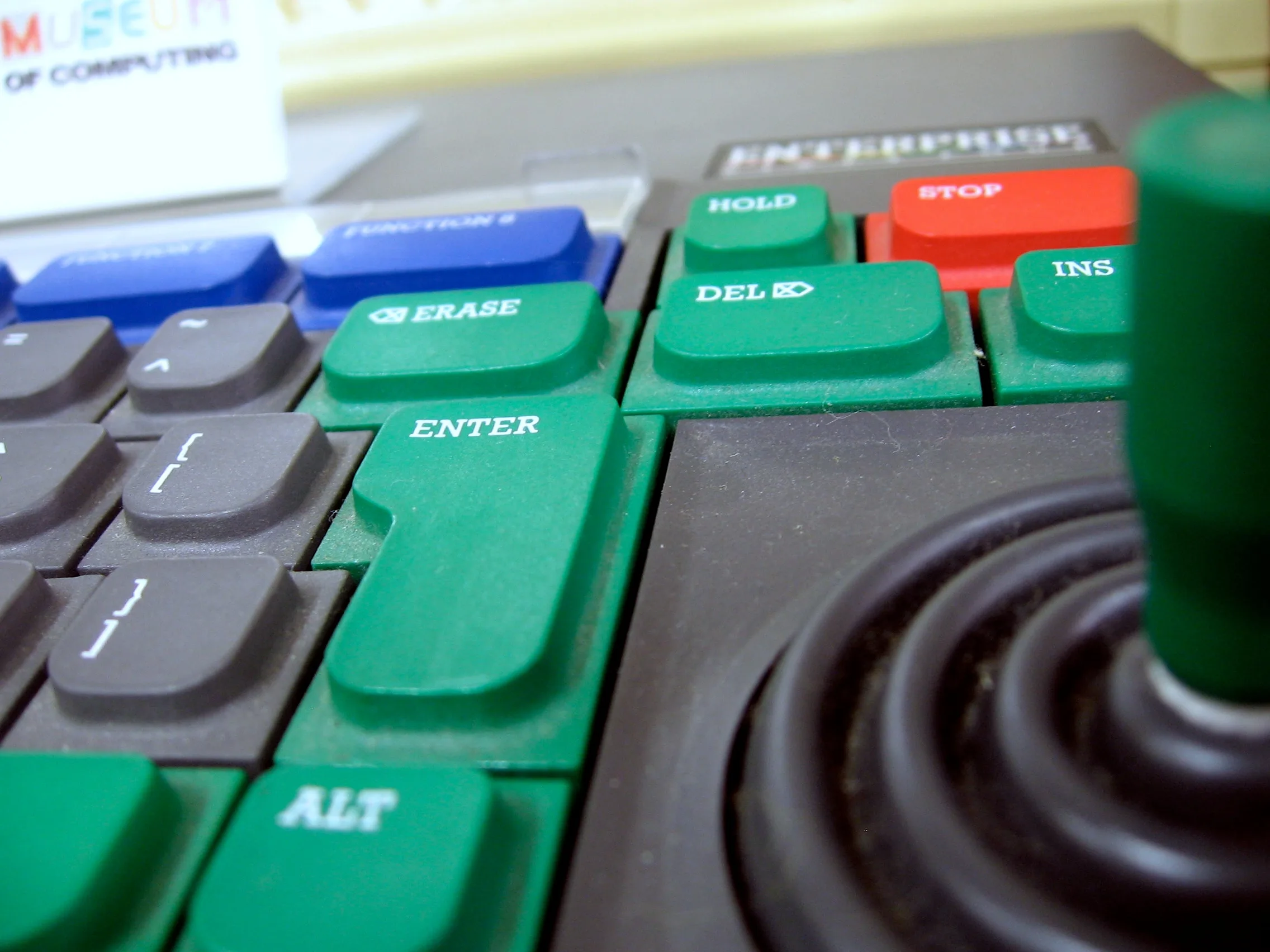
The Enterprise 64 put a small joystick where the cursor keys should be, and a custom graphics chip called Nick that let every scanline of the screen choose its own resolution and colour depth. It was announced in September 1983 and had about 80,000 pre-orders by April 1984, and then it took until 1985 to reach shops.
Why it matters
The Enterprise had a 4 MHz Z80A, two custom chips (Nick for video, Dave for sound and memory paging), three sound channels plus noise and a 256-colour palette, all in a slim case. The chips were late, though. The machine did not ship until 1985, and Enterprise Computers collapsed in 1986 before its planned business machine, the PW360, could appear. Somewhere between 70,000 and 80,000 were built, and Wikipedia says the UK took no more than 25,000 of them. Most of the rest were 128K models sold overseas, and unsold stock reached Hungary in 1987, where the machine stayed on sale until about 1992.
What to check before you buy
- Confirm the BASIC cartridge is included. The machine has no BASIC in ROM, so without the 16 KB cartridge you get very little.
- Power it up and look for a picture on both RGB and RF outputs. Video failures are the best-documented fault, and the 78L12 regulator and nearby capacitors are the first suspects.
- Press every key. The membrane wears, and there are no separate cursor keys to fall back on, only the integrated joystick.
- Ask whether it is a 64K or a 128K machine. The 128 has twice the RAM and is the more common model on the continent.
- Check the expansion slot and the non-standard joystick ports for damage, and ask what peripherals come with it.
- Prefer a seller who can show it running a game or a BASIC program from cassette, given how few working units are listed.