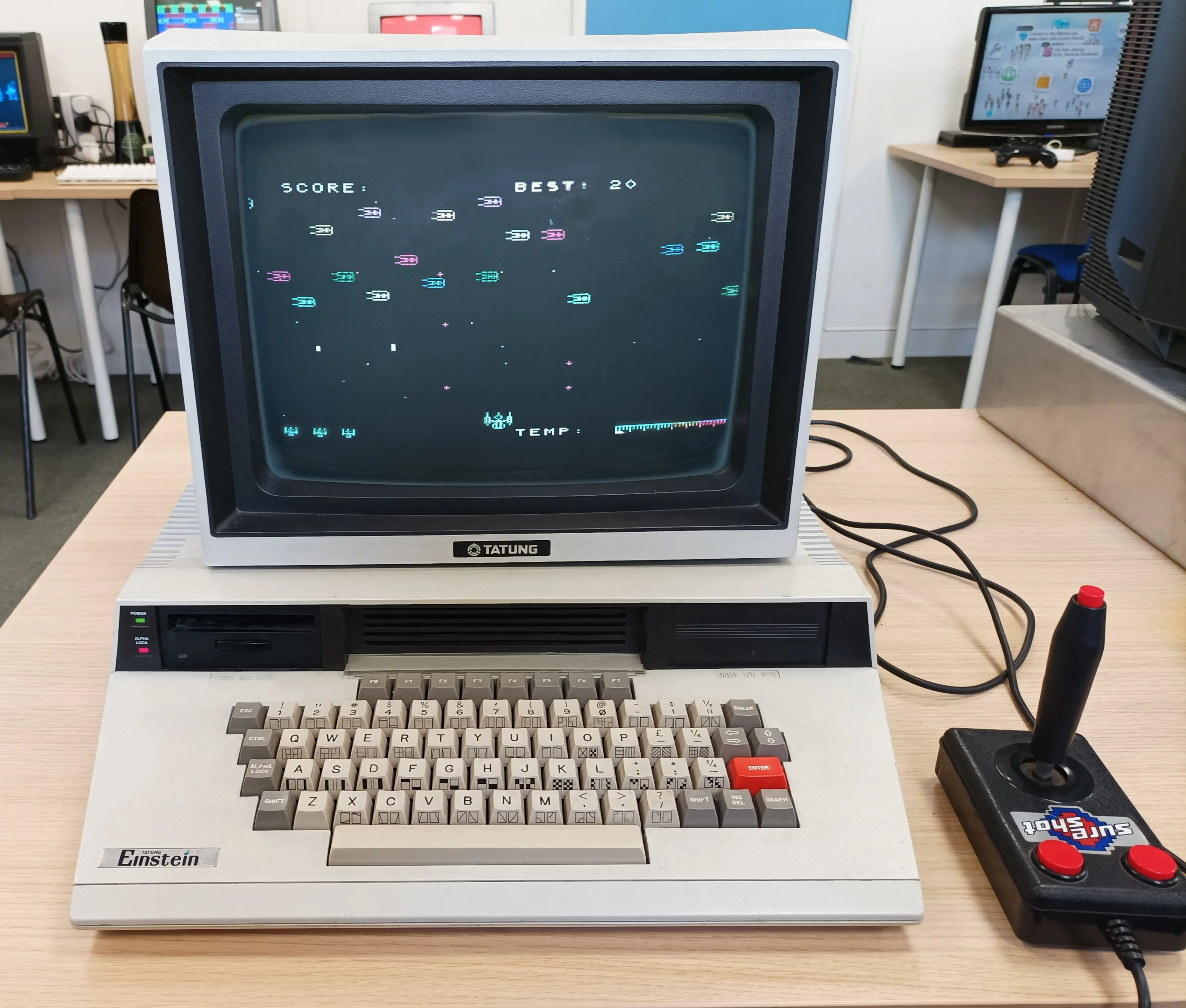
In a rented office above a chip shop in Manchester, sometime in 1985, a games programmer feeds a black three-inch disk into a slot on a computer nobody downstairs has heard of. It clicks. It whirs. Ten seconds later, it’s loaded. Three streets away, a kid with a ZX Spectrum is still forty minutes into a cassette that might, or might not, actually work this time. The programmer isn’t writing a game for the machine in front of him. He’s writing one for the Spectrum. That’s the quiet joke sitting at the centre of the Tatung Einstein‘s whole story: a computer built with real engineering ambition, priced for a customer who didn’t exist, by a company nobody expected to be making computers at all.
A television company that inherited a computer problem
Tatung wasn’t a computer company. It made televisions, radios and the sort of household electronics that fill a department store aisle, not a computer magazine. Decca was the route in. Decca’s television and radio business had been sold to Racal in 1980, after a bidding war against GEC drove the price sharply upward. A year later, Racal sold it on again. This time, to Tatung. Overnight, a Taiwanese consumer electronics firm found itself owning a British manufacturing and research operation: laboratories in Bradford, factories in Bridgnorth and Telford, a workforce that had spent decades building valves and picture tubes rather than microprocessors.
The computer wasn’t really the plan. What Tatung had was infrastructure it already knew how to run, and a British home computer boom happening right outside its own factory gates. Sinclair, Commodore and Acorn were turning bedroom hobbyists into millionaires and filling front rooms with beige boxes plugged into the family television. Tatung had the buildings. It had the engineers. Why not have a go?
Something genuinely new under the badge
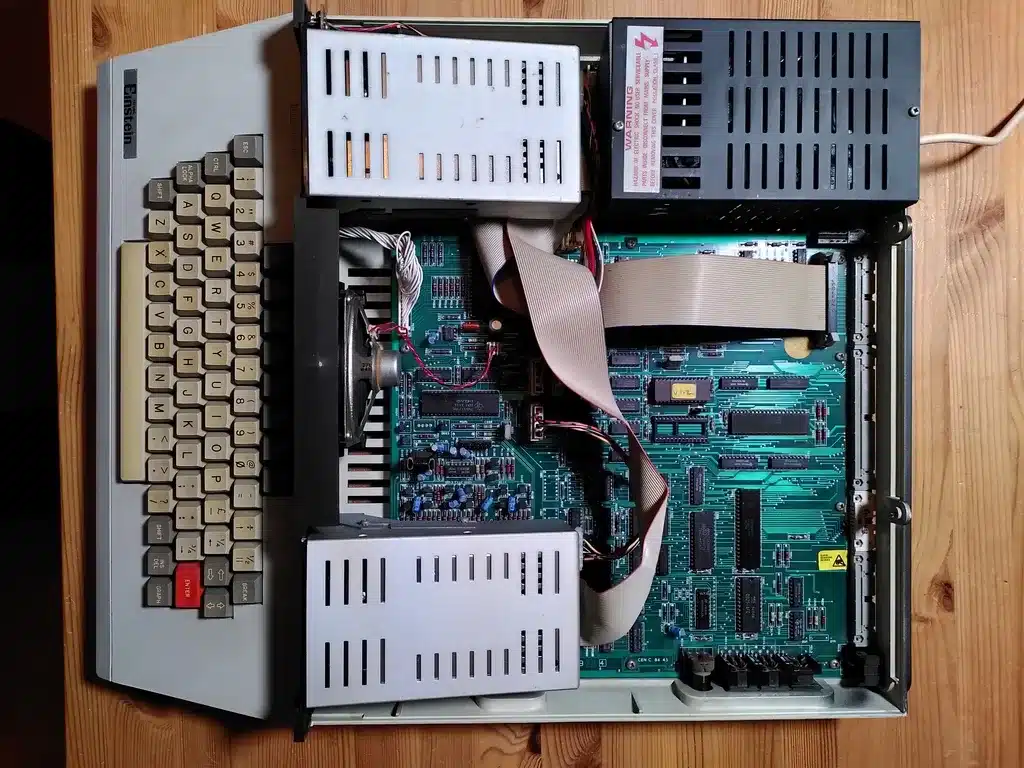
What came out of the Bradford laboratory in the summer of 1984 was no cynical rebadge job. This was real engineering. The Tatung Einstein TC-01 launched with a Zilog Z80A running at 4 MHz – a chip every Spectrum and Amstrad owner already knew from the inside. It carried 64 kilobytes of main memory, a separate 16 kilobytes set aside purely for video, and 8 kilobytes of ROM with room to grow to 32. On the graphics side, it wasn’t shy either. Colour ran to 256 by 192 pixels in up to 16 colours, driven by a Texas Instruments video chip, with an AY-3-8910 handling sound – the same chip Amstrad and Atari would later lean on for their own machines. None of that alone made the Einstein remarkable. What made it remarkable sat in the case next to the keyboard: a three-inch floppy disk drive, built in, standard, on day one, while most home computers in Britain were still asking buyers to trust a cassette tape and a prayer.
That drive wasn’t decoration. It ran through a proper Western Digital 1770 disk controller, the same chip that would later turn up in Amstrad’s own disk add-ons, and there was room to bolt on a second external drive. Loading a program took seconds, not minutes. And it didn’t quietly corrupt itself the third time someone knocked the table. Round the back sat a serial port, a Centronics printer port, RGB and television outputs and two joystick ports. And something Tatung called the “Pipe.” It was a buffered connection straight onto the Z80’s own data bus – doing for the Einstein roughly what the Tube interface did for the BBC Micro, though the two were never compatible with each other.
Sit down at one and the fit and finish told the same story. The keyboard had full travel, no mushy rubber dome to fight with, and the RGB output gave the Einstein a crisper picture on a proper monitor than anything a Spectrum ever managed through a television aerial lead. None of it was flashy. It was just built properly, the way you’d expect from a firm that had spent decades making things people plugged in and trusted.
This was a machine built by people who took hardware seriously.
No language of its own, and no name on the design
Oddly, for all that ambition, the Einstein shipped with no programming language built into its ROM. That was a genuine rarity in 1984. Every rival powered up straight into its own dialect of BASIC – the Spectrum into Sinclair BASIC, the C64 into Commodore BASIC, the whole industry had trained a generation to think that switching on a computer meant seeing a flashing cursor and a language prompt. The Einstein booted into something starker: a bare MOS, or “Machine Operating System,” just capable enough to load whatever the user actually wanted from disk. Most owners went straight for Xtal DOS. It was CP/M-compatible, credited to a company called Crystal Computers in Torquay, with Xtal BASIC loaded alongside it. It was flexibility dressed up as a design philosophy: rather than commit to one language the way Sinclair had, Tatung bet its buyers would rather choose their own software from a shelf of floppy disks.
There was a serious argument buried in that choice. Not a bad instinct, either. CP/M ran the actual business computers of the early 1980s – the machines accountants and word processors used before MS-DOS swept the field. Wiring the Einstein into that world meant aiming higher than the toy shelf. It very nearly worked. By the time the catalogue filled out, buyers could choose from more than 400 titles, roughly 120 of them games, alongside word processors, spreadsheets and programming languages a Spectrum owner could only read about in magazines. On paper, that looked clever. It wasn’t, quite. The machine never finished introducing itself to anyone.
Ask who actually designed the Einstein, and the trail goes cold fast. Every account of the machine – contemporary enthusiast archives, the collectors who still keep them running today – places the engineering at Tatung’s own research laboratory in Bradford, with assembly at Bridgnorth and Telford. Not one names the engineer who led it. Alan Stancliffe and Roy Martin Clarke put their names to the machine’s published BASIC reference manual. Whoever actually laid out its motherboard didn’t. For a computer this technically confident, that’s a strange kind of anonymity.
Priced for a customer who didn’t exist
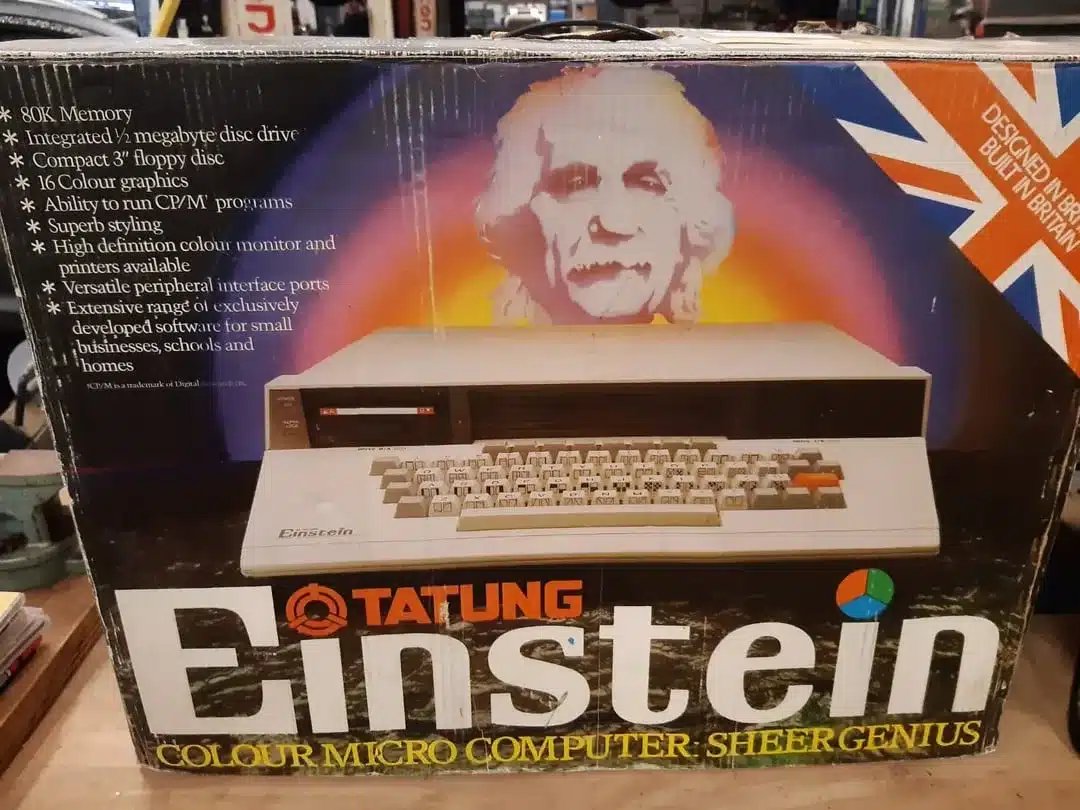
And then there was the price. £499 bought a Tatung Einstein that summer – no monitor included, just the computer and its built-in drive. That same summer, Amstrad launched the CPC 464 at £199 with a green-screen monitor thrown in, or £299 for colour. A Commodore 64 cost about £195. A ZX Spectrum 48K, cut loose from its original price, was down to £129. Buyers doing the sums saw a machine costing two and a half times as much as the computer everyone at school already owned, with none of the gaming pedigree that made a Spectrum or a C64 worth queuing for.
Retailers didn’t know where to shelve it. Neither did software houses. The Einstein was too expensive for the pocket-money end of the market, and too light on business software to win over the accountants eyeing the IBM PC. Third-party developers weighed the cost of writing for a machine with a tiny installed base against the near-certainty of another few thousand Spectrum sales, and mostly didn’t bother. Tatung published much of the software itself. It was a machine of real capability sitting behind a catalogue too thin to prove it.
Look at it from the shop floor and the problem gets simpler still. Two very different customers walked past that box. A parent buying a Christmas present wanted games, full stop, and the Einstein’s box didn’t shout about them the way Sinclair’s and Commodore’s did. A small business owner weighing up a first computer wanted something that talked to an accountant’s software package, ideally with a brand already on the high street. Not this one. The Einstein sat exactly between those two customers, visible to both, chosen by neither. It sits, as one retrospective account puts it, in ‘an uncomfortable middle ground’ between home and business computers. That’s about right.
A workbench, not a Christmas present
Here’s the twist, and it’s the one that gives the Einstein its strange, quiet afterlife. The people who wouldn’t buy one as consumers bought them anyway. Not as toys. As tools. Across the north-west of England, studios cutting code for the Spectrum and the Commodore 64 found the Einstein’s disk drive and development software made it the fastest, least infuriating machine in the building for actually writing software, even software that would never run on it itself. Games got written on it. Rarely bought on it. Somewhere in that fact sits the real shape of the Einstein’s failure: Tatung built a professional’s tool and tried to sell it in a toy shop.
Tatung’s own answer was to quietly retreat to what it already knew. Within a few years the company had moved back towards IBM-compatible clones, and eventually to the televisions that had brought it to Britain in the first place. There was a successor. The Einstein 256 arrived, built around a newer video chip, but the moment had already passed. By then, the shelves were someone else’s. No room was left for a computer that had spent its entire life explaining what it was for. Every Einstein still running today, disk drive clicking in some collector’s spare room, is proof of something rarer than commercial success: a machine so well built that outliving its own market barely slowed it down.