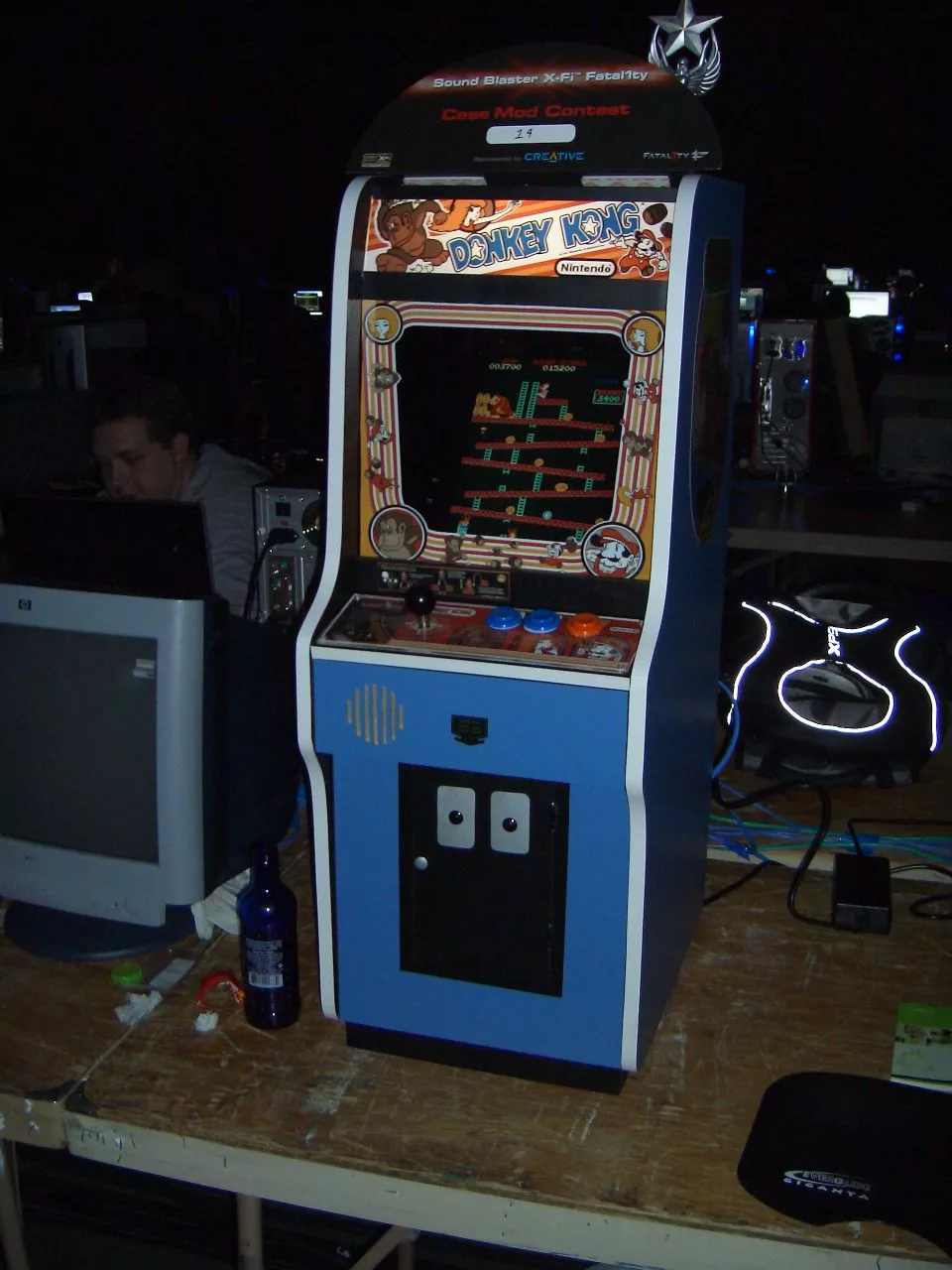
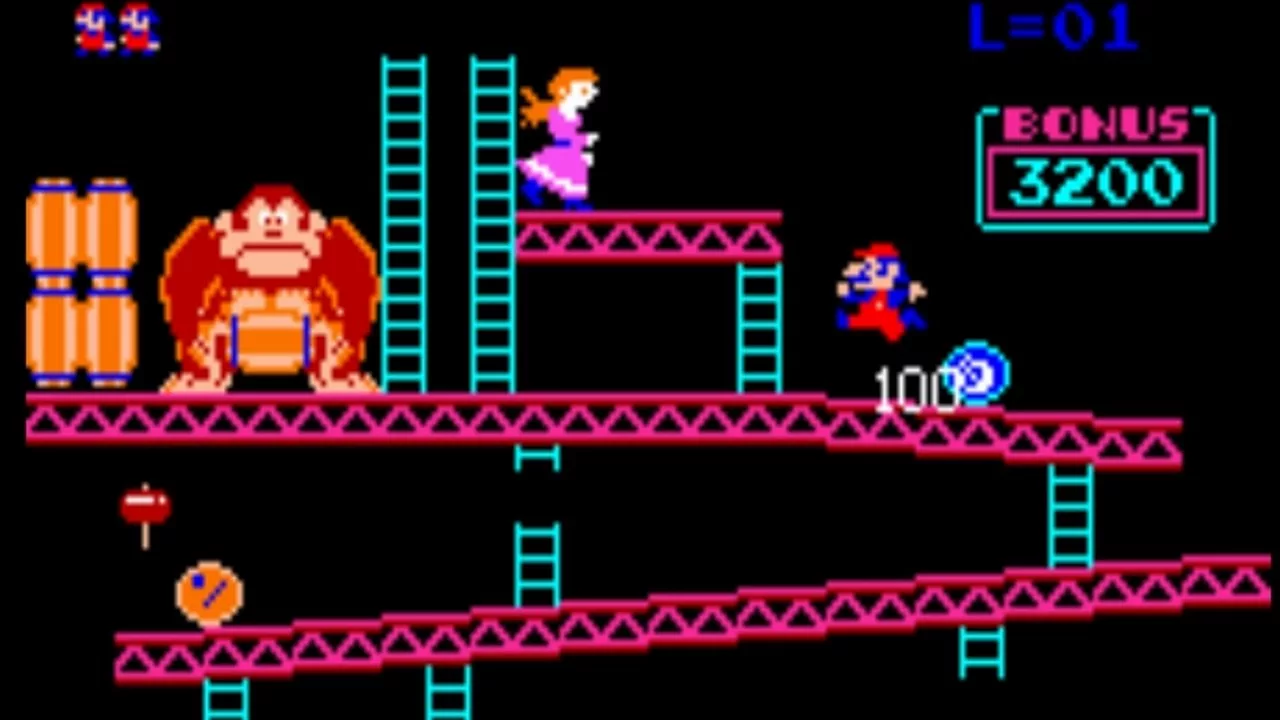
Donkey Kong is an arcade game released by Nintendo on 9 July 1981, designed by a first-time game designer named Shigeru Miyamoto and produced by Gunpei Yokoi at Nintendo R&D1. Its purpose was blunt and unglamorous: fill roughly 2,000 unsold arcade cabinets rotting in a warehouse south of Seattle. It invented the platform game, gave the world Mario and Pauline, and turned a playing-card company into the most powerful name in video games.
- Released: 9 July 1981 in Japan; North America later the same year 31 July 1981.
- Developer: Nintendo R&D1 – design Shigeru Miyamoto, producer Gunpei Yokoi, music Yukio Kaneoka, with programming work subcontracted to Ikegami Tsushinki
- Main CPU: Zilog Z80 at 3.072 MHz
- Sound: an Intel 8035-family microcontroller (a Fujitsu MB8884 on some board revisions) driving a DAC and sample playback, plus discrete circuitry
- Display: 256×224, vertical orientation, roughly 60.6 Hz
- Sprites: 128 foreground sprites at 16×16, 256 background tiles at 8×8. Mario cost one sprite, Pauline two, Donkey Kong six
- US cabinet sales: about 60,000 units by June 1982, worth around $180 million to Nintendo
Why Nintendo had 2,000 unsold arcade cabinets in a Seattle warehouse
The building in Tukwila, a few miles south of Seattle, was a rented warehouse with an office grafted onto the side of it and by the spring of 1981 most of the floor space was taken up by upright arcade cabinets that nobody wanted to buy. They were Radar Scope machines. The game had done respectable business in Japan, well enough that Nintendo built around 3,000 cabinets for the American market on the strength of it, shipped them to New Jersey, and waited for the orders.
American operators took one look and walked past. Radar Scope was a Space Invaders variant arriving rather late to be a Space Invaders variant and the cabinet made an insistent electronic racket even when nobody was playing it. Roughly a third of the run sold. The remainder went back across the country by lorry to Washington state, where they stood in rows, silent and depreciating, in a building rented from a local property developer.
Minoru Arakawa was running Nintendo of America out of that warehouse with a staff you could count on two hands and the company he was running was in any honest accounting, failing. He asked Kyoto for a new game. Not a new machine, a new game, something that could be dropped straight into the cabinets he already had. The man he was asking was Hiroshi Yamauchi, president of the parent company and as it happens, his father-in-law.
Yamauchi’s difficulty was that every developer worth the name was already committed to something. So the job went sideways to a 28-year-old staff artist in the planning department who had joined Nintendo in 1977, to draw cabinet artwork and had never designed a game in his life. That was Shigeru Miyamoto. Gunpei Yokoi, the engineer behind the Game & Watch line, was put over him as supervisor, which is the single most sensible decision anyone made in this entire story.
How Popeye’s beer barrels turned into a gorilla
Miyamoto’s first idea was not original, and he was not pretending otherwise. Nintendo went after the Popeye licence, and the working concept carried the wonderfully unsubtle title Popeye’s Beer Barrel Attack: Bluto at the top of the screen, Olive Oyl in peril, and a player who could bend girders with a jack so that barrels rolled back down into the antagonist.
The licence did not come. King Features said no, or said not yet, and a lesser designer would have shelved the whole thing and gone back to drawing cabinet sides.
Instead Miyamoto redrew the same love triangle using characters Nintendo owned outright, which turned out to be the most profitable act of improvisation in the industry’s history. Bluto became a gorilla, chosen because Miyamoto wanted something ‘nothing too evil or repulsive’, an animal a child could laugh at rather than fear. Popeye became a short carpenter in a red cap and dungarees, carrying a hammer. Olive Oyl became a girl stuck on a girder at the top of the screen.
The name has attracted more nonsense than any other detail. The story about a blurred fax turning ‘Monkey Kong’ into ‘Donkey Kong’ is a myth and has been for decades. The likelier account is the dull one: Miyamoto went looking for an English word that meant stubborn or silly, found ‘donkey’, and paired it with ‘Kong’ as shorthand for a large ape. In 2001 he put it more plainly still, saying he had been aiming at the idea of a stupid ape. Nintendo did eventually get the Popeye licence, and made a Popeye arcade game in 1982. By then it hardly mattered.
What the Donkey Kong board could actually do
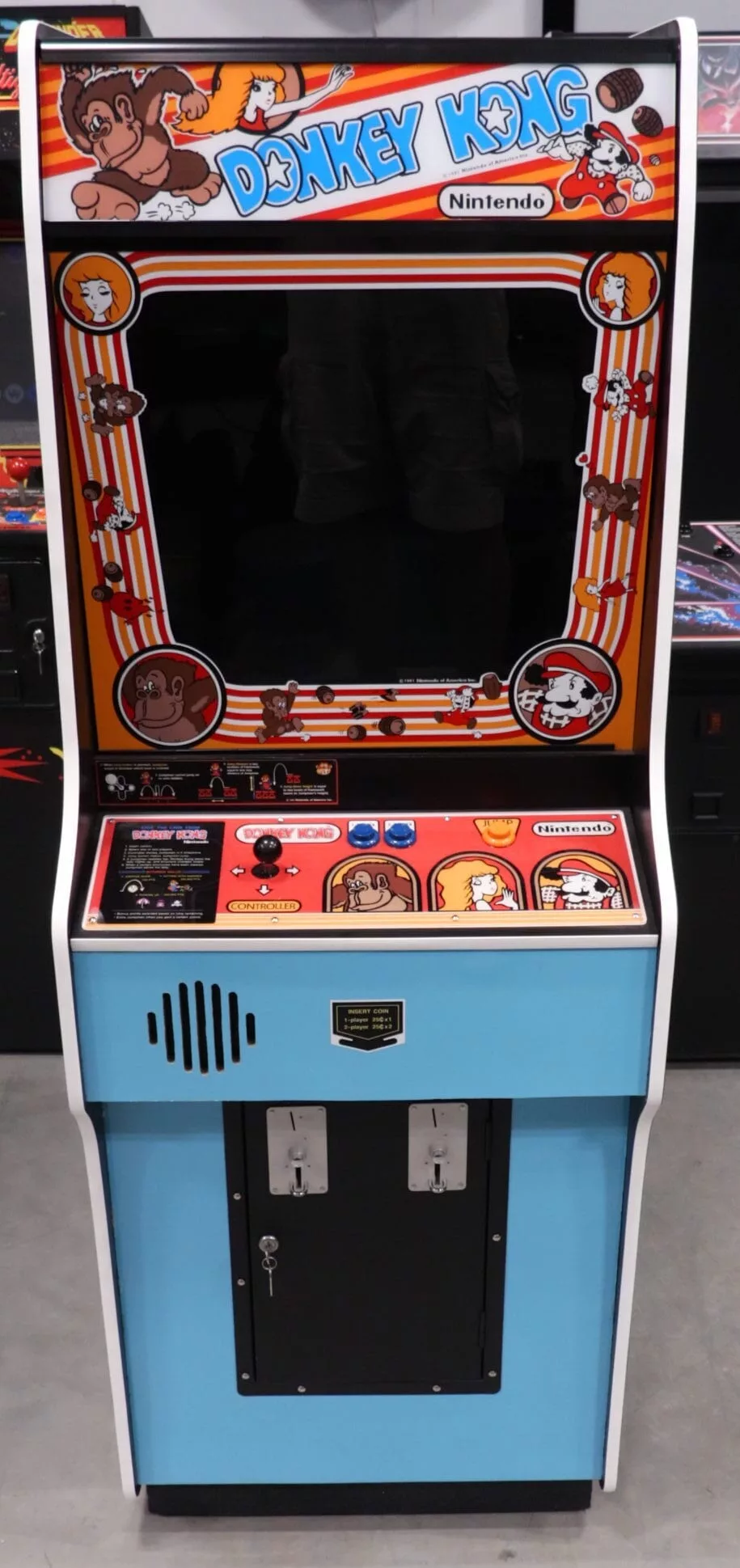
The hardware brief was the opposite of aspirational. Whatever Miyamoto designed had to run on a Radar Scope board, because the whole point was to avoid building anything new. The Z80 stayed, running at 3.072 MHz. The sound hardware stayed. The monitor stayed, mounted vertically, which is why Donkey Kong’s playfield is taller than it is wide and why the game feels like a climb rather than a scroll.
What the team did was strip out the parts of the board built for Radar Scope’s fast-moving enemy formations and spend the reclaimed capacity somewhere more useful. New ROMs went in. The result gave Miyamoto 128 foreground sprites at 16×16 pixels over a background of 256 tiles at 8×8, and the way that budget was spent tells you everything about the game’s priorities. Mario, and every barrel and flame chasing him, cost a single sprite each. Pauline, being taller, took two. Donkey Kong took six – roughly five per cent of the entire sprite budget spent on making one character big enough to be genuinely intimidating at the top of a girder stack.
The part of this that Nintendo spent years trying not to discuss is who wrote the code. Nintendo subcontracted a substantial amount of the actual programming to Ikegami Tsushinki, a Tokyo engineering firm, which supplied what was described as mechanical programming assistance to make Nintendo’s software work. Ikegami was paid for the work as a subcontractor, and then in 1983 the two companies sued each other over who owned what. The trade paper Game Machine dismissed Ikegami’s claims as a nuisance tactic at the time. Whatever the legal merits, the engineering credit for Donkey Kong is more crowded than the arcade flyer suggests.
Who Mario was named after
In Japan the carpenter had no name at all. For the American release Nintendo of America needed something to call him, and the first answer was Jumpman, picked because it rhymed comfortably with Walkman and Pac-Man, which is exactly the standard of naming rigour a struggling subsidiary applies at speed.
Jumpman did not last. The name that replaced it belonged to the man who owned the Tukwila warehouse: Mario Segale, a local property developer and construction contractor. The version everyone tells has Segale storming into the building over late rent and giving Arakawa a public dressing-down in front of the staff, after which the name suggested itself. Miyamoto confirmed in 2015 that Segale was the inspiration.
Pauline got her name from Polly James, the wife of Nintendo of America’s warehouse manager, Don James. Between the pair of them, two of gaming’s most recognisable characters are named after the landlord and a colleague’s spouse. There was no branding exercise. There was a small company in a warehouse trying to think of something before the artwork went to print.
The Seattle bar test that proved it
Before committing, Nintendo of America put prototype machines into two Seattle bars and watched the coin boxes. One manager reported takings of about $30 a day, which at a quarter a play is roughly 120 games, in a single week. For a company sitting on a warehouse of unsellable inventory, that number was oxygen.
What followed was not a manufacturing operation so much as a weekend job that got out of hand. Conversion kits were shipped over from Japan, and the whole of Nintendo of America set about converting the cabinets by hand in the warehouse: Arakawa, his wife Yoko, Don James, Ron Judy, Al Stone and whoever else was standing about. New ROMs, new artwork, new marquee, screwdriver by screwdriver, roughly 2,000 times.
By October 1981 Donkey Kong was selling 4,000 cabinets a month. By June 1982 Nintendo had shifted roughly 60,000 machines in the United States for around $180 million, and total American cabinet revenue reached something in the region of $280 million by the end of that year. Ron Judy and Al Stone had been working on straight commission because Nintendo of America could not afford to pay them properly. They became millionaires. In July 1982 Arakawa spent the profits on 27 acres of land in Redmond, which is where Nintendo of America still is.
How Nintendo won a fight with Universal over King Kong
Success of that size attracts lawyers. In April 1982 Sid Sheinberg, president of MCA, decided that Donkey Kong infringed Universal’s rights in King Kong and demanded that Nintendo hand over all its profits from the game. He gave them 48 hours. Coleco, which had licensed Donkey Kong for its home systems, folded almost immediately and agreed on 3 May to pay Universal a 3 per cent royalty, worth around $4.6 million.
Nintendo did not fold. It sued Universal on 29 June, which for a Japanese company with a tiny American subsidiary and no litigation history was either reckless or the best decision it ever made. Its counsel, John Kirby, then did the piece of homework that decided the case: he established that Universal had itself previously argued in court that the King Kong story and characters were in the public domain, in litigation against RKO. Universal had won that argument. It could not now stand up and claim the opposite.
Judge Robert W. Sweet, in the Southern District of New York, ruled for Nintendo after seven days of argument. Universal appealed, produced telephone survey evidence of consumer confusion, and lost again on 4 October 1984. On 20 May 1985 Sweet awarded Nintendo $1.8 million in fees and lost revenue, upheld on appeal on 15 July 1986. Nintendo thanked Kirby with a $30,000 sailboat named Donkey Kong and the exclusive worldwide right to use the name on sailboats, a gift so specific it is almost a joke, and later named a small pink character after him.
The uncomfortable footnote is that while Nintendo was in a New York courtroom defending its right to make an original work, it was simultaneously in a Tokyo dispute with Ikegami Tsushinki over who had written that original work. Both things were happening in 1983. The company’s principles on authorship were, at that moment, somewhat dependent on which side of the table it was sitting.
What Britain actually got instead of Donkey Kong
Here is the part that never makes the anniversary write-ups. If you played Donkey Kong in a British arcade in 1982, in a seaside amusement hall or the back of a chip shop, there is a decent chance you were not playing a Nintendo machine at all.
Nintendo could not build cabinets fast enough for Japanese demand, so it licensed a version called Crazy Kong to Falcon, explicitly for operation in Japan only. Falcon exported it anyway. Zaccaria manufactured and distributed cabinets in Europe, Nintendo revoked the licence in January 1982, and by then the horse had comprehensively left. Beneath the licensed copies sat a whole stratum of outright bootlegs with names like Big Kong and Donkey King. British operators bought what British distributors offered them, and a lot of what they offered was Crazy Kong.
On the high street it was stranger still. Nintendo had no meaningful British home-computer presence, so the platform game arrived on cassette via people who had simply looked at the arcade original and worked backwards. Adrian Stephens was 17 when he wrote Killer Gorilla for the BBC Micro after buying a magazine with screenshots of Donkey Kong in it. Micro Power published it in 1983 and paid him £400. It reached the Acorn Electron and the Amstrad CPC in 1984 and turned up on compilation tapes for years afterwards, including Superior’s Play It Again Sam 3. Atarisoft thought enough of it to commission Stephens to do an official Donkey Kong Junior conversion for the Beeb, which was then cancelled when Atari abandoned the platform.
He had company. Chris Cullen wrote Krazy Kong for Personal Software Services on the ZX81 and Spectrum in 1982, Gary Capewell wrote Killer Kong for Blaby in 1983, and Anirog published Kong across the Spectrum and Commodore 64 the same year. An officially licensed Donkey Kong did eventually reach the ZX Spectrum, published by Ocean at £7.95. That was 1986. Five years after Japan, by which point the arcade original was a period piece and half the country had already played a version of it written by a teenager in a bedroom.
The warehouse conversion that paid for everything after it
The tidy version of this story says Donkey Kong made Nintendo famous. The accurate version is narrower and better: Donkey Kong made Nintendo solvent, at a moment when its American arm was weeks of bad decisions away from being closed down and everything the company did afterwards was financed by cabinets that a first-time designer filled because nobody more senior was available.
The Redmond land was bought with Donkey Kong money. The Famicom, the NES, the American living-room revival after the 1983 crash: all of it was paid for by 2,000 unsellable Radar Scope machines and a gorilla drawn to sidestep a licensing refusal. Miyamoto and Yokoi built a genuinely new kind of game inside a hardware budget they had no power to change, and the constraint is visible in every frame of it. Six sprites for the ape, one for the man, one screen at a time, climbing.
What lingers is how nearly none of it happened. Radar Scope could have sold. The Popeye licence could have come through. Nintendo could have taken Sheinberg’s 48-hour deadline as seriously as Coleco did. Any one of those and the carpenter never gets a name, and Mario Segale spends the rest of his life as a property developer nobody outside Tukwila has heard of.