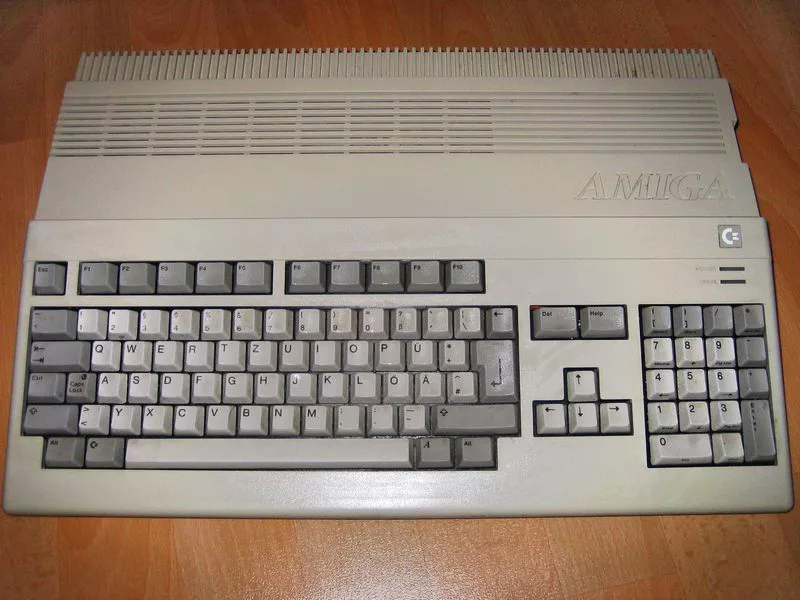
The Amiga 500 is a 16/32-bit home computer Commodore announced at the Winter Consumer Electronics Show in Las Vegas in January 1987. It took the Motorola 68000 and the custom Agnus, Denise and Paula chips of the Amiga 1000 and folded them into one keyboard case with a floppy drive built in, at roughly a third of the older machine’s price. It reached shops in the Netherlands in April 1987, the rest of Europe that May, and Britain and the United States in October.
- CPU: Motorola 68000 at 7.09379 MHz (PAL) or 7.15909 MHz (NTSC)
- RAM: 512 KB chip RAM as standard, 1 MB with the A501 trapdoor board
- Graphics: 4096-colour palette; 32 colours on screen in low resolution, 4096 in HAM mode
- Sound: four hardware audio channels of 8-bit sampled sound, paired into two stereo outputs
- Launch price: £499 in the UK and $699 in the US (October 1987), cut to £399 during 1988
- Sold: 2.6 million units by most counts, though the figure is disputed (see below)
The Amiga 1000 was the best computer almost nobody could afford
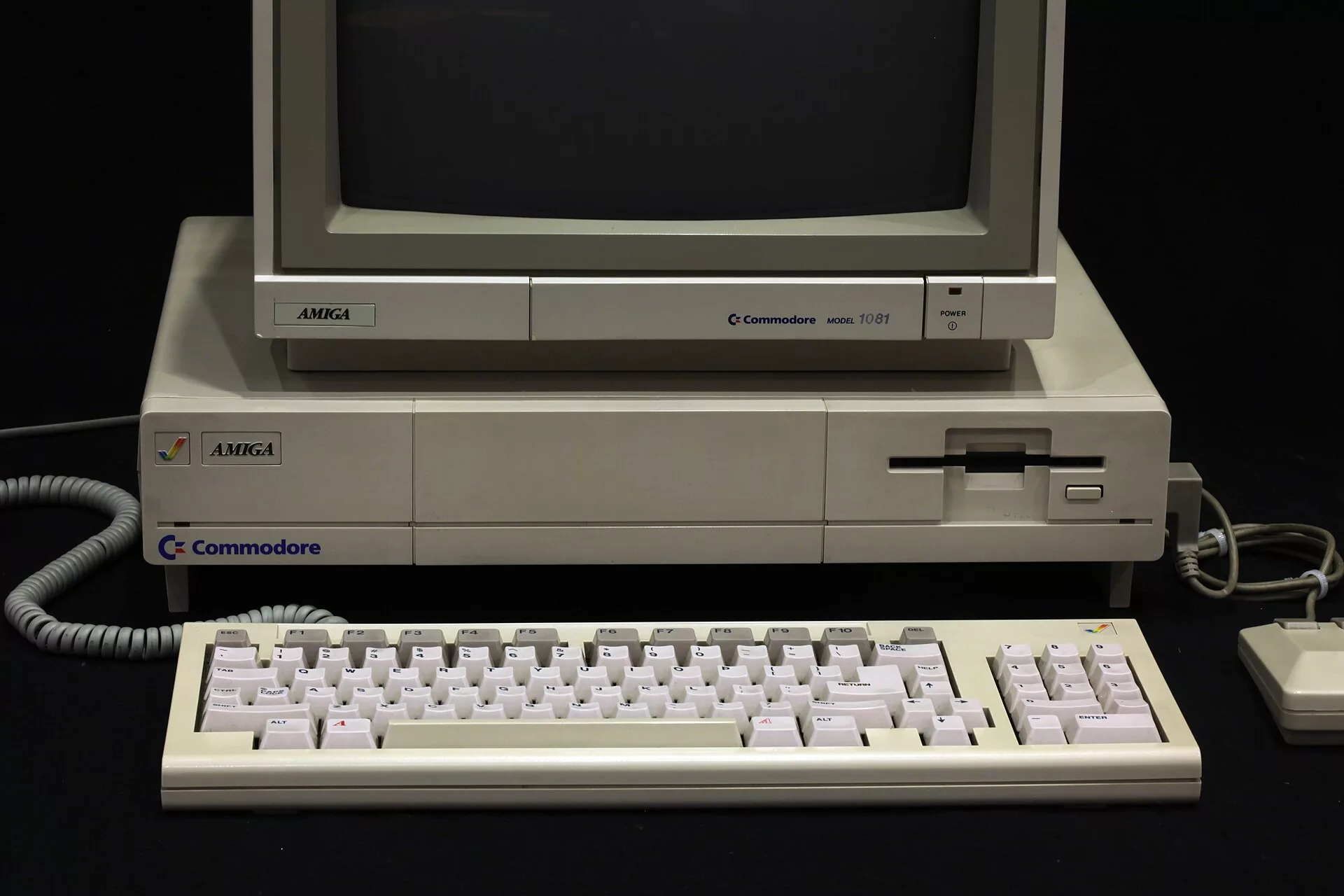
Photo: Rama & Musée Bolo, Wikimedia Commons (CC BY-SA 2.0 FR)
The Vivian Beaumont Theater at Lincoln Center, New York, on the evening of 23 July 1985. A full orchestra. Commodore staff in dinner jackets. Andy Warhol on stage in front of an Amiga 1000, digitising Debbie Harry and then flood-filling her hair from a palette of colours no home computer of the period had any business producing. It remains, forty-one years on, one of the most confident product launches this industry has ever staged.
Then somebody asked the price. The Amiga 1000 cost $1,295 with 256 KB of memory, or about $1,595 by the time you had a monitor to plug it into. Commodore had built a machine for artists and priced it for accountants.
The engineering underneath was genuinely ahead of anything else on a shop floor. Jay Miner’s custom silicon handled blitting, playfields and four channels of sampled audio without troubling the 68000, and AmigaOS pre-emptively multitasked at a time when a Macintosh could barely be persuaded to do two things at once. It was also unfinished. The operating system was too buggy to commit to ROM, so the 1000 shipped with a writable control store daughterboard and loaded Kickstart off a floppy disk at every single boot. The designers signed the inside of the case, Macintosh-style, and Miner added the paw print of his dog Mitchy.
Charming. Also a machine that sat in the window at over a thousand dollars while Atari sold 520STs to everyone who wanted 68000 graphics and didn’t care about the paw print.
Rock Lobster: the engineer who lived at the Commodore plant
The fix came out of Commodore’s West Chester site in Pennsylvania, from two engineers who had just watched their previous project die. George Robbins and Bob Welland had been working on the Commodore 900, a Unix workstation that never shipped. They were handed the low-end Amiga instead.
The project was called B52 at first, and then Rock Lobster, after the song. Commodore’s internal codenames were rarely more dignified than that.
Robbins is worth pausing on, because the story of the A500 is largely his. He was, by his own later description, a bit overweight with long hair that was getting thin on top. He also lost his driving licence, and rather than solve the commute he simply stopped leaving, living at the West Chester facility for over a year, sleeping in the offices and washing in the sinks. Whatever you want to say about Commodore management, and there is a great deal to say, the company’s low-end Amiga line was designed by a man who was physically incapable of going home.
What Robbins and Welland actually did was a cost-reduction exercise of the highest order. Agnus, the most complicated chip in the set, was re-engineered into a smaller and cheaper package that everyone called Fat Agnus, shipping as the 8370 in NTSC machines and the 8371 in PAL ones. Kickstart went into ROM, where it should have been all along, killing the daughterboard and the boot floppy at a stroke. The separate keyboard, the expansion chassis and the external drive all disappeared into a single wedge that looked like an overfed Commodore 128.
Nothing that mattered was thrown away. Same 68000, same 4096-colour palette, same four channels of 8-bit audio out of Paula. The A501 trapdoor board underneath added another 512 KB and a battery-backed clock, and here the corner-cutting does show: on revision 3 and revision 5 boards the original Agnus can only address half a megabyte, so that second 512 KB sits at $C00000 where only the processor can reach it. Slow RAM, the community named it, which is honest. It hangs off the chip bus and takes all the same contention, but the blitter cannot touch it. Fit a later 8372A Agnus and move the jumpers and it becomes real chip RAM, which is why so many surviving A500s have had a screwdriver in them.
What Commodore showed at Winter CES in January 1987
Winter CES ran in Las Vegas from 8 to 12 January 1987, and Commodore turned up with two Amigas. The 2000 was the expansion-slot machine aimed at professionals. The 500 was the one that mattered, and the company announced it in a closed-door presentation rather than out on the show floor, which tells you something about how much internal conviction was behind it.
Shipments began in the Netherlands in April 1987 and rolled across the rest of Europe in May. Britain and the United States waited until October.
The British price was £499. Within a year Commodore UK had it at £399, and the advert that ran in Your Computer that November carried a line worth remembering for how little it hedged: ‘New Amiga 500 – Now other home computers are just toys’.
That was aimed squarely at the Spectrum and the C64, which is to say at Commodore’s own best-selling machine, and it was more or less true.
Why Commodore fired the man who got the Amiga 500 to market
Thomas Rattigan became Commodore’s president in December 1985 and chief executive in April 1986, inheriting a company the Marshall Smith years had driven close to the wall. He negotiated a loan package worth around $135 million, which bought roughly a year of survival. He cost-reduced the Commodore 64 into the 64C and simultaneously put its wholesale price up by twenty per cent, on the correct reading that people would buy it anyway. He pushed Commodore into PC clones, which worked well in Europe. And he got the A500 and the A2000 out of the door.
By early 1987 the numbers had turned around, from heavy losses into quarterly profit.
On the morning of 23 April 1987, three weeks or so after the first A500s shipped, Rattigan arrived at work and the company’s own security guards told him he no longer worked there.
Irving Gould, chairman and largest shareholder, gave as his reasons that Rattigan had disobeyed the chairman and shown gross disregard of his duties. He never specified either charge. People inside the company put it more plainly: Rattigan had been getting good press, including a Commodore Magazine cover, and Gould did not care for that. Rattigan sued for breach of contract and won roughly $9 million in 1991.
So the A500 went on sale into a company that had just decapitated itself, and the sustained advertising a new flagship home computer needs walked out of the building with him.
Why the Amiga 500 sold in Germany and Britain but not in America
By early 1988 Commodore had shifted about 500,000 Amigas worldwide. Two hundred thousand of them, forty per cent, had gone to West Germany. Another seventy thousand had gone to Britain. West Germany alone, with a quarter of the population of the United States, was buying more Amiga hardware and software by value than the whole of America.
The American operation had decided the Amiga was a serious computer and would be sold through serious computer dealers. It refused to put the machine into Sears or Toys R Us, the very channels that had made the C64 unavoidable a few years earlier. In 1989 it spent $20 million on an advertising campaign involving Amblin Entertainment, Lucasfilm and celebrity cameos, and sold approximately nothing.
The European operations, West Germany in particular, had made a different call. They put the A500 in bright electronics chains and in supermarkets, bundled it with games, ran it on demonstration in shop windows with a Deluxe Paint picture or a scrolling shooter on screen, and told teenagers it was the best games machine money could buy. Which it was. German magazine Chip voted it home computer of the year three times running, and the European Computer Trade Show gave it the same award in 1991.
British software houses read the signal quickly. Frank Herman, chairman of Mastertronic, told Popular Computing Weekly in December 1987 that the A500 was a very sensible move because it made the Amiga more affordable, and that his company was already fully committed to Amiga product. That is a sentence about margins, and it is also the sound of an entire industry deciding where the next decade was going to happen.
How the Batman pack made the Amiga 500 a British high-street machine
The moment the A500 stopped being a computer for enthusiasts and became a Christmas present arrived in October 1989, and it was engineered by a salesman rather than an engineer.
David Pleasance at Commodore UK went to Ocean Software and asked for a two-month Amiga exclusive on their Batman tie-in, off the back of the Tim Burton film. Ocean said no. He kept asking, offered a royalty on every pack sold, and put down an opening order for ten thousand units. The Batman pack was an A500 with a TV modulator, Batman: The Movie, The New Zealand Story, F/A-18 Interceptor and Deluxe Paint II, for £399.
That opening order of ten thousand ended up at 186,000 units over the run to September 1990. It is generally reckoned the most successful home computer bundle ever sold in Britain, and it took Pleasance to joint managing director of Commodore UK. His line about it, quoted at the time, was that they did not sell computers, they sold dreams.
Cynical? Slightly. It was also the right product at the right price for a market that Commodore’s American arm had never bothered to look at, arrived at by a man who had actually stood in a British shop over Christmas and watched what people picked up.
How many Amiga 500s were really sold, and what the machine was worth
The sales figures are a mess, and saying so is better than picking a number and pretending. Wikipedia puts the A500 at 2.6 million units, with 1,160,500 of those in Germany once the A500 Plus is counted in. A widely repeated claim says six million worldwide. Commodore UK contradicted that outright, saying total Amiga sales across Europe and America, every model combined, came to four or five million. Somebody is wrong. The company that could have settled it went bankrupt in 1994 and the paperwork went with it.
What is not in dispute is what the machine did. The A500 Plus arrived in October 1991, the A600 in the summer of 1992, and the original was discontinued that same year after a five-year run in which it quietly defined what a European teenager thought a computer was. Shadow of the Beast, Lemmings, Sensible Soccer and the whole demoscene happened on it, and none of them would have happened on a machine costing $1,295.
Here is the verdict. The Amiga 500 is one of the finest pieces of cost engineering in the history of the home computer, and it was designed on the wreckage of a cancelled project by two men, one of whom was sleeping in the building. Everything that went wrong afterwards went wrong in a boardroom: a chairman who sacked a chief executive for the crime of being photographed, an American arm too proud to sell through the shops where people actually bought computers, and a marketing budget spent on Hollywood cameos instead of on the German and British operations who were doing the work.
George Robbins died in West Chester on 26 April 2002, aged 48. There are rather a lot of his machines in museums now, and a good many still running on a bench somewhere, which is more than can be said for the company that got rid of the people who understood them.