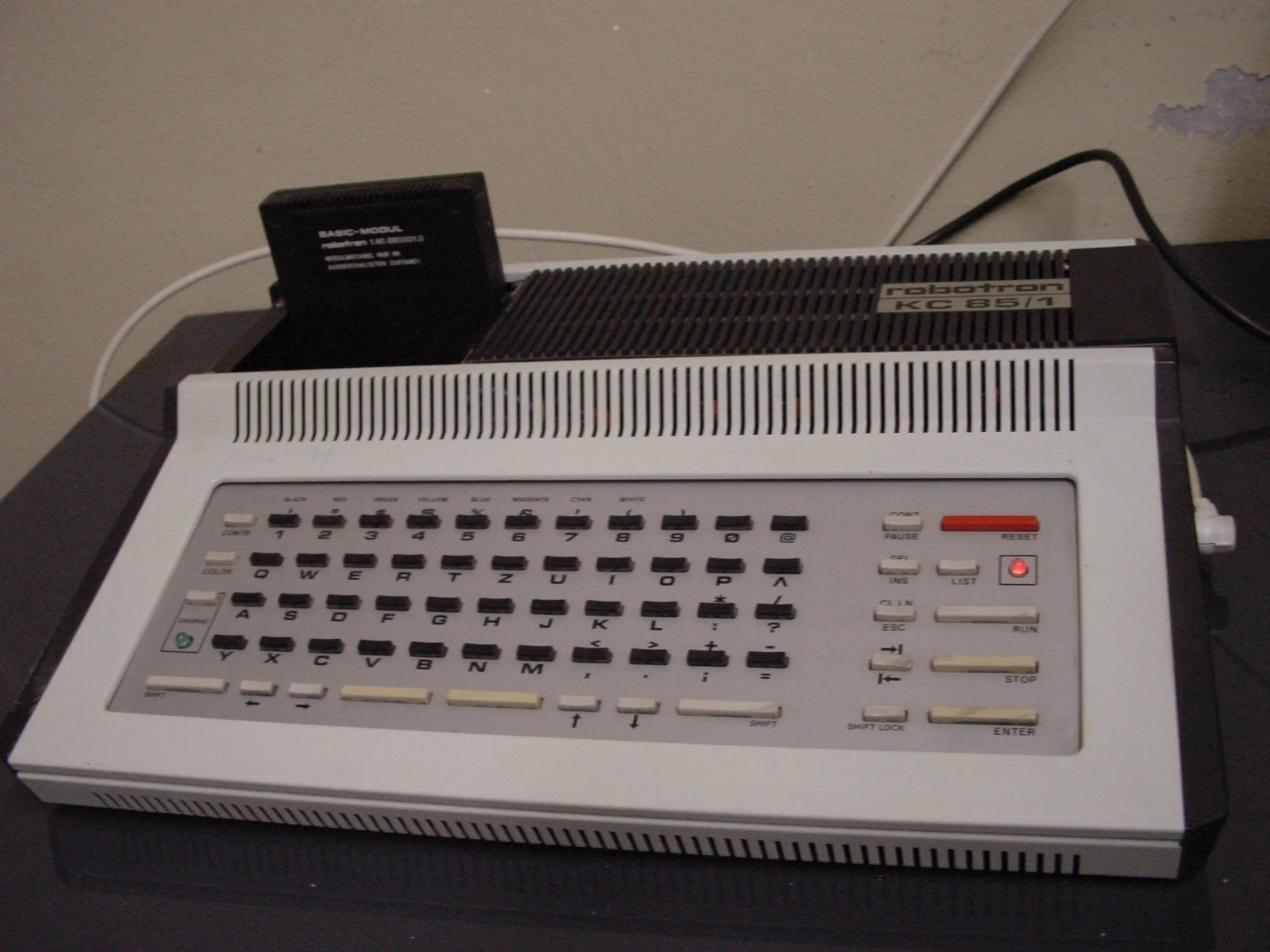
Could a country that was not allowed to buy a Zilog Z80 still put one on a desk in Dresden? Robotron did it anyway. What turned up on my bench is proof, right down to the chip stamped on the board where a Zilog part should sit.
The KC 85/1 in front of me is a heavy, grey-beige slab of a machine, built by someone who plainly had never seen a Sinclair product and would have been suspicious of one anyway. No wasted curves anywhere. Lift the lid and the smell is the same stale-solder-and-warm-Bakelite smell every 1980s computer eventually earns. It never quite leaves you. Inside, stamped on the processor in place of a Zilog logo, sits a chip marked U880. That single detail explains almost everything else about this machine, and everything it was built to answer: a question nobody in Dresden was allowed to ask out loud, which was where you actually bought the parts. Not from Zilog. Not legally, anyway.
Two computers, one confusing name
Get the history straight before anything else. It trips up almost every account you will find online. This machine started life in 1984 as the Robotron Z 9001, built by VEB Robotron-Meßelektronik “Otto Schön” in Dresden. Then came the renames. In 1985 it became the KC 85/1, and in 1987 a revised version with BASIC built into ROM appeared as the KC 87. Production ran until March 1989. Across all three names, Robotron shifted something in the region of 30,000 units. None of that is the confusing part.
The confusing part is the name. At almost the same moment, a completely different state combine, VEB Mikroelektronik “Wilhelm Pieck” in Mühlhausen, launched its own machine, originally called the HC 900. It became the KC 85/2, then the KC 85/3, then the KC 85/4. Two combines. Two unrelated designs. One overlapping model number. The Dresden machine and the Mühlhausen machine share nothing at the hardware level, and they cannot run each other’s software. If you have read that this computer does 320 by 256 graphics in sixteen colours, you are reading about the wrong KC 85. That spec belongs to Mühlhausen. This one does not have it, and pretending otherwise shortchanges the people who actually built it.
The chip nobody was allowed to sell them
Now, the chip. The U880 is not licensed Zilog silicon wearing a German part number for the paperwork. It is a real, unlicensed clone. It came out of VEB Mikroelektronik “Karl Marx” in Erfurt, a plant that started life as VEB Funkwerk Erfurt before its 1983 renaming. Not Mühlhausen. Despite what you might have read elsewhere. It reproduces the Z80 instruction set closely enough to include the undocumented opcodes. That is a real compliment: one engineering team paying tribute to another without ever being allowed to shake hands. Zilog never licensed it. It never saw a penny of it either. COCOM export controls kept commercial-scale Z80 supply out of the Eastern Bloc, so East German engineers built their own from first principles. The result runs at 2.5 MHz. Nothing exotic. Just slower. A licensed Z80A of the same period, in a Sinclair or an Amstrad, could be clocked at 3.5 or 4 MHz without drama. That gap is not a design choice. It is what happens when your silicon comes from a domestic fab still wrestling with yield problems, rather than an established supplier with a decade of process refinement behind it. They hit that ceiling anyway. They still shipped a working, expandable machine. That deserves respect, not a joke about the clock speed.
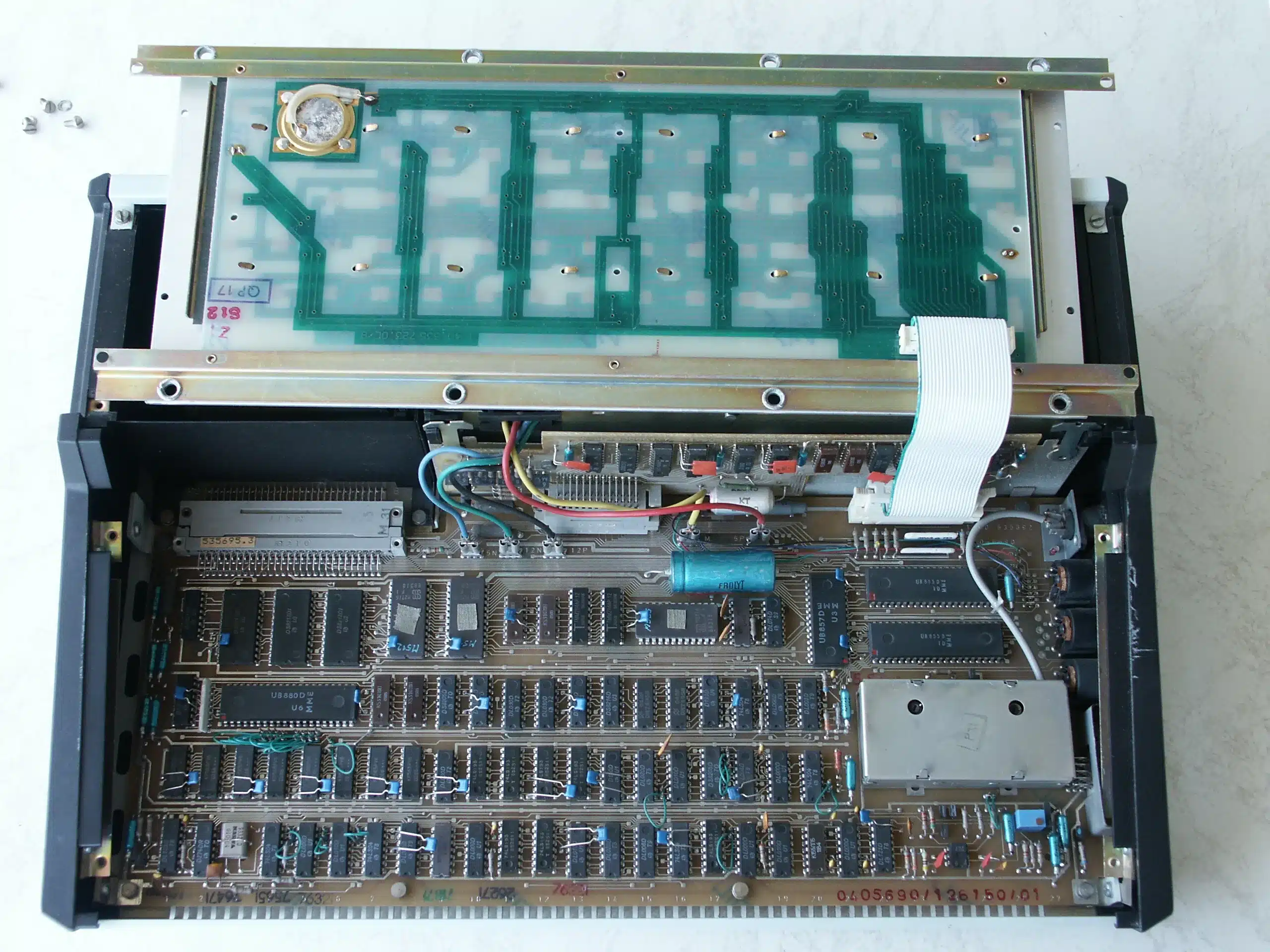
Photo: Enrico Grämer, Wikimedia Commons (Attribution)
Inside the case
Inside the case: 16 KB of RAM, standard. Expandable to 64 KB, through two 16 KB modules on the bus. Nothing more than that. The operating system lives in 4 KB of ROM, backed by a 2 KB character generator. The later KC 87 added BASIC to ROM. Not ideal before that. But workable. Push a fully expanded machine hard enough and it would run SCP, an East German clone of CP/M, opening the door to whatever business software existed for that ecosystem. Not bad, for a clone of a clone. No more loading your programming language from tape before doing anything else, which the earlier machines had demanded of every user. Text and semigraphics run at 40 by 20 or 40 by 24 characters. A hundred and twenty-eight alphanumeric symbols. A hundred and twenty-eight pseudographic ones alongside them. Monochrome on the base .10 models, colour on the .11 variants. Bolt-on graphics were optional, not standard. The module added 256 by 192 pixel monochrome bitmap graphics, once you had ordered it and waited. It was never standard. You had to want it and wait.
Sound, keys and the long wait for storage
Sound is a single piezoelectric buzzer, programmable for pitch. Nothing more. Do not write that off as an Eastern Bloc failing on its own; the Sinclair Spectrum shipped with essentially the same one-channel beeper in 1982. Where the KC 85/1 genuinely falls behind is the Commodore 64‘s SID chip, a proper three-voice synthesiser with filters and envelope control. Nothing in East German industry matched it. That was never a fair fight. It was never going to be.
The keyboard is a 65-key QWERTZ elastomer membrane, built into the case. Two lights only: red for power, green for caps lock. Mushy travel throughout. You feel the press in the pad of your finger, not in any satisfying click. Storage is compact cassette, through a standard audio recorder, at around 1,000 bits per second. Not fast. Sixty minutes of tape, both sides used, got you 300 to 360 KB. A 5.25-inch dual floppy option, holding 800 KB, only arrived in late 1988. Late to the party. Less than a year before the whole line was discontinued. Everything else plugs into the K 1520 bus, a 58-pin standard Robotron specified back in 1980. Four bays only. RAM, the graphics board, printer and plotter interfaces or I/O and ADC cards. Whatever else you wanted had to be sourced, queued for, or built by hand.
How it stacks up against the West
Set it beside its Western contemporaries and the picture sharpens fast. The Sinclair ZX Spectrum went on sale in 1982, for £125 to £175. A real Zilog part. 3.5 MHz, licensed, no clone about it. Colour graphics came as standard too: 256 by 192 pixels in eight colours, no optional module required. The Amstrad CPC 464 undercut it further still, the same year as the Z 9001. £199, monitor bundled in. A genuine 4 MHz Z80. Sixty-four kilobytes of RAM out of the box. A three-voice AY-3-8912 sound chip nothing in the GDR could touch. The Commodore 64 topped the pile on both counts. Sound and colour alike. None of that is a verdict on Dresden or Erfurt. It is a verdict on geography and hard currency instead. Simple as that. One side of a divided continent could walk into a shop and buy a Zilog part. The other side had to reverse-engineer one, fabricate it at home at a fraction of the yield, and still ship a working machine regardless.
The real failure was never the engineering
Here is where the real cynicism belongs, and it has nothing to do with silicon. The KC 85/1 was priced at 1,550 Mark for the monochrome model, 1,940 Mark for colour. Real money. An average wage that year was 1,140 Mark a month. Do the sum yourself. That is more than a month’s pay for the cheapest machine on the list, before a single expansion module. Most units never reached an ordinary household at all. Not close. They went to schools, polytechnics and state institutions running a computer-literacy drive the government wanted to be seen running. Robotron was no scrappy workshop. It employed 68,000 people by 1989, the largest electronics combine in the country. Run the way a planned economy runs anything it rates as strategic. The engineers did not fail here. The planning did. A state that wanted its citizens computer-literate never built the factory lines, the shops or the pricing to put one in most of those citizens’ actual homes. Not remotely. Two factories a few hundred kilometres apart landed on the same model number for two unrelated products. Nobody with the authority to stop that mess seems to have noticed or cared.
The verdict
I will not pretend the KC 85/1 competes with a Spectrum or a CPC 464 on raw capability, because it does not. Saying otherwise would be false balance. This machine does not need it. What it deserves instead is respect for what it actually is. A working, expandable, genuinely usable Z80-class computer. Built by people who could not legally buy the chip at its centre, and built one anyway. That is a harder engineering problem than anything Sinclair or Amstrad ever had to solve. Dresden and Erfurt solved it. The tragedy on my bench is not the 2.5 MHz clock or the buzzer standing in for a sound chip. Not really. It is that a machine built to prove East German engineering could match the West mostly ended up in classrooms. Rationed by a system that could plan a Kombinat down to the last employee, and still never work out how to get a home computer into an actual home.