MACHINE REFERENCE

Atari 5200

The Atari 5200 shipped in October 1982 with a numeric keypad built into every controller and a joystick that didn’t self-centre, a control scheme nobody else on the market was using, for better and for worse. Under the hood it ran the same ANTIC, GTIA and POKEY silicon as Atari’s own 8-bit home computers, on a 6502C clocked at 1.79 MHz with 16 KB of RAM.

Why it matters

The 5200 was Atari’s answer to Mattel’s Intellivision, built to sit above the ageing 2600 in the line-up, and it sold over a million units in under two years before the company pulled it from shelves on 21 May 1984. The same ANTIC, GTIA and POKEY chipset carried straight through to Atari’s own 8-bit computers, which is why a 5200 board looks so familiar to anyone who has opened an Atari 800. The non-centering analogue stick suited the driving and flight games it was designed for, but the rubber and plastic of 1982 couldn’t survive years of hard use.

What to check before you buy

  • Test every button and the keypad before paying for a "working" unit. Flex-circuit failure under the fire buttons is close to universal on surviving controllers, working or not.
  • Ask whether it's the original four-port model or the 1983 two-port revision; the two use different power arrangements and the switchbox on the four-port version is the more failure-prone of the two.
  • Check the picture for rolling colour bands or dropout, which usually points to the GTIA chip or a tired electrolytic capacitor rather than anything cosmetic.
  • If the seller mentions audio crackle or distortion, ask if the styrene coupling capacitors have been replaced. Original ones are now over forty years old and known to fail.
  • Confirm which RF channel and adapter is included, since the original combined power/RF switchbox is specific to the four-port console and not interchangeable with the revised model's separate supply.
  • A trak-ball controller, if included, adds real value for the handful of games designed around it, but check its rollers and buttons separately from the standard controllers.
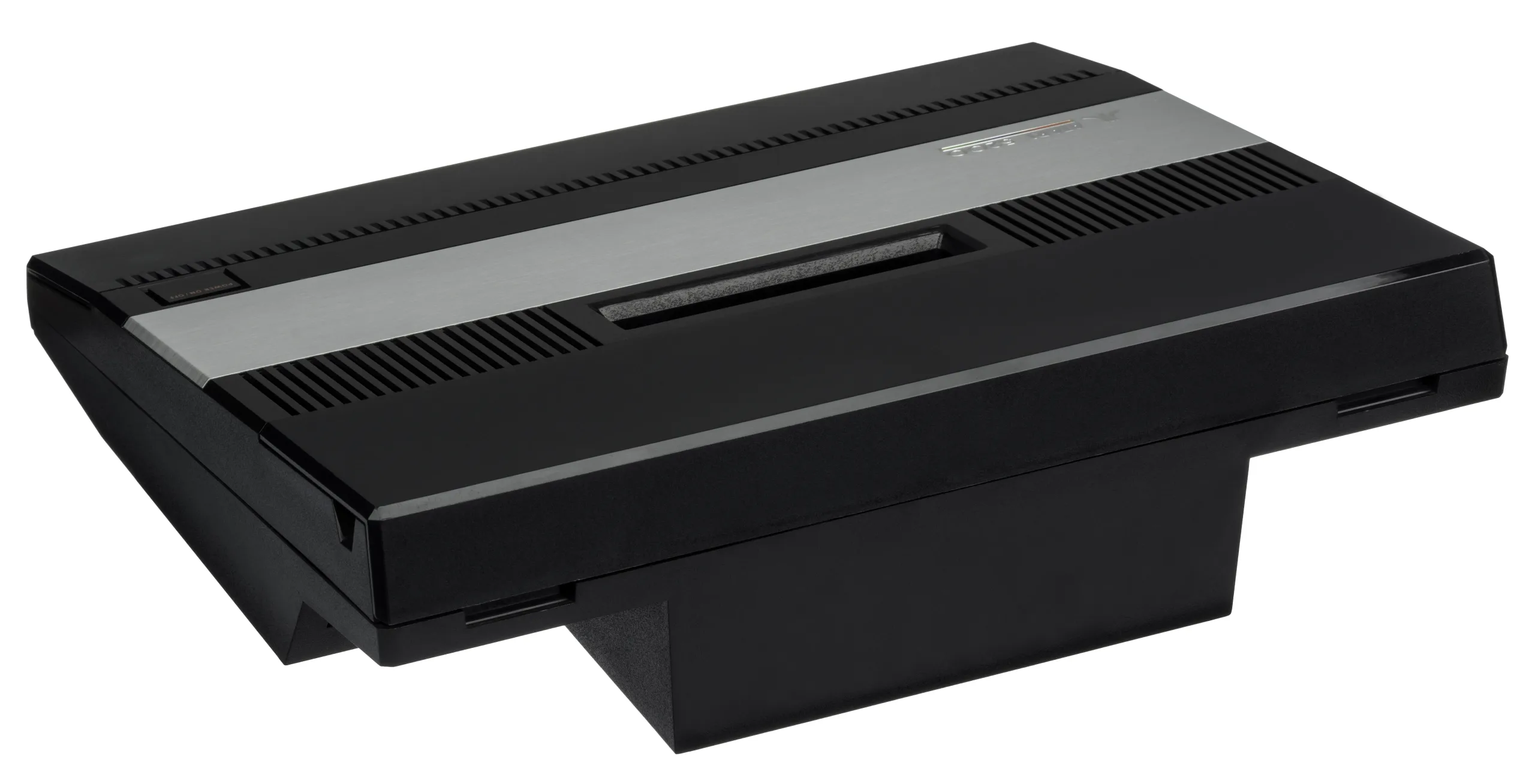
Atari 5200

Photo: Evan-Amos, Wikimedia Commons (Public domain)

Released

1982

RAM

16 KB

CPU

MOS 6502C (‘SALLY’) at 1.79 MHz

Launch price

US$299.95

Manufacturer

Atari, Inc.

Form factor

Home video game console, cartridge-based

CPU

MOS 6502C (‘SALLY’) at 1.79 MHz

Chipset

ANTIC (display list processor) and GTIA (graphics/colour), the same family used in the Atari 8-bit computers; POKEY for sound and I/O

RAM

16 KB

ROM

2 KB on-board BIOS (boot and interrupt handling); cartridges addressed through a 32 KB ROM window, expandable via bank switching

Graphics

14 display modes (text and graphics), resolution up to 384×240 with overscan; palette of 128-256 shades across 16 hues, with 2-23 colours available on screen depending on mode

Audio

4-channel POKEY sound chip

Storage

ROM cartridge only

Ports

Original four-port console had four controller ports; the 1983 revised model cut this to two. Video/audio out was RF only on both

OS

None as such. A fixed on-board BIOS boots straight into the cartridge; there is no user-facing OS or file system

PSU

Original model used a combined power/RF switchbox with automatic TV switching; the 1983 two-port revision replaced this with a conventional external power supply and a separate standard RF adapter

Units sold

Sources consistently give just over 1 million units; no single authoritative precise figure found beyond “over a million”

Successors

Atari 7800 (1986)

  • Controller flex-circuit and button failure
    The conductive-rubber flex circuit under the fire buttons and keypad degrades with age, so buttons stop registering; the non-centering analogue stick also suffers from worn potentiometers, causing drift. Almost every original controller shows some version of this fault.
  • Switchbox and power failures on the four-port model
    The combined power/RF switchbox on the original four-port console is prone to cold solder joints, causing intermittent or total power loss; reseating the coax and checking the switchbox's internal joints is the usual first fix.
  • GTIA and capacitor-related video/audio faults
    Video corruption or loss often traces to a failed GTIA graphics chip or ageing electrolytic capacitors, and the original styrene capacitors used for audio coupling are known to fail and are commonly replaced with polystyrene or ceramic equivalents.
  • 1982 Atari 5200 launches in the US in October at $299.95, initially in a handful of department stores
  • 1983 Nationwide US distribution begins in January; a revised two-port model replaces the original four-port design later in the year
  • 1983 A planned European launch is cancelled in July
  • 1984 Atari discontinues the 5200 on 21 May, after under two years on the market
  • 1986 Atari's 7800 launches as the console's successor