
Get a ZX Spectrum working in 1982 and the first fight isn’t with BASIC, it’s with the television. You plug the RF lead into the aerial socket round the back, flick the set to channel 36 and nudge the fine-tuning dial back and forth until the fuzz resolves into something resembling a picture. Load a game and the picture gets worse before it gets better: bright blocks of colour bleed sideways across sprite edges, a red spaceship trailing a smear of yellow it was never drawn in. Nobody called it a bug for long. Sinclair’s engineers had squeezed the Spectrum’s colour information down to one byte per 8×8 block of pixels, two colours and no more, and the moment an artist tried to put a third colour anywhere in that block, one of the other two simply vanished. Players named the result “colour clash” and mostly stopped noticing it, the way you stop noticing an accent. It became so much a part of the Spectrum’s look that some developers started designing sprites specifically to hide the seams rather than fight them.
That’s the story of the home computer screen between 1980 and 2000, in miniature. Nobody handed the games industry a display built for games. It borrowed the family television, then a business monitor standard nobody had designed with a joystick in mind, and out of both constraints came a decade of genuinely clever workarounds before the display finally caught up with what gaming actually needed from it.
The family television moonlights as a games console
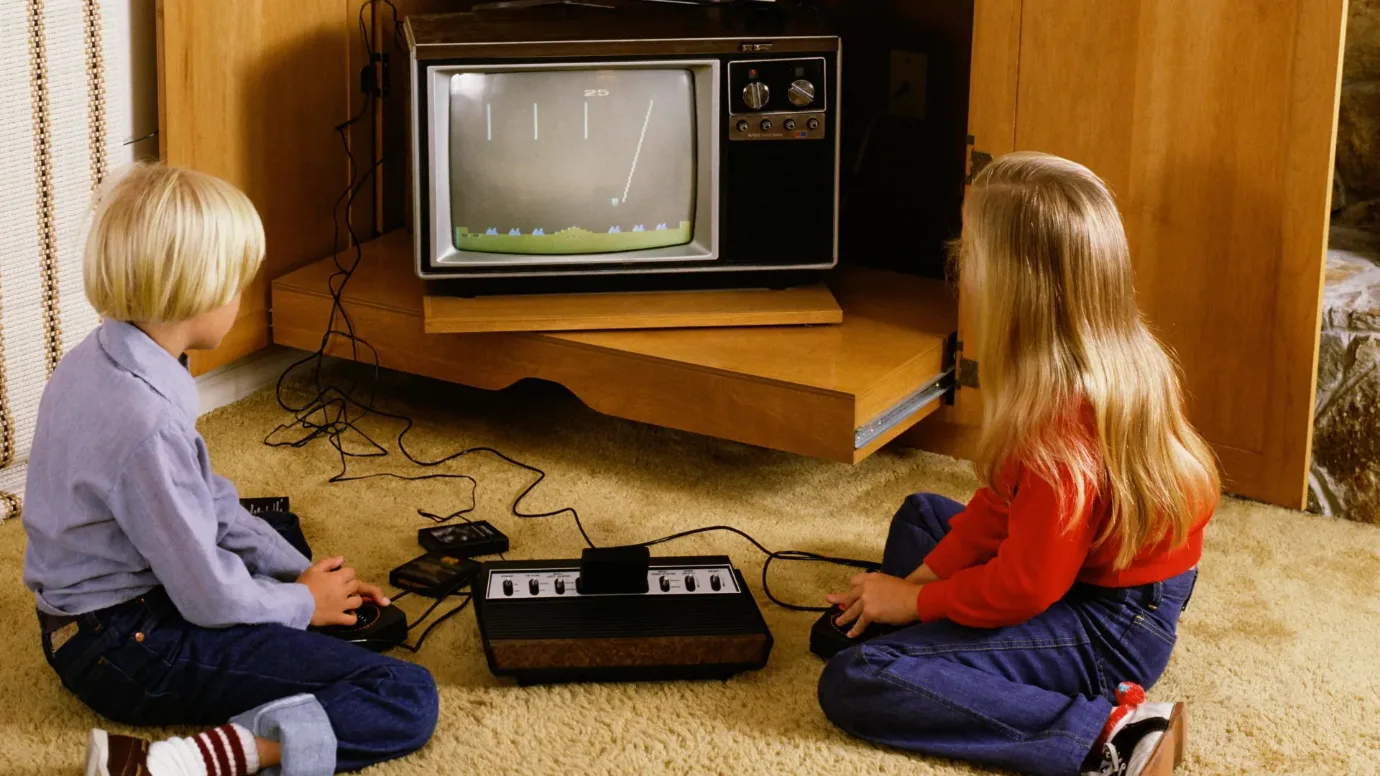
Through the early-to-mid 1980s, a home computer’s picture was only ever as good as whatever television happened to be in the room. The Apple II, the Commodore 64, the ZX Spectrum, all of them pushed their signal out through an RF modulator or, if you were lucky enough to own the right cable, a slightly cleaner composite lead, and all of them inherited the domestic television’s PAL or NTSC broadcast standard along with its blur. Resolutions sat in roughly the same cramped territory: the Spectrum’s 256×192, the C64’s 320×200, the Apple II’s 280×192 in its high-resolution mode. None of it was a design choice so much as an admission. A dedicated monitor cost more than the whole computer, and the target buyer already owned a telly. The Atari VCS, selling by the million once Atari licensed a home version of Space Invaders in 1980, went out through exactly the same aerial socket for exactly the same reason: a console was a Christmas present, not a line item with a monitor budget attached.
The compromises varied by machine but rhymed with each other. The Spectrum had colour clash. The Commodore 64 had a video chip, the VIC-II, generous enough with sprites and palette that Commodore’s marketing leaned on it for years, but a composite signal soft enough that a lot of its finer detail simply dissolved into colour bleed on an actual telly rather than a dedicated monitor. None of this stopped a generation of ten-year-olds from finishing entire games squinting at a fuzzy 14-inch portable balanced on a bedroom chest of drawers. The picture was never the point. The game running underneath it was.
Business graphics crash the gaming party
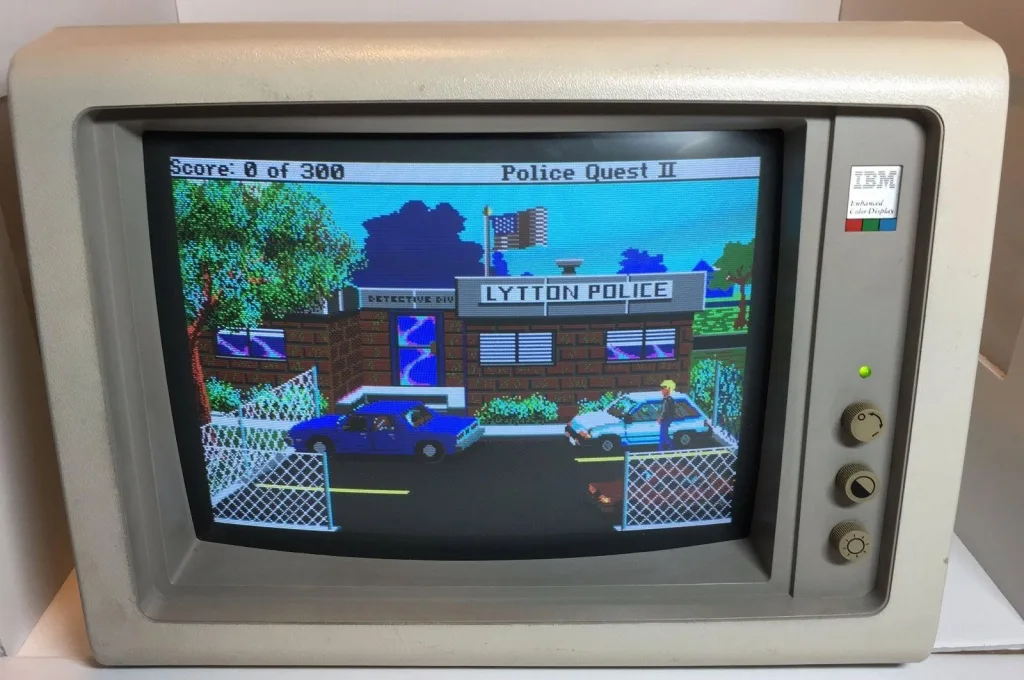
The IBM PC arrived in 1981 with a split personality it never quite resolved. Businesses wanted the Monochrome Display Adapter, all crisp green text and no colour whatsoever, because nobody doing a spreadsheet needed colour and IBM had spent the saved bandwidth on sharpness instead. Anyone who wanted to play a game bought the other card, the Colour Graphics Adapter, a digital RGBI signal offering sixteen fixed colours that IBM had actually built for business charts and Lotus 1-2-3 pie graphs, not Sierra adventure games. CGA became the accidental engine of early PC gaming anyway, because it was the only colour option on the platform, and 1984’s Enhanced Graphics Adapter widened the available palette to 64 colours, sixteen of them on screen at once at 640×350, before anyone in gaming had asked for it either.
CGA hid one deliberate piece of cleverness inside its ostensibly dull colour scheme. Feed the standard’s four-bit code for dark yellow to IBM’s companion 5153 monitor and dark yellow isn’t what comes out: the monitor’s circuitry catches that exact signal and halves the green voltage, forcing it to brown instead, because a desaturated dark yellow reads to the eye as faintly unwell in a way brown doesn’t. It’s a strange, deliberate hack buried in a business peripheral, and it’s exactly the kind of decision a team paying real attention to what a screen looks like ends up making.
The same card also produced a much less deliberate quirk that gaming would eventually turn to its advantage. CGA’s video memory was single-ported, so the CPU and the display controller had to take turns reading it, and on a 4.77 MHz 8088 running 80-column text the two fell out of step often enough to scatter corrupted characters across the screen, a glitch players nicknamed “snow”. IBM spent a decade treating it as an embarrassment. In 2015, the programmers behind the demoscene production 8088 MPH worked out the underlying bus contention down to the sub-instruction wait state and started triggering it on purpose, using the exact defect IBM wanted hidden to draw graphics CGA was never supposed to be capable of. Three decades on, somebody finally read the small print on what a “faulty” graphics card could actually do.
Mode 13h becomes the shape of a decade of PC games
VGA changed the terms of the argument completely. IBM launched it with the PS/2 line in 1987, replacing CGA and EGA’s fixed digital signal with analogue RGB carried over a 15-pin connector, and analogue meant continuous voltage rather than a handful of preset states. The mode that mattered to games arrived almost as an afterthought inside the spec: Mode 13h, 320×200 pixels with a full 256 colours drawn from a palette of 262,144. It was never the VGA standard’s headline feature, and it became the single most important resolution in PC gaming history regardless, the mode behind Wing Commander, King’s Quest V and, eventually, DOOM.
Mode 13h had one flaw serious enough that programmers went looking for a fix: its pixels weren’t square, stretched slightly by a screen geometry built for 200 lines rather than a true 4:3 picture. In 1991, Michael Abrash publicised a workaround in Dr Dobb’s Journal that the games industry immediately adopted wholesale. By switching VGA’s memory into “unchained” planar mode, a programmer could coax the hardware into 320×240 with actually square pixels and access to far more video memory than the documented mode allowed, at the cost of a considerably harder programming job. Abrash called it Mode X, and it powered a sizeable share of the decade’s best-remembered PC games without IBM ever admitting the trick existed, entirely dependent on hardware doing something its own manual never mentioned.
Chasing the flicker out of the tube
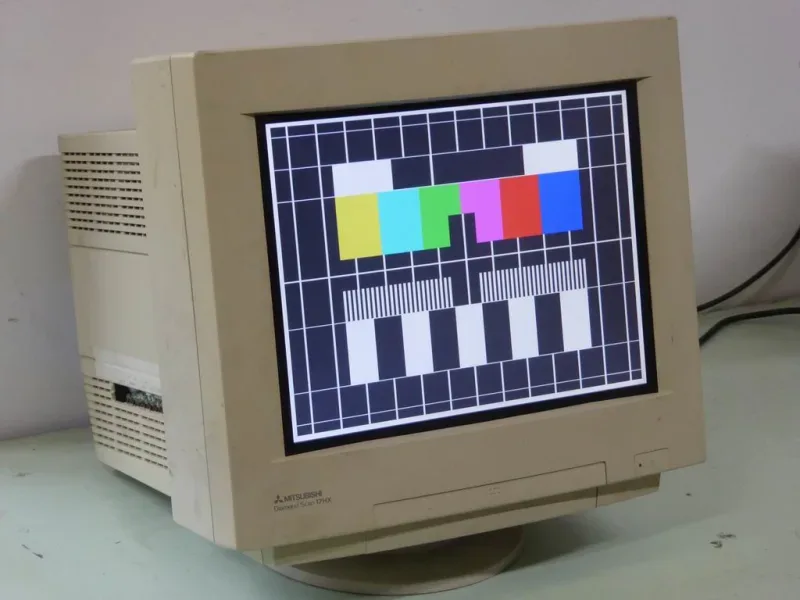
The rest of the 1990s was less a revolution than a decade of the CRT quietly getting better at its one job. Fixed-frequency monitors gave way to multisync chassis that could lock onto whatever signal a graphics card sent them, and refresh rates climbed from a headache-inducing 60 Hz toward a properly comfortable 75 to 85 Hz as resolutions worked their way up through SVGA’s 800×600 and XGA’s 1024×768. Tube construction improved alongside the electronics: Sony’s Trinitron and Mitsubishi’s Diamondtron replaced the perforated shadow mask with vertically tensioned aperture-grille wires, delivering a noticeably brighter, flatter picture that made them the default recommendation for anyone buying a monitor specifically to game on, at the cost of one or two faint horizontal damping wires visible across the glass that plenty of buyers assumed, wrongly, was a manufacturing fault.
None of this was aimed at gaming specifically. Multisync chassis existed because businesses wanted one monitor that worked with whatever graphics card came next, and Trinitron tubes sold to television buyers as readily as to PC owners. Gaming simply benefited from a display technology getting better for reasons that had nothing to do with it, the same way it had benefited from a business colour standard a decade earlier.
The tube that refused to hand over the desk
By the late 1990s, flat panels were finally good enough to matter. Active-matrix TFT screens, mature by the mid-1990s after years of ghosting and narrow viewing angles on earlier passive-matrix laptop displays, gave every subpixel its own transistor and near-instant, independent control. The Apple Studio Display’s 15-inch LCD arrived on desks in 1998, and by 2000 flat panels were a real, if still expensive, alternative to the CRT sitting next to it.
Gaming was the last place in the building to switch. Early LCD panels answered to a response time measured in tens of milliseconds rather than the CRT’s near-instant phosphor decay, more than enough for a fast-moving sprite or a first-person shooter’s rapid pan to leave a visible trail smeared behind it. An office spreadsheet never moves fast enough to notice. A game does, constantly, and a generation of PC gamers who had just spent a decade fighting colour clash and coaxing square pixels out of an undocumented VGA mode were not about to trade a crisp, instant CRT picture for one that blurred every time something on screen actually moved. The CRT would keep its grip on serious gaming desks for years after the rest of the office had already gone flat, for the entirely practical reason that it was still, at the turn of the millennium, better at the one thing gaming actually needed a screen to do.
